Whenever we think of B. R. Ambedkar, images of the Indian Constitution, his iconic blue suit, and his ocean-like knowledge immediately come to mind. But beyond these widely known aspects lies a lesser-known yet fascinating chapter of history—his first-ever biography, published during his lifetime.
What makes this story even more remarkable is that this historic work was not written in English or Hindi, but in Gujarati. On August 28, 1940, a unique and powerful narrative about Ambedkar’s life was presented to the world—capturing his struggle, and revolutionary journey in real time.
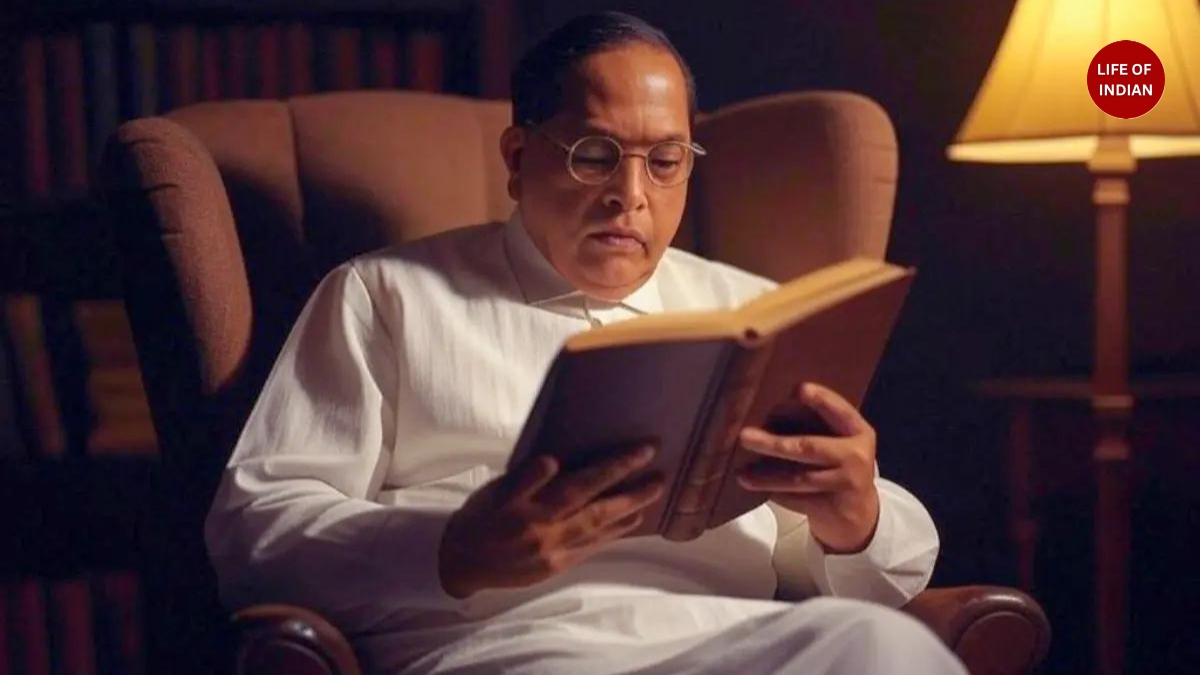
A Man Deeply in Love with Books
Dr. Ambedkar’s relationship with books was not just intellectual—it was deeply emotional. It is often said that he had only two passions: buying books and reading them. Over time, this passion evolved into a lifelong devotion.
By 1940, he had already collected nearly 7,000 to 8,000 books, an extraordinary number for that era. The estimated value of this collection ranged between ₹30,000 to ₹40,000 at that time—equivalent to crores today.
For Ambedkar, books were not mere objects; they were tools of empowerment, weapons against inequality, and the foundation of social transformation.
August 28, 1940: When History Was First Documented
For followers of Ambedkar’s ideology, August 28 holds immense significance. It was on this day that his first biography, titled “Dr. B.R. Ambedkar, Esquire”, was published in Gujarati.
This was not just a biography—it was a living document. Unlike most biographies written after a person’s death, this one captured Ambedkar’s struggles, movements, and ideas while he was still actively shaping history.
In Gujarat, this book became a revolutionary medium to spread his thoughts among the masses, especially within marginalized communities.
The Vision Behind the Biography
The driving force behind this historic work was Karshandas Leuva, a prominent leader of the Scheduled Castes Federation in Gujarat. He believed that Ambedkar’s life story needed to reach the people, particularly those who were fighting similar social battles.
However, there was a major challenge—low literacy rates among Dalits at the time. The question was: even if the book was written, who would read it?
Despite these concerns, Leuva’s determination remained unshaken. He set out to find someone who not only admired Ambedkar but also understood the depth of his विचारधारा.
U.M. Solanki: The Man Who Penned History
The search ended with U.M. Solanki, a dedicated follower of Ambedkar’s ideology. Though not a professional writer, Solanki possessed a strong command of both English and Gujarati.
He meticulously studied Ambedkar’s speeches, writings, and thoughts, and handwrote the entire biography. His language was simple yet impactful—gentle in tone but sharp in its critique of social evils like untouchability.
Solanki managed to present a powerful narrative without bitterness, making the book both accessible and revolutionary.
Dr BR Ambedkar: The Man Who Shaped the Indian Constitution
Why Was the Book Called ‘Priceless’?
Publishing a book in the 1940s was no easy task, especially with limited financial resources. While some support came from donors like Kanjibhai Bechardas Dave, it was not enough.
Karshandas Leuva took full responsibility to ensure the book was published. When it was finally printed, something unusual caught everyone’s attention—there was no price mentioned on the cover. Instead, it simply read: “Priceless.”
This was not a marketing strategy but a statement. The publishers believed that Ambedkar’s life, struggles, and ideas could not be measured in monetary terms.
Where Was This Historic Book Printed?
The book was published by the Mahagujarat Dalit Navayuvak Mandal in Dariyapur, Ahmedabad, and printed at the Mansur Printing Press in Dhalgarwad.
As a mark of respect, the book included photographs of U.M. Solanki, Karshandas Leuva, and Kanjibhai Dave. At the time, it became a powerful tool of awareness among Dalits, spreading consciousness and inspiring social change.
Rediscovery and Reprint in Modern Times
Over time, this invaluable book risked being lost forever. However, editor Amit Priyadarshi Jyotikar took the initiative to revive it.
In 2023, the biography was republished with both the original Gujarati text and an English translation, making it accessible to a global audience. Interestingly, the original grammatical and linguistic style was preserved to maintain its historical authenticity.
Today, the book stands not just as literature but as a historical artifact.
Vijay Surwade: The Man Who Preserved History
The survival of this biography owes much to Vijay Surwade, a noted Ambedkarite scholar and collector of rare documents.
In 1993, he obtained a copy of the book and wisely made a photocopy. By 2020, the original had deteriorated beyond readability, but Surwade’s preserved copy became the foundation for its reprint.
Without this effort, an important piece of history might have been lost forever.
A Bold Declaration Captured in Time
One of the most striking aspects of the biography is its mention of Ambedkar’s famous declaration at the Yeola Conference—that although he was born a Hindu, he would not die as one.
This statement, later fulfilled in 1956 when he embraced Buddhism, shows that his ideological transformation had begun much earlier. The 1940 biography captures this turning point with remarkable clarity.
Clash of Ideas and Global Vision
The book does not merely praise Ambedkar—it also discusses his ideological differences with leaders like Mahatma Gandhi. It presents his views on caste, religion, and social justice with honesty and depth.
It also highlights his global exposure, intellectual brilliance, and interactions with international thinkers, proving that by 1940, Ambedkar had already emerged as a global figure.
Mahaparinirvan Diwas 2025: Life, Legacy & Death of Dr. B.R. Ambedkar
Historical Importance: A Foundation Stone
While later biographies by renowned writers gained popularity, this first biography by U.M. Solanki remains unique. It was written during Ambedkar’s lifetime, making it a real-time account of his journey.
Its simplicity, the struggle behind its publication, and the efforts to preserve it make it more than just a book—it is a legacy.
For followers of Ambedkar, it is not just history, but a sacred document that reflects the early efforts to document a revolutionary life.
Disclaimer
This article is based on historical references, archival materials, and information available through various sources and publications. LifeofIndian.in does not independently verify the absolute accuracy of all details mentioned.
FAQ
1. When was Dr. B.R. Ambedkar’s first biography published?
The first biography of B. R. Ambedkar was published on August 28, 1940.
2. In which language was Ambedkar’s first biography written?
It was written in Gujarati, making it unique as most early works on Ambedkar were not in regional languages.
3. Who wrote the first biography of Dr. Ambedkar?
The biography was written by U.M. Solanki, a follower of Ambedkar’s ideology who studied his speeches and writings in detail.
4. Why was the book called “Priceless”?
The book had no fixed price because the publishers believed that Dr. Ambedkar’s life and struggles were beyond monetary value.
5. What is the significance of this biography?
It is considered historically important because it was written during Ambedkar’s lifetime, offering a real-time account of his struggles and contributions.
6. Has the book been republished?
Yes, the book was republished in 2023 with both Gujarati text and English translation to preserve its legacy and make it accessible globally.