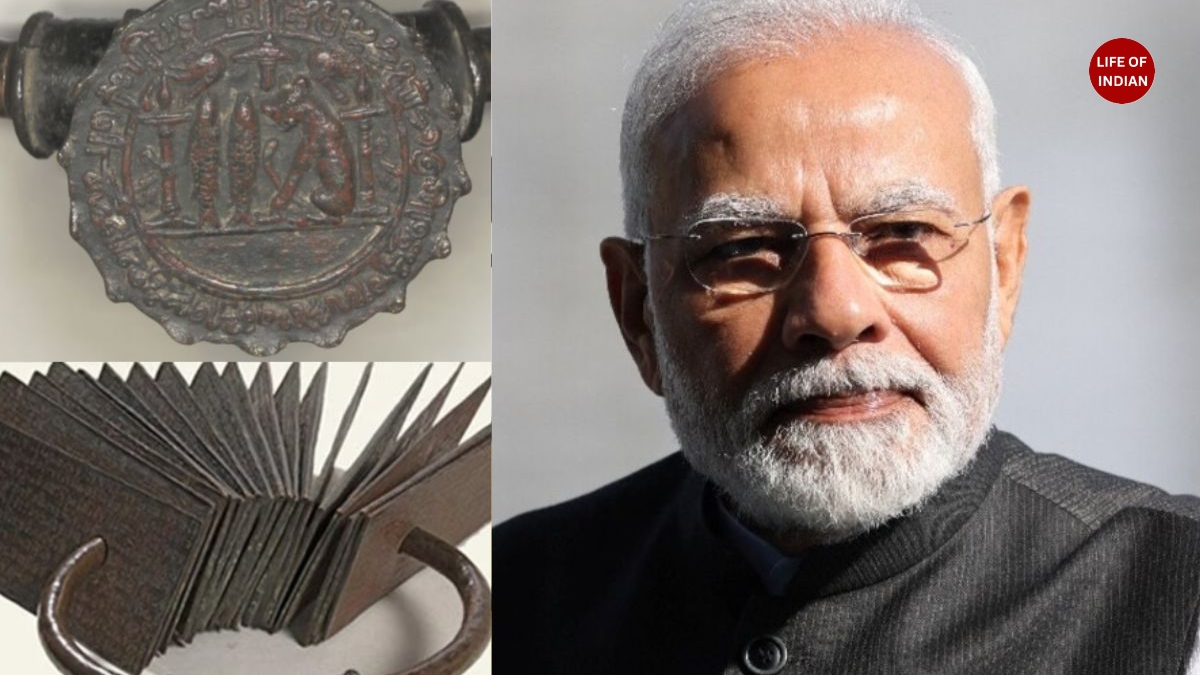
For centuries, India was not merely invaded for its gold, spices, or diamonds. It was also systematically stripped of its memory. Temples were destroyed, manuscripts disappeared, idols were smuggled out, and priceless historical records slowly found their way into foreign museums and private collections. Over time, many Indians grew up seeing fragments of their own civilization displayed behind glass walls in Europe — admired globally, but disconnected from the soil where they truly belonged. Now, after years of diplomatic efforts, one such priceless treasure has finally returned home.
Recently, the Netherlands officially returned the 1,000-year-old Anaimangalam copper plates — globally known as the Leiden Plates— back to India. Weighing around 30 kilograms and consisting of 21 large and 3 smaller copper plates linked together by a massive bronze ring, these are not ordinary pieces of metal. They are among the most important surviving records of India’s ancient administrative brilliance, linguistic sophistication, international cultural influence, and highly organized governance during the powerful Chola Empire.
Prime Minister Narendra Modi called their return a matter of pride for every Indian — and for good reason. Because these copper plates are not just historical artifacts.
They are living proof that nearly a thousand years ago, India possessed advanced systems of governance, land administration, legal documentation, multilingual statecraft, and global cultural connections that many civilizations had not yet fully developed. And perhaps most importantly, they remind modern India of a deeper truth: when a civilization loses its historical memory, future generations begin doubting their own roots.
What Exactly Are the Anaimangalam Copper Plates?
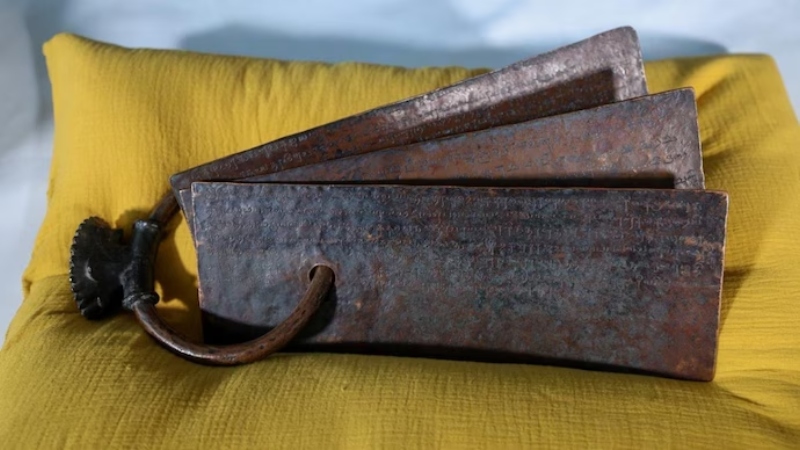
The Anaimangalam copper plates, popularly known worldwide as the Leiden Plates, are an extraordinary set of royal inscriptions from the Chola period. These plates were originally issued during the reign of Rajaraja Chola I and later continued under Rajendra Chola I around the 11th century CE. The plates officially record a royal land grant made to a Buddhist monastery called the Chudamani Vihara located in Nagapattinam, present-day Tamil Nadu.
In simple words, these copper plates served as a legally recognized government document granting an entire village to a Buddhist institution. That alone is astonishing. Because it proves that around 1,000 years ago:
- Land grants were officially documented
- Administrative orders were systematically preserved
- Legal records were written with precision
- Governments maintained organized bureaucratic systems
And most remarkably, these inscriptions remain readable even today.
Why Are These Copper Plates So Important?
Many people wonder why India fought for years to bring these copper plates back. The answer lies in what these plates represent. These are not just ancient writings — they are evidence of an extraordinarily advanced civilization.
1. Proof of India’s Advanced Administration
The Leiden Plates demonstrate that the Chola Empire had a highly sophisticated administrative structure. The inscriptions contain:
- Royal orders
- Details of land grants
- Village boundaries
- Tax information
- Witness records
- Religious endowments
This shows that medieval India was not chaotic or primitive, as colonial narratives often suggested. Instead, it had:
- Organized governance
- Legal systems
- Revenue administration
- Documentation methods
- Institutional authority
Long before many modern states evolved structured governance, Indian kingdoms were already maintaining official records in durable archival form.
2. A Powerful Symbol of India’s Civilizational Confidence
One of the most remarkable aspects of these copper plates is their bilingual nature. The inscriptions were written in:
- Sanskrit
- Tamil
This was not accidental. Sanskrit at that time functioned as a pan-Indian intellectual and cultural language connecting different regions of the subcontinent, while Tamil was used for local governance and administration.
This reveals something deeply important about ancient India:
The Cholas balanced regional identity and pan-Indian civilization simultaneously. They did not see local culture and broader civilizational identity as opposites. Instead, both coexisted together.
3. Evidence of India’s Global Influence
The Chudamani Vihara mentioned in the plates was not an ordinary monastery. Historians believe it was linked to the maritime Buddhist networks connecting South India with Southeast Asia, especially the Srivijaya Empire. This demonstrates the massive international influence of the Chola Empire. During that period, India was not isolated.
It was:
- A maritime power
- A center of trade
- A hub of religious exchange
- A cultural superpower
Indian influence spread across:
- Indonesia
- Malaysia
- Thailand
- Cambodia
- Sri Lanka
through trade, religion, architecture, and language. The Leiden Plates are direct evidence of these global connections.
The Massive Bronze Ring and Royal Seal
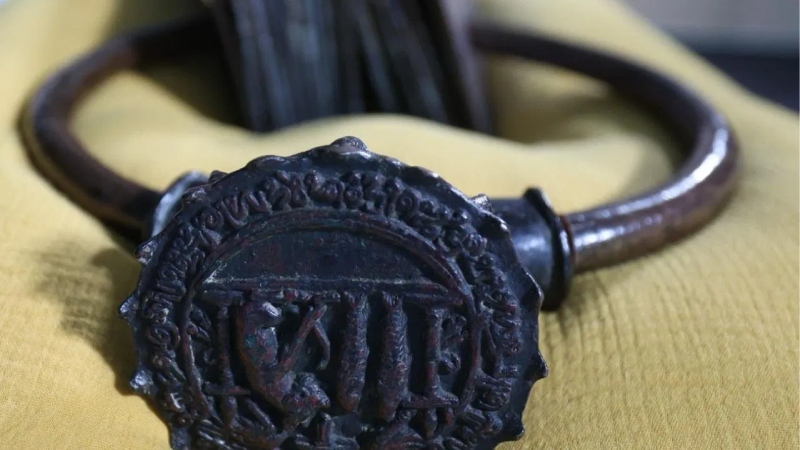
Perhaps the most visually stunning feature of the copper plates is the giant bronze ring that binds all the plates together. Attached to this ring is the royal seal of the Chola Empire, clearly engraved even after centuries. The seal symbolizes:
- State authority
- Legal authenticity
- Royal legitimacy
This was essentially the medieval equivalent of an official government stamp or constitutional seal. The craftsmanship itself reflects extraordinary metallurgical and artistic expertise.
How Did These Plates Leave India?
This is where the story becomes painful. During the colonial era, countless Indian artifacts were removed from the country under various circumstances — through trade, missionary activity, colonial collection, excavation, and direct looting. The Anaimangalam copper plates were taken out of India during the 18th century when Nagapattinam came under Dutch control.
Historical accounts suggest that a Dutch missionary associated with colonial administration, Florentius Camper, transported the plates to the Netherlands. Eventually, they became part of collections in the city of Leiden, which is why the world came to know them as the “Leiden Plates.” For centuries, these priceless records of Indian civilization remained locked away in European institutions, physically separated from the culture that created them.
India’s Long Battle to Bring Them Home
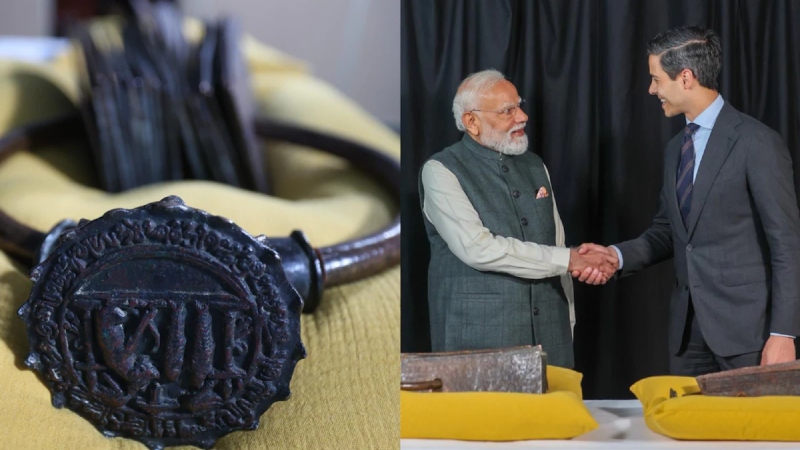
India has been attempting to recover these copper plates since around 2012. The process involved:
- Diplomatic negotiations
- Cultural discussions
- Heritage claims
- International cooperation
Finally, after years of efforts, the Netherlands agreed to return the plates to India. Their return is part of a broader global conversation about restoring cultural artifacts to their countries of origin. Across the world, former colonies are increasingly demanding the return of:
- Sculptures
- Manuscripts
- Temple idols
- Historical documents
- Sacred artifacts
that were taken during colonial rule.
Why the Return Matters Emotionally
The return of the Leiden Plates is not just an archaeological event. It is emotional. Because civilizations survive not only through land and people, but through memory. When historical evidence is removed from a nation:
- Cultural continuity weakens
- Historical confidence declines
- Future generations lose connection with their roots
This is why recovering such artifacts matters deeply. These copper plates remind Indians that:
- Their civilization was highly organized
- Their ancestors mastered governance and law
- Their culture was intellectually advanced
- Their influence reached far beyond India’s borders
The Chola Empire: One of India’s Greatest Civilizations
The story of these plates also shines light on the greatness of the Chola Empire itself. The Cholas were among India’s most powerful dynasties. They were famous for:
- Naval strength
- Temple architecture
- Maritime trade
- Administrative systems
- Art and literature
- International diplomacy
The magnificent Brihadisvara Temple stands even today as a symbol of their engineering brilliance. The Leiden Plates further strengthen our understanding of how advanced Chola governance truly was.
More Than 30 Kilograms of Copper
At first glance, the Leiden Plates may appear to be merely heavy sheets of copper. But in reality, they carry something far more valuable than metal. They carry memory. They preserve the voice of a civilization speaking across a thousand years. They prove that India’s past was not built only on mythology or oral traditions, but also on documented law, administration, multilingual scholarship, and global cultural networks.
And perhaps that is why their return matters so much. Because these copper plates are not simply artifacts returning home. They are pieces of India’s civilizational identity reclaiming their place in history once again.
FAQ
1. What are the Leiden Plates?
The Leiden Plates are 1,000-year-old copper plate inscriptions from the Chola Empire. They record royal land grants made to the Chudamani Vihara Buddhist monastery in Tamil Nadu.
2. Why are the Leiden Plates important?
The plates provide strong evidence of ancient India’s advanced administration, legal systems, multilingual governance, and international cultural connections during the Chola period.
3. Why are they called Leiden Plates?
They are called Leiden Plates because they were kept for centuries in Leiden, a city in the Netherlands, after being taken out of India during colonial rule.
4. How old are the Leiden Plates?
The copper plates are around 1,000 years old and date back to the reigns of Rajaraja Chola I and Rajendra Chola I in the 11th century CE.
5. Which languages are used in the copper plates?
The inscriptions use both Sanskrit and Tamil. Sanskrit served as a pan-Indian scholarly language, while Tamil was used for regional administration and local communication.
6. How did the copper plates leave India?
The plates were taken to the Netherlands during the 18th century when Nagapattinam was under Dutch control. Historical records suggest a Dutch missionary carried them abroad.
7. Why did India try to bring them back?
India considered the plates an important part of its civilizational and cultural heritage. Their return symbolizes the recovery of historical memory and national identity.
8. What do the Leiden Plates reveal about the Chola Empire?
The plates show that the Chola Empire had highly organized governance, legal documentation systems, international cultural connections, and sophisticated administrative practices.