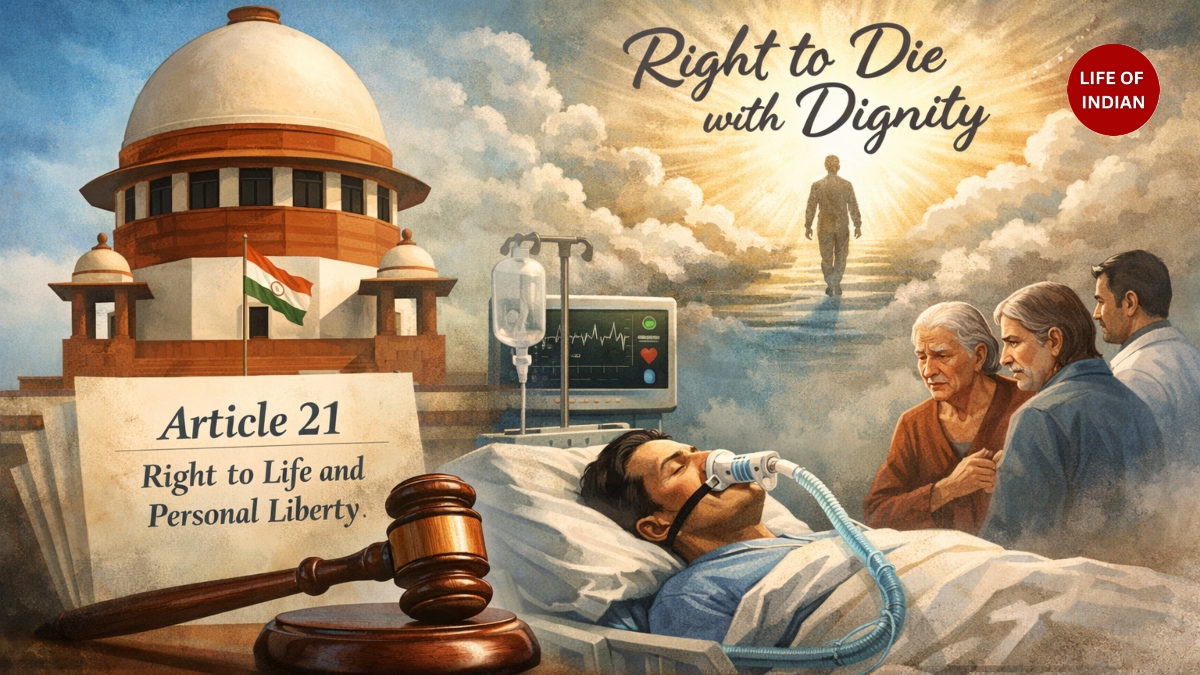
In March 2026, the debate around passive euthanasia once again came into national focus after the Supreme Court of India delivered a historic decision. The court allowed passive euthanasia for Harish Rana, a 31-year-old man from Ghaziabad who had been in a permanent vegetative state for more than 13 years following a severe accident. The court permitted doctors to withdraw life-sustaining treatment after medical experts concluded that there was no possibility of recovery.
This ruling has reignited discussions in India about the right to die with dignity, medical ethics, and the legal framework surrounding end-of-life care. To understand the issue fully, it is important to explore what passive euthanasia is, how the law in India evolved, and why the Supreme Court’s decision is considered significant.
Aravalli Hills to Remain Protected: Centre Rejects Mining Fears, Cites Supreme Court Safeguards
What Is Passive Euthanasia?
Passive euthanasia refers to the withdrawal or withholding of life-supporting medical treatment—such as ventilators, artificial nutrition, or other medical interventions—allowing a terminally ill or permanently unconscious patient to die naturally from the underlying disease.
In simple terms:
- Doctors do not actively cause death.
- Instead, they stop artificial life-support measures that are prolonging life without hope of recovery.
This is different from active euthanasia, where a doctor deliberately administers a substance to cause death. Active euthanasia remains illegal in India.
Recent Supreme Court Decision: The Harish Rana Case
The most recent and widely discussed case is that of Harish Rana.
Background of the Case
- Harish Rana suffered a severe head injury in 2013 after falling from a building while studying.
- The accident left him in a persistent vegetative state, meaning he had no awareness of his surroundings and required constant medical care.
- For more than 13 years, his elderly parents cared for him and eventually approached the court seeking permission for passive euthanasia.
Supreme Court’s Ruling
In March 2026, a bench of the Supreme Court of India allowed the withdrawal of life-support treatment after examining medical reports that showed no chance of recovery.
The court directed doctors at All India Institute of Medical Sciences (AIIMS), Delhi to oversee the process of withdrawing life support while ensuring dignity and medical ethics.
This decision is considered the first full practical application of India’s passive euthanasia guidelines.
Evolution of Passive Euthanasia Law in India
The legal position of euthanasia in India has evolved gradually through several landmark court cases.
1. The Aruna Shanbaug Case (2011)
One of the earliest cases that triggered a national debate was the case of Aruna Shanbaug, a nurse who remained in a vegetative state for decades after a brutal assault in 1973.
In this case, the Supreme Court of India recognized passive euthanasia under strict conditions and allowed courts to approve such decisions.
2. The Common Cause Judgment (2018)
In 2018, the Supreme Court delivered another landmark ruling in Common Cause v. Union of India.
The court held that the right to die with dignity is part of the fundamental right to life under Article 21 of the Constitution. It also recognized the concept of a “living will”, allowing individuals to state in advance that they do not want life-prolonging treatment if they become terminally ill.
3. Updated Guidelines in 2023
In 2023, the Supreme Court simplified the procedure for implementing passive euthanasia and living wills to make the process easier for hospitals and families.
The new guidelines reduced bureaucratic hurdles and allowed hospital medical boards to take decisions more efficiently.
Conditions for Passive Euthanasia in India
Passive euthanasia is allowed in India only under strict safeguards.
Key conditions include:
- The patient must be terminally ill or in a permanent vegetative state.
- Medical experts must confirm that recovery is impossible.
- A hospital medical board must review the case.
- The decision must consider the best interests and dignity of the patient.
These safeguards ensure that euthanasia is not misused.
Ethical Debate Around Passive Euthanasia
The issue of euthanasia often triggers strong ethical and emotional debates.
Arguments in Favor
Supporters believe that:
- Every person should have the right to die with dignity.
- Prolonging life artificially without hope of recovery may cause unnecessary suffering.
- Families often face emotional and financial stress caring for patients with no chance of recovery.
Arguments Against
Critics argue that:
- It could be misused for financial or personal motives.
- Religious traditions often view life as sacred and oppose intentional death.
- There may always be uncertainty in medical predictions.
Difference Between Passive and Active Euthanasia
| Feature | Passive Euthanasia | Active Euthanasia |
|---|---|---|
| Method | Withdrawal of life support | Direct action to cause death |
| Legality in India | Allowed under strict guidelines | Illegal |
| Cause of death | Underlying illness | Medical intervention |
Why the 2026 Supreme Court Decision Is Important
The Harish Rana case is significant because it shows the practical implementation of India’s euthanasia framework.
The ruling highlights:
- The recognition of human dignity at the end of life
- The need for clear legislation on euthanasia
- The importance of medical ethics and family consent
The court also suggested that the government consider creating a comprehensive law on passive euthanasia to avoid future legal uncertainties.
Passive euthanasia remains one of the most sensitive and complex issues in modern medicine and law. In India, it is permitted only under strict guidelines to ensure that decisions are taken ethically and responsibly.
The recent decision of the Supreme Court of India in the case of Harish Rana has brought renewed attention to the debate over the right to die with dignity.
As medical technology continues to advance, societies around the world—including India—will continue to grapple with the difficult balance between preserving life and respecting human dignity at the end of life.
FAQ
1. What is passive euthanasia?
Passive euthanasia is the withdrawal or withholding of life-support treatments such as ventilators, feeding tubes, or medications that artificially prolong life in terminally ill or permanently unconscious patients.
2. Is passive euthanasia legal in India?
Yes, passive euthanasia is legal in India under strict guidelines laid down by the Supreme Court of India. The decision must be approved by a medical board and follow legal safeguards.
3. What is the difference between active and passive euthanasia?
In passive euthanasia, doctors withdraw life-support treatment and allow the patient to die naturally. Active euthanasia involves directly administering a substance to cause death, which is illegal in India.
4. What is the Harish Rana case related to passive euthanasia?
The Harish Rana Passive Euthanasia Case involved a man who remained in a vegetative state for over 13 years after a severe accident. The Supreme Court allowed the withdrawal of life support after medical experts confirmed there was no chance of recovery.
5. What is a living will in India?
A living will is a legal document where a person states in advance that they do not wish to receive life-prolonging medical treatment if they become terminally ill or unconscious in the future.