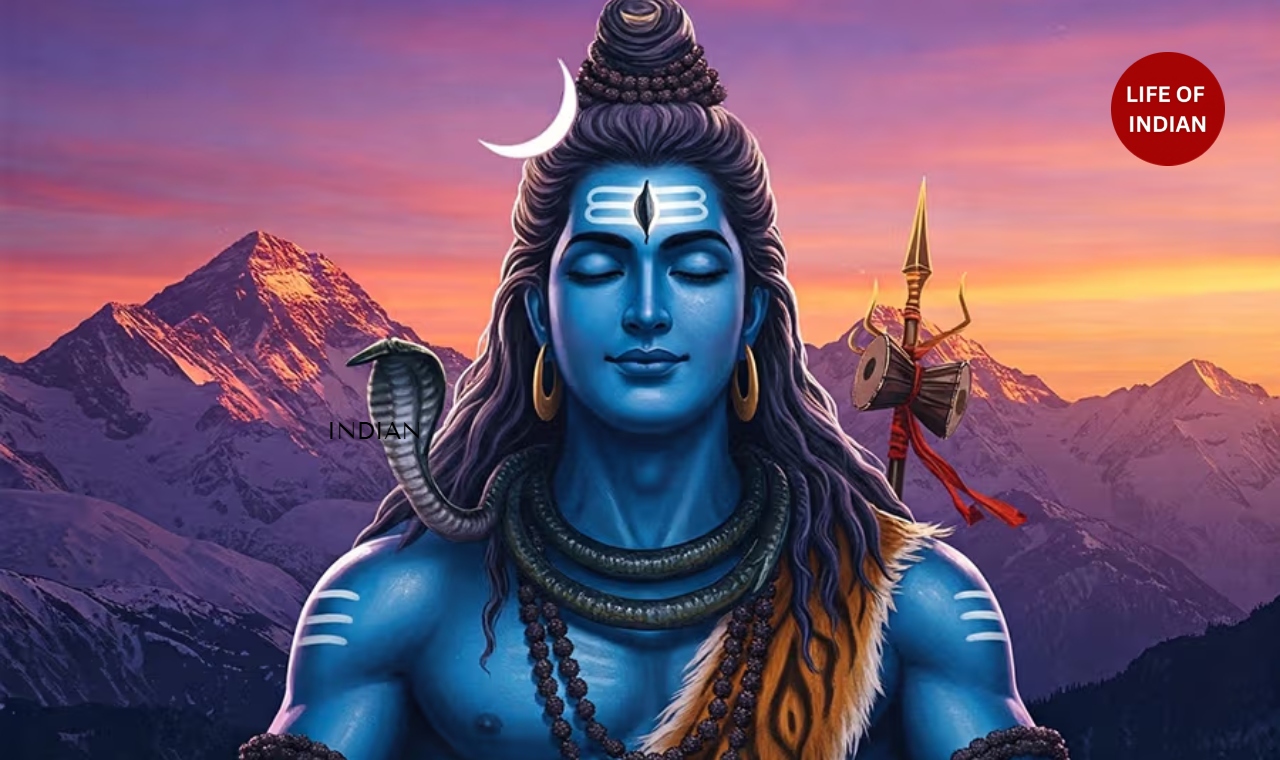
Lord Shiva, known as Mahadev, Bholenath, and Devadhidev, holds a unique place in Indian culture and Sanatan Dharma. Unlike other deities adorned with gold, jewels, and royal garments, Shiva’s appearance is simple, ascetic, and deeply symbolic. A serpent around his neck, ash covering his body, the crescent moon on his head, Ganga flowing from his matted locks, and a Rudraksha mala — each element carries profound spiritual and philosophical meaning.
Shiva’s ornaments are not merely decorations; they represent life, death, time, detachment, and cosmic balance. Understanding these symbols helps us connect not only with mythology but also with deeper truths about human existence.
Let’s explore the hidden meanings behind Lord Shiva’s extraordinary adornments.
The Serpent (Naag Vasuki): Symbol of Control Over Fear and Ego
The serpent Vasuki coiled around Shiva’s neck is one of the most striking features of his form.
In Hindu symbolism, snakes often represent:
- Desire (Kaam)
- Anger (Krodh)
- Ego (Ahankar)
- Fear and death
By wearing the serpent as an ornament, Shiva shows that he has complete control over negative emotions and worldly attachments. The snake also symbolizes alertness and awakened consciousness.
There is also a mythological link: Vasuki played a key role in the Samudra Manthan (churning of the ocean), acting as the rope between gods and demons. This represents balance between positive and negative energies—something Shiva perfectly embodies.
Message for life: Control your ego and fears, or they will control you.
The Crescent Moon (Chandra): Symbol of Time and Mind
The half-moon resting on Shiva’s head is called Chandrakor or Ardha Chandra.
The moon represents:
- Time cycles
- Emotions
- Calmness
- The human mind
Just as the moon waxes and wanes, life constantly goes through ups and downs. Shiva placing the moon on his head signifies mastery over time and emotional stability.
It teaches that even during changing phases of life, one must remain calm and balanced.
Message for life: Control your mind, and you can overcome every challenge.
Ganga in the Jata: Symbol of Purity and Knowledge
According to mythology, when the sacred river Ganga descended from heaven, her powerful force could have destroyed the Earth. Shiva caught her in his matted locks (jata) to soften her flow.
Spiritually, Ganga represents:
- Purity
- Wisdom
- Continuous flow of life
- Liberation from sins
By holding Ganga, Shiva becomes the protector of humanity, channeling divine energy gently for the welfare of the world.
It also shows that knowledge should flow steadily and peacefully, not destructively.
Message for life: Let wisdom guide your actions with compassion.
Rudraksha Mala: Symbol of Meditation and Spiritual Energy
Shiva is often seen wearing a Rudraksha bead mala around his neck.
Rudraksha is believed to have originated from Shiva’s tears during deep meditation. These sacred beads symbolize:
- Spiritual awakening
- Protection from negative energies
- Focus and concentration
- Connection with the universe
Even today, sages and yogis wear Rudraksha during meditation to maintain mental balance and inner peace.
Message for life: Meditation connects the soul with the cosmos.
Bhasma (Sacred Ash): Symbol of Detachment and Truth of Life
Perhaps the most powerful symbol is the ash covering Shiva’s body.
Bhasma represents:
- Impermanence of life
- Detachment (Vairagya)
- Destruction of ego
- Ultimate truth: everything turns to ash
While humans run after wealth, beauty, and material success, Shiva reminds us that everything is temporary. Only the soul is eternal.
This makes Shiva the ultimate yogi—free from worldly desires.
Message for life: Practice detachment and focus on inner growth.
Shiva’s Appearance: A Lesson in Simplicity
Unlike gods dressed like kings, Shiva lives on Mount Kailash, wears animal skin, and meditates in silence. His simple form teaches:
- Minimalism
- Self-control
- Inner strength
- Harmony with nature
He shows that true power does not come from luxury but from self-realization.
Spiritual Meaning of Shiva’s Ornaments Together
When we look at Shiva’s complete form, every ornament tells a story:
| Symbol | Meaning |
|---|---|
| Snake | Control over ego & fear |
| Moon | Mastery over time & mind |
| Ganga | Purity & knowledge |
| Rudraksha | Meditation & spirituality |
| Bhasma | Detachment & truth of life |
Together, they make Shiva not just a deity but a philosophy of living.
Lord Shiva’s unique adornments are not meant for external beauty—they are symbols of deep spiritual wisdom. They teach us to:
- Control desires
- Stay calm
- Gain knowledge
- Meditate regularly
- Detach from materialism
In essence, Shiva’s form reminds us that true liberation comes from inner awakening, not outer possessions.
That is why Mahadev is called Bholenath—the simplest yet the most powerful.