


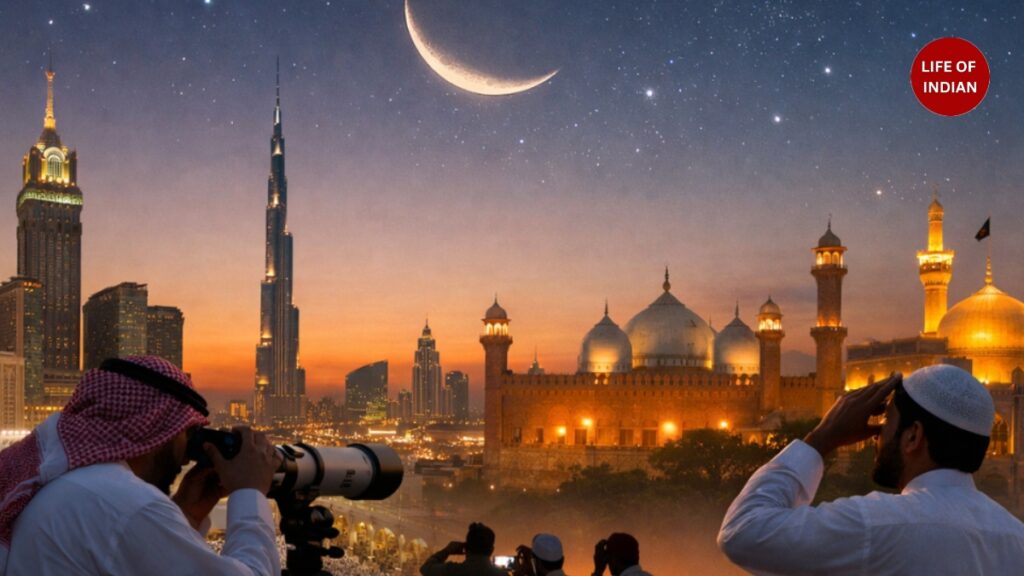
Eid: Have you ever noticed how the sight of a thin crescent moon instantly brings a unique sparkle to the eyes of Muslims around the world? It’s not just an astronomical event—it’s a moment filled with hope, joy, and deep faith, eagerly awaited throughout the month.
From the bustling streets of India to the minarets of mosques and small homes, one question echoes everywhere—“Has the moon been sighted?” Children rush to rooftops, elders raise their hands in prayers, and the entire atmosphere fills with a strange yet beautiful mix of excitement and anticipation.
But amid this joy, another question arises—why is Eid celebrated earlier in Saudi Arabia and a day later in India? Are we waiting for another country, or is there a deeper story behind it?
This is not just a difference in dates, but a beautiful blend of faith, tradition, science, and emotions that binds Muslims across the world—whether it’s the sacred land of Mecca or the soil of India
Three Ashras of Ramadan: Mercy, Forgiveness & Protection – What Islam Really Says
The Basis of the Islamic Calendar: Moon Sighting
First, let’s understand the core concept:
The Islamic (Hijri) calendar is based on the moon, not the sun.
Every new month begins only after the sighting of the crescent moon.
That’s why:
- Dates of Ramadan, Eid-ul-Fitr, and Eid-ul-Adha change every year
- The moon may be sighted at different times in different countries
Why Is There a Difference Between India and Saudi Arabia?
Geographical Reasons
The Earth is round, so the moon is not visible everywhere at the same time.
- Saudi Arabia lies to the west of India
- Therefore, the chances of sighting the moon earlier are higher there
- In India, the same moon is often seen the next day
That’s why:
- Eid in Saudi Arabia → usually 1 day earlier
- Eid in India → usually 1 day later
Example:
In 2025, Eid was celebrated on March 30 in Saudi Arabia, while in India it was observed on March 31.
Local Moon Sighting Tradition
One important principle in Islam is:
Each region can decide based on its own local moon sighting
In India:
- There are Ruet-e-Hilal (moon sighting) committees in different cities
- They officially announce Eid only after confirming the moon locally
So, India does not directly “follow” Saudi Arabia—it relies on its own sightings.
Religious Significance of Saudi Arabia
So why does Saudi Arabia still seem important?
Because:
- Mecca and Medina are located there
- Hajj pilgrimage takes place in Saudi Arabia
As a result:
- Muslims worldwide keep an eye on announcements from Saudi Arabia
- But it does not mean every country follows it strictly
Time Zone and Scientific Factors
- The crescent moon is not visible at the same time everywhere
- Weather conditions like clouds and pollution also affect visibility
Scientifically, it is completely normal for dates to differ across countries.
Ramadan 2026 Begins in India: Check Full Sehri & Iftar Timings
Different Islamic Interpretations
Islamic scholars have differing opinions on this matter:
Two main views:
- Local Sighting
Followed in India, Pakistan, Bangladesh - Global Sighting
Some believe if the moon is seen anywhere, it should be accepted everywhere
This is why sometimes even within the same country, Eid may be celebrated on different days.
Why Does Eid Usually Come After Saudi Arabia in India?
This is not about “following” Saudi Arabia—it’s a natural and religious process:
✔ The moon is seen earlier in Saudi Arabia
✔ It appears slightly later in India
✔ Hence, Eid in India is often celebrated a day later
This is a natural pattern, not a fixed rule.
The Tradition of “Chaand Raat”
In India and South Asia, there’s a special tradition:
The night when the moon is sighted is called “Chaand Raat”
- Eid is officially decided on this night
- Markets come alive, people shop, and apply mehendi
Muslim festivals in India are not celebrated according to Saudi Arabia, but based on local moon sightings.
What Breaks a Fast in Ramadan? Complete Guide to Rules Every Muslim Should Know
The difference between Saudi Arabia and India happens due to:
- Geographical distance
- Different moon visibility timings
- Local religious traditions
- Islamic interpretations
So, it would be incorrect to say that India “follows” Saudi Arabia. In reality, it’s a blend of natural phenomena and religious practices.