Holi is not just a festival of colors; it is a festival that reflects cosmic timing, spiritual symbolism, mythological depth, and seasonal transformation. Every year, Holi is celebrated on Phalguna Purnima, the full moon day of the Hindu lunar month of Phalguna. This timing is not random, nor is it merely traditional convenience. The connection between Holi and Purnima is deeply embedded in Hindu cosmology, astronomy, scriptural symbolism, and natural rhythms.
To truly understand why Holi falls on Purnima, one must explore the structure of the Hindu calendar, the legend of Holika and Prahlada, the spiritual importance of the full moon, and the seasonal transition that occurs during this period.
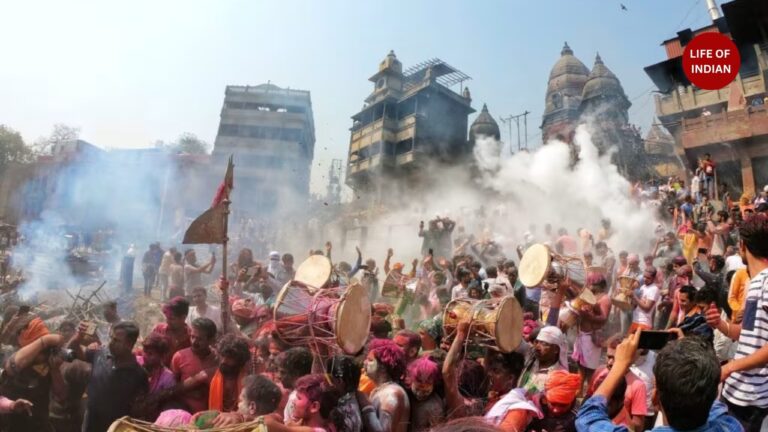
Why Varanasi Plays Holi With Ashes: The Powerful Story Behind Masan Holi 2026
The Importance of Purnima in the Hindu Lunar Calendar
The Hindu calendar is primarily based on lunar cycles rather than purely solar calculations. Each month is divided into two parts: Shukla Paksha, which begins after the new moon and continues until the full moon, and Krishna Paksha, which starts after the full moon and ends at the next new moon. Purnima marks the climax of Shukla Paksha — the day when the moon is fully illuminated.
In Hindu spiritual understanding, the full moon represents completeness, expansion, and heightened consciousness. The moon is closely associated with the mind and emotions in Vedic philosophy. When the moon is full, it is believed that emotional and spiritual energies are also at their peak. Many significant Hindu observances such as Guru Purnima, Sharad Purnima, and Buddha Purnima are aligned with the full moon for this very reason.
Phalguna Purnima, which usually falls in February or March, holds a special place because it marks the end of winter and the arrival of spring. Spiritually and naturally, this period symbolizes renewal, cleansing, and transition — themes that are central to Holi.
The Mythological Foundation: Prahlada, Holika and the Triumph of Devotion
The most widely accepted explanation for celebrating Holi on Purnima lies in the ancient legend of Prahlada and Holika. According to Puranic narratives, the demon king Hiranyakashipu grew arrogant after gaining powerful boons and demanded that everyone worship him instead of Lord Vishnu. His own son, Prahlada, remained devoted to Vishnu despite repeated punishments.
In a final attempt to eliminate Prahlada, Hiranyakashipu asked his sister Holika, who possessed a boon that protected her from fire, to sit in a burning pyre with Prahlada in her lap. However, divine protection ensured that Prahlada survived while Holika was burned to ashes. This event symbolized the destruction of ego and the protection of true faith.
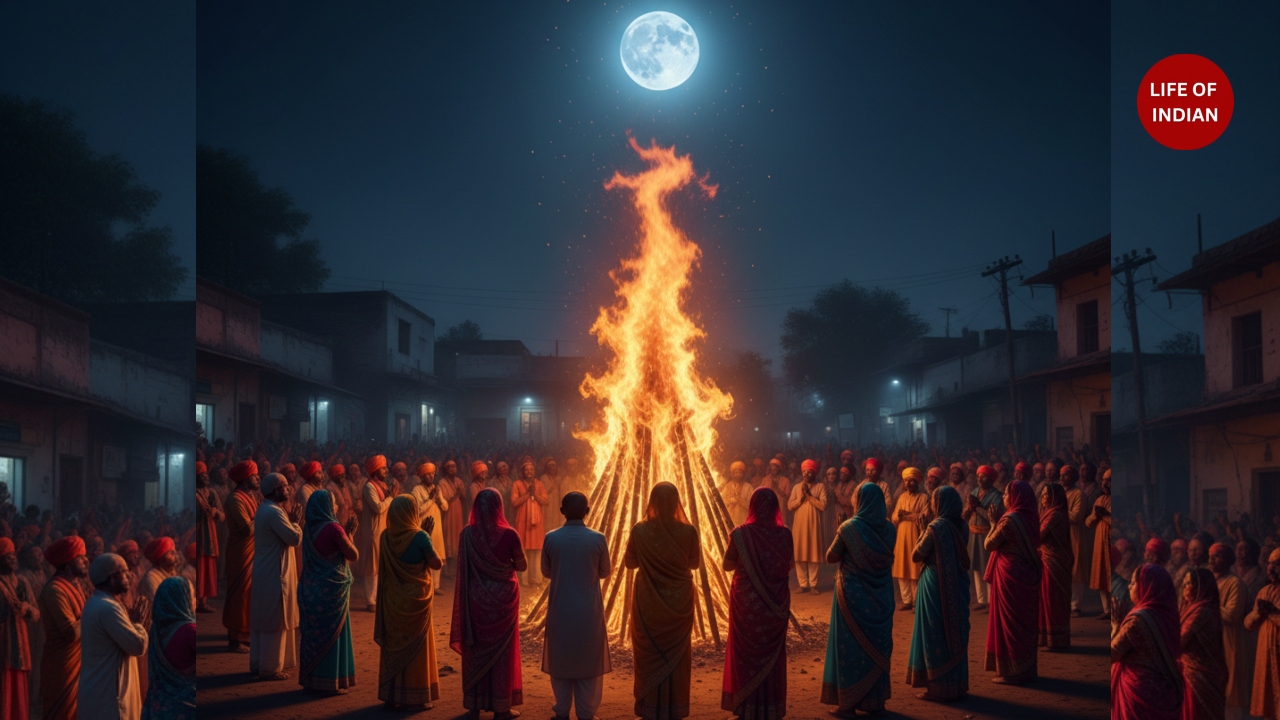
Holika Dahan, the ritual bonfire of Holi, commemorates this event. It is performed specifically on the night of Phalguna Purnima because the full moon represents illumination and truth. The burning of Holika during the brightest night of the month reinforces the symbolism of light overcoming darkness. The lunar fullness amplifies the spiritual message — when consciousness is at its peak, negativity can be destroyed completely.
Holi Around the World: Countries Where the Festival of Colors Is Celebrated
Why the Celebration Continues the Next Day With Colors
While Holika Dahan takes place on Purnima night, the festival of colors is celebrated the following day, on the first day of Krishna Paksha. This sequence carries deep philosophical meaning. The fire ritual represents purification and the burning away of internal impurities such as anger, jealousy, ego, and negativity. Once this cleansing occurs, the next day becomes a celebration of life, harmony, and emotional expression through colors.
Thus, Holi is structured as a two-step spiritual process. The full moon night marks the destruction of negativity, and the day after signifies renewal and joy. The timing ensures that the festival moves from spiritual intensity to social celebration, mirroring the natural cycle of completion and new beginnings.
Astronomical Significance: Why Full Moon Timing Matters
From an astronomical perspective, a full moon occurs when the Earth is positioned between the Sun and the Moon, allowing the moon to reflect maximum sunlight toward Earth. This alignment creates a visually complete and luminous moon.
Ancient Indian sages were keen observers of celestial patterns. Festivals were not randomly assigned but carefully aligned with cosmic movements. The full moon was regarded as a period of energetic amplification. Rituals performed during this time were believed to carry greater spiritual impact.
Phalguna Purnima, specifically, coincides with the seasonal shift from winter to spring. The body undergoes physiological adjustments during this period. Traditional practices such as gathering around fire and applying herbal colors were not merely symbolic but also practical. The warmth of the fire helped combat residual winter chills, while natural colors made from flowers and herbs supported immunity and skin health.
Thus, Holi’s timing on Purnima reflects a harmonious blending of astronomy, environmental awareness, and spiritual consciousness.
Braj Holi Begins with Basant Panchami: What Is Holi Danda & Why Braj Celebrates Holi for 40 Days
Seasonal Transition and the Arrival of Spring
Holi also marks the transition into Vasant Ritu, the spring season. Spring in Indian tradition symbolizes rebirth, fertility, and blossoming life. Crops are harvested, flowers bloom, and the climate becomes pleasant after the harshness of winter.
Celebrating Holi on the full moon of Phalguna amplifies this sense of fullness in nature. The lunar brightness complements the natural blossoming occurring on Earth. Symbolically, just as the moon reaches its complete form, nature too reaches a stage of vibrancy and readiness for renewal.
The festival’s colors reflect the blooming of flowers, while the communal joy reflects agricultural prosperity. In this way, the Purnima timing aligns spiritual cycles with agricultural and environmental rhythms.
Spiritual Symbolism of the Full Moon in Holi
In Vedic philosophy, the moon governs the mind. A full moon is believed to intensify emotional states. Holi, as a festival, encourages emotional release, forgiveness, laughter, and reconnection. By celebrating on Purnima, the festival provides a structured outlet for heightened emotional energy.
The bonfire symbolizes the burning of subconscious negativity, while the colors symbolize the acceptance of diversity and joy. The brightness of the moon represents clarity of thought and inner illumination. Holi on Purnima thus becomes a symbolic journey from darkness to light, from rigidity to openness, and from isolation to unity.
The Occasional Overlap With Lunar Eclipse
It is also worth noting that a lunar eclipse, or Chandra Grahan, can only occur on a full moon day. This is because an eclipse requires the Earth to come directly between the Sun and the Moon, which is only possible during Purnima. When Holi coincides with a lunar eclipse, it highlights the shared astronomical foundation of both events.
The fact that both Holi and lunar eclipses depend on the full moon further reinforces how closely Hindu festivals are connected with cosmic alignments.
A Festival Perfectly Timed With Cosmic Rhythm
Holi is celebrated on Purnima because the full moon represents culmination, illumination, and energetic peak. Phalguna Purnima marks not only a mythological victory of good over evil but also a seasonal transformation and astronomical alignment. The timing integrates devotion, natural science, emotional psychology, and cultural tradition into one cohesive celebration.
The fire of Holika Dahan on the brightest night of the month symbolizes the destruction of darkness at the moment of maximum light. The following day’s explosion of colors represents life renewed after purification. This seamless blending of cosmic rhythm and human celebration is what makes Holi on Purnima profoundly meaningful.
In essence, Holi is not just celebrated on Purnima — it is celebrated because of Purnima.
FAQ
1. Why is Holi celebrated on Purnima?
Holi is celebrated on Phalguna Purnima because it marks the victory of devotion over evil in the story of Prahlada and Holika. The full moon symbolizes completeness, spiritual illumination, and energetic peak, making it the ideal time for Holika Dahan.
2. Why does Holika Dahan happen on full moon night?
Holika Dahan is performed on the night of Phalguna Purnima because the full moon represents the destruction of darkness and the triumph of light. Spiritually, rituals performed on Purnima are considered highly powerful.
3. Does Holi always fall on a full moon?
Yes, Holi always falls on the full moon day of the Hindu month of Phalguna, according to the lunar calendar.
4. Why can a lunar eclipse happen on Holi?
A lunar eclipse can only occur on a full moon day. Since Holi is celebrated on Purnima, sometimes a Chandra Grahan coincides with Holi due to astronomical alignment.
5. What is the spiritual meaning of Holi on Purnima?
The full moon represents emotional intensity and completeness. Holi uses this energy symbolically to burn negativity and celebrate renewal through colors.
About the Author