
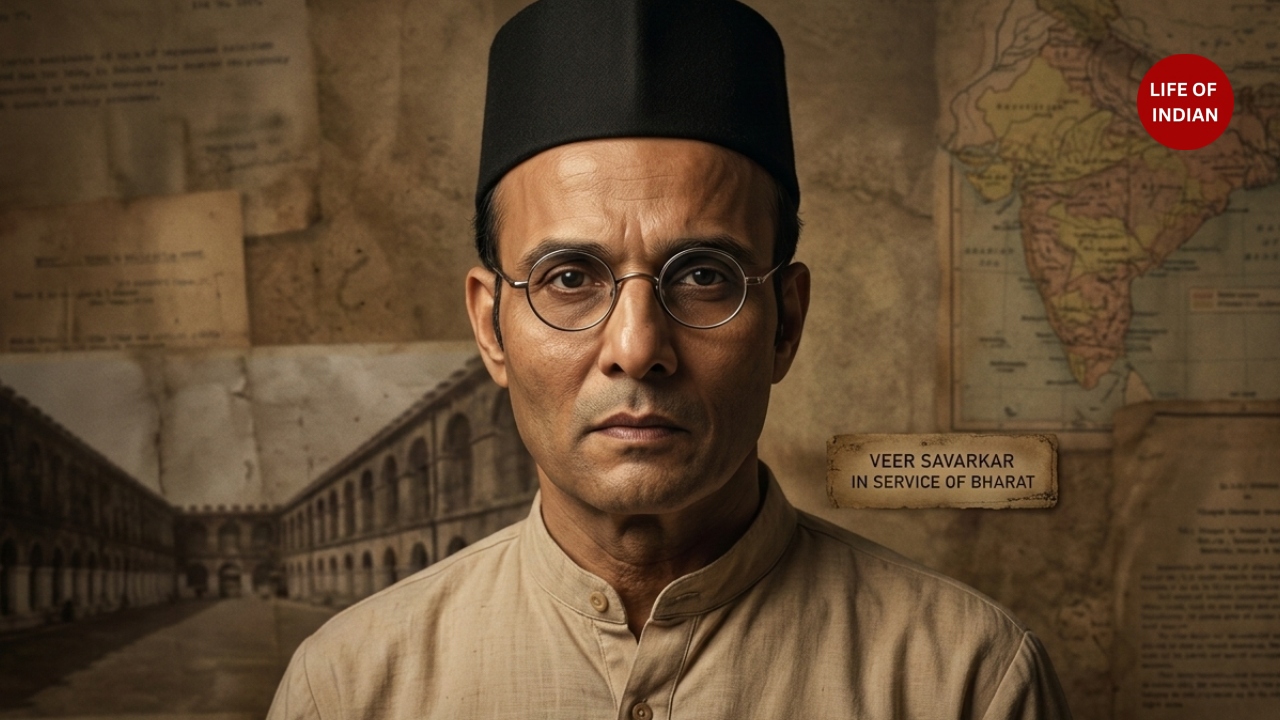
Veer Savarkar Death Anniversary: Every year on 26 February, India remembers Vinayak Damodar Savarkar, popularly known as Veer Savarkar, on his death anniversary. A revolutionary, political thinker, writer, and social reformer, Savarkar remains one of the most discussed and debated figures in modern Indian history. His life journey—from anti-colonial activism and imprisonment in the Cellular Jail to the articulation of Hindutva and involvement in national politics—continues to shape political and intellectual discourse in India.
On his Punyatithi, it is important to revisit his life not through slogans or headlines, but through a deeper understanding of his ideas, sacrifices, achievements, and controversies.
Who Was Samarth Ramdas Swami? Why Das Navami Is So Important in Maharashtra
Early Life and Formative Influences
Vinayak Damodar Savarkar was born on 28 May 1883 in Bhagur, near Nashik, in present-day Maharashtra. Raised in a Chitpavan Brahmin family, Savarkar grew up in an environment shaped by stories of resistance and valor. The execution of Indian revolutionaries and the growing nationalist sentiment during the late 19th century deeply influenced his young mind.
As a student, he founded a secret society called Mitra Mela, which later evolved into Abhinav Bharat, an organization committed to ending British rule in India through revolutionary means. His early writings and speeches reflected a fiery nationalism and a belief that armed resistance was a legitimate path to freedom.
Revolutionary Activities in London
Savarkar moved to London in 1906 to study law at Gray’s Inn. During his stay, he became associated with India House, a hub of Indian revolutionary activity led by Shyamji Krishna Varma.
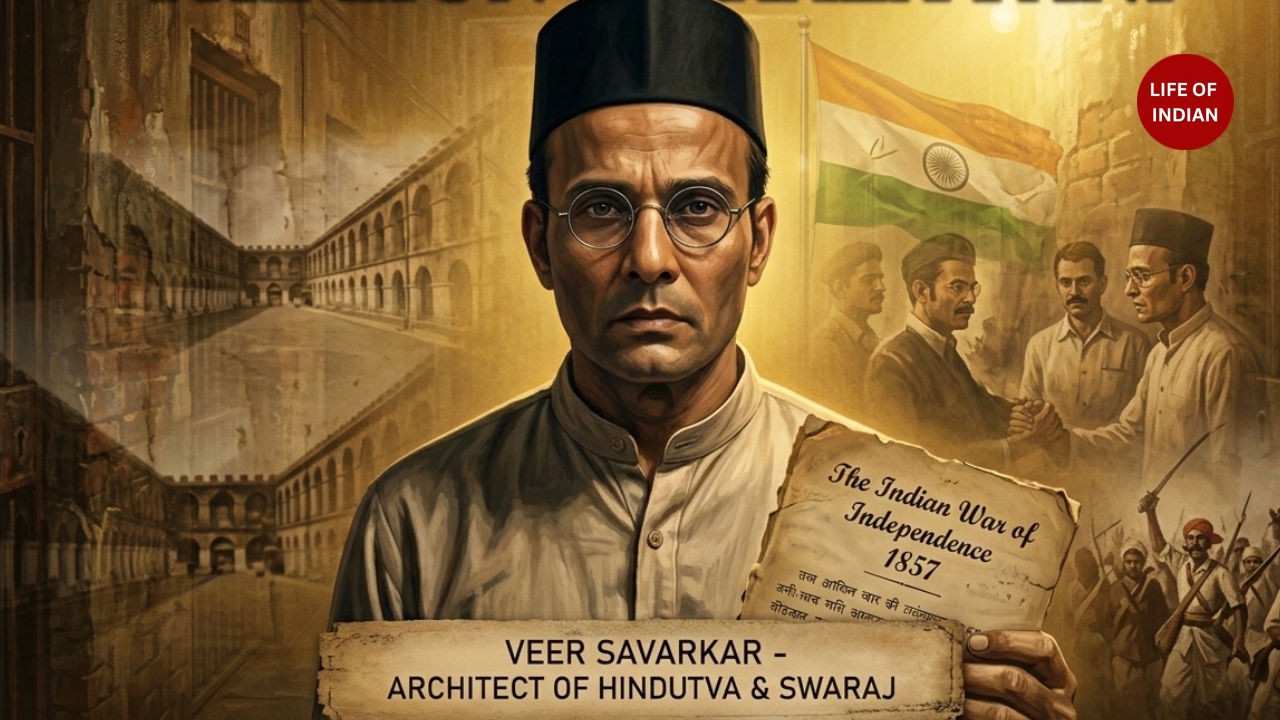
It was in London that Savarkar wrote one of his most significant works, The Indian War of Independence of 1857. In this book, he argued that the uprising of 1857 was not merely a sepoy mutiny but a well-planned national war for independence. The book was banned by the British even before its publication in India, but copies circulated secretly and inspired many revolutionaries.
Savarkar was later arrested in 1909 in connection with revolutionary activities. In a dramatic episode, he attempted to escape British custody in Marseilles, France, by jumping into the sea from a ship. However, he was recaptured and extradited to India.
National Unity Day 2025: Honouring Sardar Vallabhbhai Patel, the Iron Man Who United India
Imprisonment in the Cellular Jail
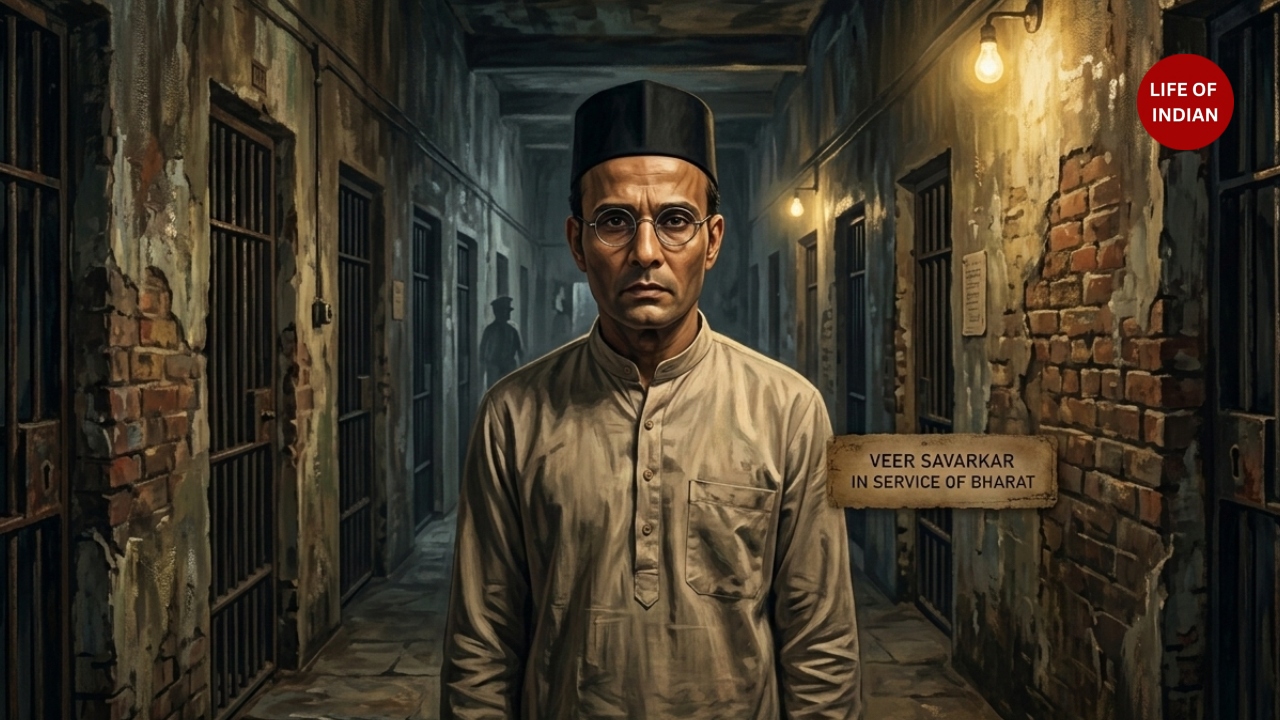
In 1911, Savarkar was sentenced to two life terms of imprisonment totaling 50 years and was transported to the infamous Cellular Jail in the Andaman and Nicobar Islands.
The Cellular Jail was known for its harsh conditions. Prisoners were subjected to solitary confinement, hard labor, and physical punishment. Savarkar spent years in isolation, reportedly writing poetry on prison walls and memorizing verses to preserve them.
During his imprisonment, Savarkar submitted mercy petitions to the British authorities—a subject that remains controversial. Supporters argue that these petitions were strategic moves to secure release and continue political work outside prison. Critics, however, question the language and tone of these appeals.
Savarkar was eventually transferred to mainland prisons and later placed under restricted residence in Ratnagiri in 1924.
Ideology and the Concept of Hindutva
While under restrictions in Ratnagiri, Savarkar developed and articulated his political philosophy in his book Hindutva: Who Is a Hindu? In this work, he defined Hindutva not merely as a religious identity but as a cultural and civilizational concept. According to him, a Hindu was someone who considered India both as Pitrubhumi (fatherland) and Punyabhumi (holy land).
Savarkar’s interpretation of Hindutva laid the intellectual foundation for a stream of nationalist thought that later influenced several organizations and political movements in India. His ideas continue to be central in contemporary debates about identity, secularism, and nationalism.
Role in Hindu Mahasabha and Political Career
Savarkar became a prominent leader of the Akhil Bharat Hindu Mahasabha and served as its president from 1937 to 1943. During this period, he advocated for the political consolidation of Hindus and promoted the idea of militarization as a means of strengthening Indian society.
Unlike leaders of the Indian National Congress who launched mass civil disobedience movements, Savarkar adopted a different political strategy. His critics argue that he did not actively participate in the Quit India Movement of 1942, while his supporters maintain that his approach was shaped by a pragmatic assessment of global events, including World War II.
Social Reform Efforts
Savarkar was also a social reformer. In Ratnagiri, he worked toward the eradication of untouchability and promoted temple entry for all castes. He advocated for inter-caste dining and social integration, challenging orthodox practices within Hindu society.
These efforts reveal a lesser-discussed dimension of Savarkar’s life: his commitment to internal social reform alongside political nationalism.
Controversies and Gandhi Assassination Case
Savarkar’s legacy remains contentious, particularly due to his alleged connection to the assassination of Mahatma Gandhi in 1948. He was arrested and tried as a co-accused in the case but was acquitted due to lack of evidence.
Decades later, debates continue regarding his role. Various commissions and historians have examined the matter, leading to differing interpretations. For some, his acquittal settles the issue legally; for others, moral and political questions remain open.
Final Years and Death
In his later years, Savarkar withdrew from active politics. In February 1966, he declared that he had fulfilled his life’s mission and chose to undertake Atmaarpan—a voluntary fast unto death. He passed away on 26 February 1966 in Mumbai.
His death anniversary is observed by followers and admirers across India, who remember him as a patriot and visionary. At the same time, discussions around his ideology continue in academic and political spaces.
Legacy in Contemporary India
Savarkar’s life represents a complex chapter in India’s freedom struggle. He was a revolutionary who endured one of the harshest imprisonments under British rule. He was also a political thinker whose ideas have had lasting influence.
In recent years, there have been renewed efforts to reassess his contribution. Statues, memorials, and academic discussions reflect his enduring presence in public discourse. Whether viewed as a heroic nationalist or a polarizing ideologue, Savarkar undeniably occupies a significant place in India’s modern history.
On the death anniversary of Veer Savarkar, it is essential to move beyond one-dimensional portrayals. His life combined courage, intellect, ideological conviction, and controversy. From the revolutionary activities in London to the harsh years in the Cellular Jail, from the articulation of Hindutva to debates surrounding his political legacy, Savarkar’s journey mirrors the complexities of India’s path to independence.
Remembering him on 26 February is not merely about paying tribute; it is about engaging with history thoughtfully and critically—acknowledging both achievements and debates that continue to shape India’s democratic conversation.
About the Author


