
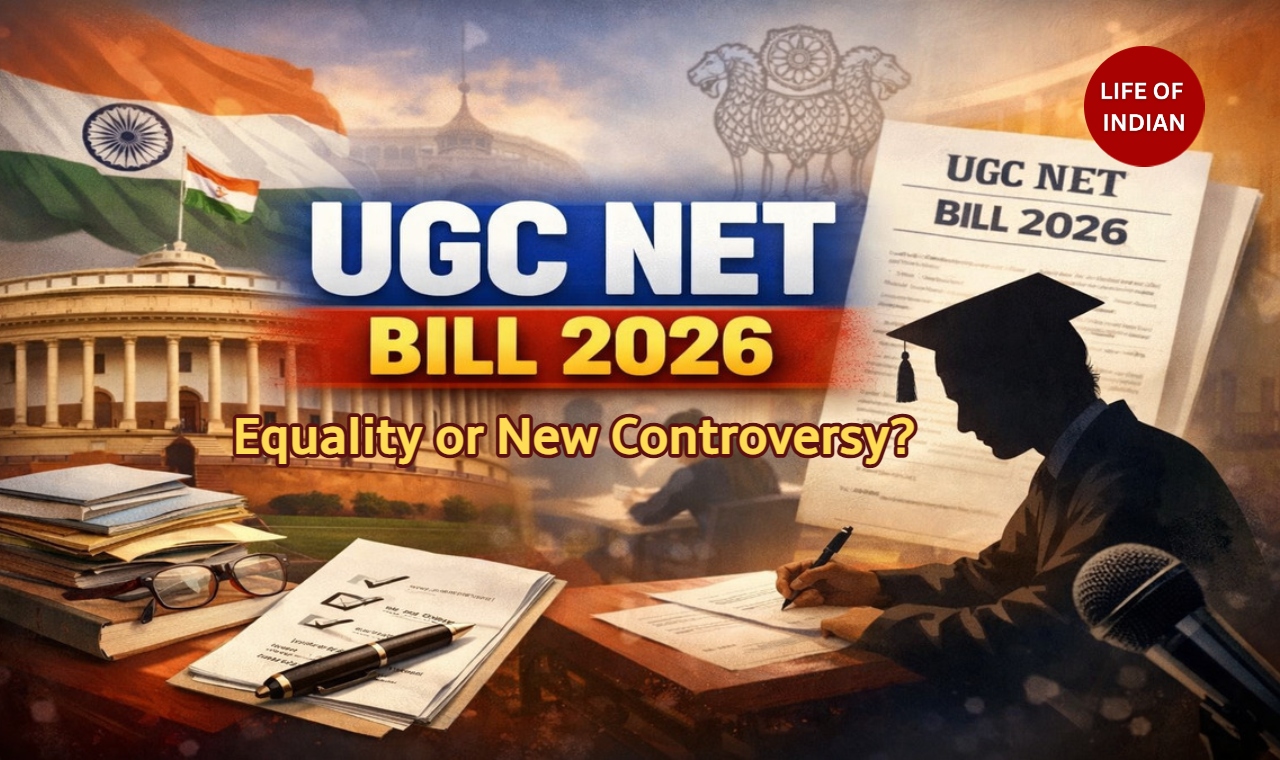
UGC Controversy Explained: The University Grants Commission (UGC) is India’s primary regulatory body for higher education. It is responsible for framing and implementing policies for universities and colleges across the country, ensuring academic standards and institutional governance.
Recently, the UGC introduced a new set of rules titled “Promotion of Equity in Higher Education Institutions Regulations, 2026.” According to the commission, the objective of these regulations is to prevent discrimination within educational institutions and to promote equality, safety, and fairness for all students.
These regulations aim to strengthen protection against discrimination based on factors such as caste, religion, gender, identity, disability, and social background. The stated goal is to ensure that every student receives equal opportunities, studies in a secure environment, and has access to justice within the campus system.
However, soon after the rules came into force in January 2026, they triggered widespread controversy. Several institutions, student groups, and political organizations began voicing strong opposition, arguing that the regulations raise serious concerns related to fairness, implementation, and academic freedom.
UGC’s New Rules (Equity Regulations 2026): Key Provisions
The Equity Regulations 2026 have replaced earlier guidelines issued in 2012 and 2018. These new rules are now mandatory for universities and colleges. Their major provisions include the following:
Major Changes and Provisions
-
Mandatory Equal Opportunity Centres (EOC):
Every university and college must establish an Equal Opportunity Centre along with an Equity Committee. -
Composition of Equity Committees:
These committees must include representatives from SC, ST, OBC communities, women, and persons with disabilities. -
24×7 Support and Monitoring Mechanisms:
Institutions are required to set up round-the-clock helplines, formal grievance redressal systems, and monitoring mechanisms. -
Expanded Definition of Discrimination:
Discrimination is broadly defined to include caste, religion, gender, disability, language, and other social identities. -
Time-bound Complaint Resolution:
Complaints related to discrimination must be addressed within a fixed and clearly defined timeframe. -
Penalties for Non-Compliance:
Institutions that fail to comply with these regulations may face financial penalties or consequences related to accreditation and recognition.
According to the UGC, these measures are intended to strengthen anti-discrimination mechanisms and create a safer, more inclusive campus environment.
Why Are the New UGC Rules Being Opposed?
Despite their stated intent, the implementation of these rules has led to widespread resistance. Protests and criticism have emerged not only within universities but also at political and social levels.
Key Objections Raised by Critics
1. Fear of “Reverse Discrimination”
Critics argue that the definition of discrimination in the regulations is too broad and ambiguous, which could lead to misuse, false complaints, and biased decision-making.
Some believe that students and faculty from the General Category (unreserved category) may be viewed with inherent suspicion, effectively creating a sense of reverse discrimination.
2. Lack of Safeguards Against False Complaints
Earlier draft versions reportedly included provisions to penalize false or malicious complaints, but such safeguards are either weak or absent in the final regulations.
This has raised concerns that complaints could be filed without sufficient evidence, potentially damaging academic careers and campus harmony.
3. Representation Imbalance
While the Equity Committees ensure representation for reserved categories, there is no explicit provision for formal representation of the General Category.
Opponents argue that this imbalance could result in one-sided decisions and erode confidence in the grievance redressal process.
4. Impact on Campus Culture and Academic Freedom
Many students and teachers fear that excessive monitoring or the creation of informal “surveillance-like” mechanisms could discourage free interaction, debate, and discussion on campus.
There is concern that even routine social or academic exchanges might be interpreted as discriminatory, creating an atmosphere of fear and mistrust.
5. Implementation and Legal Challenges
Several petitions have reportedly been filed in the Supreme Court, questioning the constitutional validity and scope of the regulations.
At the same time, social media campaigns such as #UGCRollback have amplified public debate and mobilized opposition across different sections of society.
Political and Social Reactions
The controversy has extended beyond campuses into the political sphere.
-
Multiple student unions have organized protests and demonstrations.
-
Some political leaders and social organizations have described the regulations as a source of social imbalance rather than harmony.
-
In a few cases, resignations by office-bearers have further intensified the debate.
On the other hand, the government and the UGC have maintained that the regulations are designed to promote equality and student safety, and they have assured that safeguards will be put in place to prevent misuse.
The Deeper Issue Behind the UGC Debate
The UGC’s new Equity Regulations are rooted in a legitimate concern—eliminating discrimination and ensuring equal opportunity in higher education. Strengthening grievance redressal mechanisms and protecting vulnerable students are important objectives.
However, concerns over clarity, balance, fair representation, and implementation have created uncertainty and resistance among students, educators, and institutions.
Critics argue that unless these regulations are made more transparent, balanced, and inclusive of all stakeholders, they risk undermining trust and academic freedom.
The ongoing debate highlights a deeper challenge: how to balance social justice with fairness, due process, and an open academic environment. Addressing this balance will be crucial for the long-term credibility and effectiveness of the UGC’s reforms.