


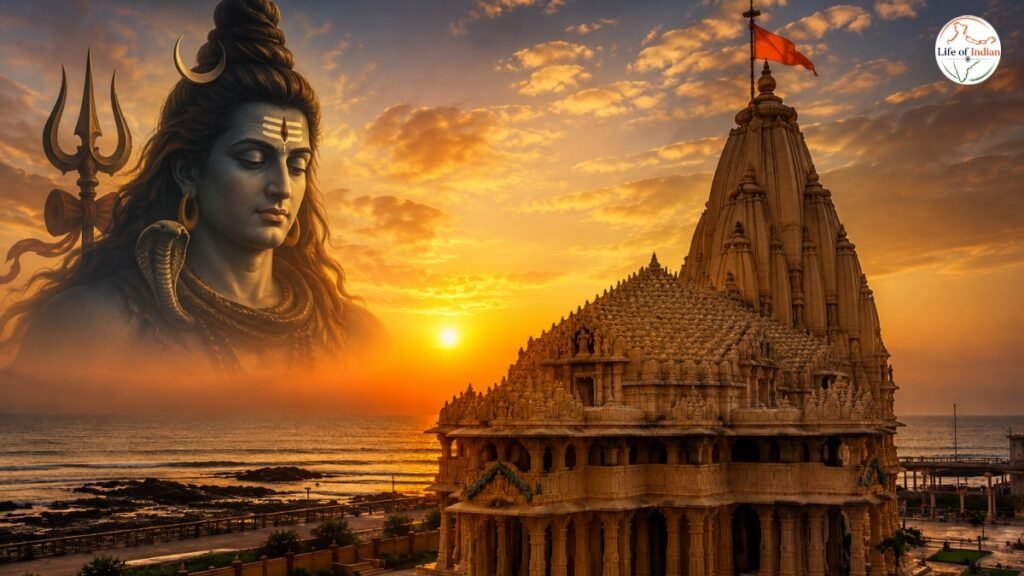
Somnath Jyotirlinga: On the western coast of India, where the Arabian Sea meets the sacred land of Prabhas Patan in Gujarat, stands one of Hinduism’s most revered pilgrimage sites — Somnath Jyotirlinga. For millions of devotees, Somnath is not simply an ancient temple. It is regarded as the first among the twelve Jyotirlingas of Lord Shiva, a sacred place associated with the Moon God, Lord Krishna, ancient pilgrimage traditions and centuries of India’s religious and cultural history.
The temple’s story is equally remarkable. Over the centuries, the shrine was attacked and damaged several times, yet it was repeatedly rebuilt. The present temple, reconstructed after India’s independence, became a powerful symbol of cultural revival and continuity. Today, the magnificent Somnath Temple stands beside the Arabian Sea in Prabhas Patan, Gujarat, attracting pilgrims, history enthusiasts and travellers throughout the year.
Where Is Somnath Jyotirlinga Located?
Somnath Jyotirlinga is located at Prabhas Patan in Gir Somnath district of Gujarat, close to the coastal town of Veraval. The temple stands directly on the Arabian Sea coast. Its location is one of the reasons Somnath has such a distinctive atmosphere: the sound of the waves, the temple’s towering shikhara and the vast sea create a dramatic setting for one of India’s most important Shiva shrines.
The pilgrimage region is also associated with the Triveni Sangam, traditionally identified as the meeting point of the Hiran, Kapila and Saraswati rivers with the Arabian Sea. According to the Shree Somnath Trust, Somnath is the first of the twelve Aadi Jyotirlingas and has references in ancient Hindu texts including the Skanda Purana, Shiva Purana and Srimad Bhagavatam.
What Is a Jyotirlinga?
The word Jyotirlinga is formed from two Sanskrit words: Jyoti, meaning light or radiance, and Linga, representing Lord Shiva. According to Hindu tradition, the Jyotirlingas are sacred manifestations of Shiva in which the deity appeared as an infinite column of divine light.
There are traditionally twelve Jyotirlingas spread across different parts of India:
- Somnath – Gujarat
- Mallikarjuna – Srisailam, Andhra Pradesh
- Mahakaleshwar – Ujjain, Madhya Pradesh
- Omkareshwar – Madhya Pradesh
- Baidyanath – Deoghar, Jharkhand
- Bhimashankar – Maharashtra
- Rameshwaram – Tamil Nadu
- Nageshwar – Gujarat
- Kashi Vishwanath – Varanasi, Uttar Pradesh
- Trimbakeshwar – Maharashtra
- Kedarnath – Uttarakhand
- Grishneshwar – Maharashtra
Somnath occupies a special position because it is traditionally regarded as the first or Aadi Jyotirlinga. The famous Dwadasha Jyotirlinga tradition begins with the invocation “Saurashtre Somanatham”, connecting Somnath with the Saurashtra region.
Why Is Somnath Called Somnath?
The name Somnath literally means “Lord of Soma”. In Hindu tradition, Soma is associated with the Moon God, Chandra. The mythology surrounding Somnath therefore begins not with a king or an empire, but with the Moon himself.
The Story of Chandra and Daksha Prajapati
According to Hindu scriptures and temple tradition, Chandra married the twenty-seven daughters of Daksha Prajapati. These twenty-seven daughters are traditionally associated with the twenty-seven Nakshatras of Hindu astronomy. However, Chandra was especially attached to Rohini and neglected his other wives.
Daksha became angry with Chandra and cursed him. As a result of the curse, Chandra began to lose his brilliance. Seeking relief, Chandra performed severe penance and worshipped Lord Shiva at Prabhas Teerth. Pleased with his devotion, Lord Shiva relieved Chandra from the curse. Because Shiva became the Lord who restored the Moon’s radiance, the deity came to be worshipped here as Somnath — the Lord of Soma. The story is preserved in the religious traditions associated with Somnath and explains the temple’s connection with the Moon God.
The Mythological Origin of Somnath Temple
There is an important distinction between religious tradition and archaeologically documented history when discussing the origin of Somnath. According to traditional Hindu accounts, the shrine has existed since extremely ancient times. The popular traditional account describes the temple as having been constructed successively in different materials:
- Soma (Moon God) built the first temple in gold.
- Ravana rebuilt it in silver.
- Lord Krishna rebuilt it in sandalwood.
- King Bhimdev/Bhima rebuilt it in stone.
The Shree Somnath Trust preserves this traditional account as part of the temple’s religious history. These accounts belong to the sacred and Puranic tradition and should not be confused with archaeological evidence establishing the dates of individual structures.
Somnath in Ancient India
Somnath’s importance goes beyond the temple itself. The larger region of Prabhas Patan has been a sacred pilgrimage centre for centuries. Ancient Hindu literature associates Prabhas with several important religious stories and pilgrimage traditions. The site is also connected with the final earthly journey of Lord Krishna.
According to Hindu tradition, after being struck by the arrow of the hunter Jara at Bhalka Tirth, Krishna proceeded towards the area of Prabhas where he is believed to have undertaken his final journey to his divine abode. The Somnath region therefore represents a rare convergence of two major traditions: the worship of Shiva as Somnath and the sacred traditions surrounding Krishna’s final earthly journey.
The Historical Somnath Temple
The history of the physical temple is complicated because Somnath was rebuilt several times. It is important to remember that the present Somnath Temple is not the same physical structure that existed in the medieval period. Rather, it is a modern reconstruction built on the historic sacred site.
Archaeological and historical accounts indicate that earlier temples existed at the site and were reconstructed multiple times before and after the famous raid of Mahmud of Ghazni. The temple’s history is therefore best understood as a sequence of construction, destruction, rebuilding and continued worship.
Who Destroyed Somnath Temple?
One of the most famous episodes in Somnath’s history occurred in the early eleventh century.
Mahmud of Ghazni’s Attack in 1026 CE
In 1026 CE, Mahmud of Ghazni attacked Somnath. The raid became one of the most famous episodes in medieval Indian history. Historical accounts describe the temple as a wealthy and important pilgrimage centre, and Mahmud’s forces looted the shrine and caused extensive destruction.
The attack became particularly significant because Somnath was already a major religious centre and was associated with considerable wealth.
Most historical accounts identify the attack of Mahmud of Ghazni as the most famous and damaging episode in the temple’s long history. However, it is inaccurate to say that Somnath’s entire history consists only of one destruction. The shrine was rebuilt after the raid and subsequently experienced further periods of destruction and reconstruction.
Was Somnath Destroyed Only Once?
No. This is one of the most important points to understand about Somnath.
The temple was subjected to several attacks and periods of destruction over the centuries. Different historical sources provide somewhat different dates and details for individual episodes, so claims about an exact number of destructions should be treated carefully.
An archaeological report prepared in the early years after independence and later historical research identify several episodes of desecration and rebuilding after Mahmud of Ghazni’s attack. The temple was attacked again during the Delhi Sultanate period, including an attack associated with Alaf Khan in 1297 CE. Later episodes are recorded in the fourteenth and fifteenth centuries, and the shrine faced another major destruction under Aurangzeb in the late seventeenth/early eighteenth-century period. Because historical narratives differ over the exact chronology, the safest conclusion is that Somnath was repeatedly damaged or destroyed and repeatedly rebuilt over several centuries.
Who Rebuilt Somnath After Mahmud of Ghazni?
Following Mahmud of Ghazni’s raid, the temple was rebuilt by Hindu rulers. Historical sources associate the reconstruction in the eleventh century with King Bhima I of the Chaulukya/Solanki dynasty, with some traditions also connecting the reconstruction to the Paramara ruler Bhoja.
Later rulers and local communities continued to maintain the shrine through different historical periods. This pattern — destruction followed by reconstruction — became one of the defining features of Somnath’s history.
Somnath During the Delhi Sultanate Period
The temple experienced another major disruption in the late thirteenth century when Gujarat came under the expansion of the Delhi Sultanate. Historical accounts identify Alaf Khan, a general associated with the Khilji ruler Alauddin Khilji, with an attack on Somnath around 1297 CE.
The temple was subsequently rebuilt again. Further attacks and political changes affected the shrine in later centuries. Historical scholarship records additional episodes of desecration in the fourteenth and fifteenth centuries, although the exact chronology differs among sources.
What Happened to Somnath Under Aurangzeb?
The temple again faced destruction during the reign of Mughal emperor Aurangzeb. Historical accounts differ over the precise dates and sequence of orders concerning Somnath. Some sources place the final major Mughal destruction around 1699–1706, while the temple tradition generally associates Aurangzeb with the destruction of the shrine. The site subsequently fell into a period of decline. The story, however, did not end there.
Ahilyabai Holkar and the Revival of Worship
In the eighteenth century, Maharani Ahilyabai Holkar, the celebrated Maratha queen known for restoring and rebuilding numerous Hindu pilgrimage sites, established a temple dedicated to Somnath in 1782.
This temple was constructed near the ruins of the old shrine and helped preserve the tradition of worship at Somnath during a period when the original temple site was in ruins. The Shree Somnath Trust identifies the Ahilyabai temple as an important part of Somnath’s religious history.
The British and the “Gates of Somnath” Controversy
The story of Somnath was also used politically during British rule. In 1842, British Governor-General Lord Ellenborough claimed that wooden gates brought from Afghanistan were the gates supposedly taken from Somnath by Mahmud of Ghazni centuries earlier.
The British presented the episode as the symbolic restoration of something taken from India. However, subsequent examination showed that the gates were not the original gates of Somnath. Modern historical research has therefore treated the episode as an important example of how the Somnath story was politically interpreted during the colonial period. This episode is important because the history of Somnath is not simply a story of medieval warfare; it is also a story about how historical memory has been interpreted and used in different periods.
Somnath After India’s Independence
The modern chapter of Somnath began soon after India became independent in 1947. At that time, the temple site was largely in ruins. On 13 November 1947, Sardar Vallabhbhai Patel visited the ruins of Somnath and supported the reconstruction of the temple.
According to the Shree Somnath Trust, the formal reconstruction process began soon afterward. The foundation-related ceremonies were held in 1950, and Maharaja Jam Saheb Digvijaysinhji laid the foundation stone for the new temple on 8 May 1950. The project was supported by important figures including K. M. Munshi, a prominent Gujarati statesman, writer and freedom fighter.
Who Built the Present Somnath Temple?
The present Somnath Temple was reconstructed after independence under the leadership and inspiration of Sardar Vallabhbhai Patel. The architectural plan was prepared by Prabhashankar Sompura, a renowned temple architect from the Sompura tradition.
The temple was constructed in the traditional Chaulukya-style/Nagara architectural tradition, drawing inspiration from the historic temple architecture of Gujarat. The modern temple was built using stone and traditional architectural principles rather than simply preserving the ruins of the medieval structure.
When Was the Present Somnath Temple Consecrated?
The present temple’s Pran Pratishtha ceremony took place on 11 May 1951. The ceremony was performed by Dr. Rajendra Prasad, the first President of India. The reconstruction itself continued in stages. According to the Shree Somnath Trust, the first two major components — the Garbhagriha with its shikhara and the Sabha Mandap — were completed by 1965.
The fully reconstructed temple was formally dedicated to the nation on 1 December 1995 by then President Dr. Shankar Dayal Sharma.
Why Is Somnath Temple Important to India’s History?
Somnath is significant for several reasons. Religiously, it is revered as the first of the twelve Jyotirlingas. Historically, it represents the long and complicated history of religious institutions in medieval western India. Architecturally, the present temple is an important example of the revival of traditional Hindu temple architecture after independence.
Culturally, its reconstruction became associated with ideas of heritage, national revival and the restoration of a historic pilgrimage centre. At the same time, historians have pointed out that the story of Somnath has been interpreted differently by different groups and in different political periods. A balanced account should therefore distinguish between Puranic tradition, historical records, archaeological evidence and modern political interpretations.
Architecture of Somnath Temple
The present Somnath Temple is built in the Kailash Mahameru Prasad style, a form of traditional Hindu temple architecture associated with the western Indian architectural tradition.
The temple has three principal architectural sections:
1. Garbhagriha
The Garbhagriha, or sanctum sanctorum, is the spiritual heart of the temple.
It houses the sacred Jyotirlinga of Lord Somnath.
2. Sabha Mandap
The Sabha Mandap serves as the principal assembly space and forms an important part of the temple’s monumental design.
3. Nritya Mandap
The Nritya Mandap forms another major architectural component of the temple complex. The temple’s soaring shikhara rises approximately 155 feet above the structure. According to the Shree Somnath Trust, the kalasha at the top weighs around 10 tonnes, while the dhwajadanda is approximately 27 feet high. The honey-coloured stone exterior, detailed carvings and imposing coastal setting give the temple its distinctive appearance.
The Baan Stambh: The Mysterious Arrow Pillar
One of the most fascinating features associated with Somnath is the Baan Stambh, or Arrow Pillar. The pillar indicates an unobstructed line towards the Southern Ocean. According to the Shree Somnath Trust, the inscription and geographical alignment indicate that there is no landmass directly between the pillar and the South Pole along that direction, with Antarctica being the nearest land in the far south. The Baan Stambh has therefore become one of the most discussed symbols associated with Somnath. It represents the temple’s coastal and geographical significance as much as its religious importance.
The Somnath Jyotirlinga
At the heart of the temple is Lord Somnath Mahadev, worshipped in the form of a Shiva Linga. For devotees, the Jyotirlinga represents the divine presence of Shiva and the spiritual power of the sacred Prabhas region. The mythology of the shrine connects the Jyotirlinga with Chandra’s penance and liberation from Daksha’s curse. This connection also explains the association between Somnath, the Moon and the cyclical nature of time.
Religious Significance of Somnath
Somnath is one of the most important Shiva pilgrimage destinations in India. Devotees visit the temple to seek the blessings of Lord Shiva, perform prayers and participate in traditional rituals.
The temple is especially significant during:
- Mahashivratri
- Shravan month
- Mondays dedicated to Lord Shiva
- Kartik Purnima
- Major Hindu festivals and pilgrimage occasions
The temple also conducts various forms of puja and devotional ceremonies through the Shree Somnath Trust.
Mahashivratri at Somnath
Mahashivratri is among the most important festivals celebrated at Somnath. On this sacred night dedicated to Lord Shiva, large numbers of devotees visit the temple. The entire pilgrimage area takes on a special spiritual atmosphere, with prayers, rituals and religious programmes continuing throughout the festival. Gujarat Tourism also identifies Somnath as one of the state’s major pilgrimage destinations for Mahashivratri celebrations.
Shravan Month at Somnath
The Hindu month of Shravan, also known as Sawan, is especially sacred for devotees of Lord Shiva. During Shravan, devotees traditionally offer water, milk, Bilva leaves and other offerings to Shiva. Somnath conducts special devotional programmes and pujas during the month. The temple’s official website also lists special Bilva Puja and other Shravan-related worship programmes. For Shiva devotees, visiting Somnath during Shravan can therefore be a particularly meaningful pilgrimage experience.
Somnath and Lord Krishna
Somnath is unique among India’s major Shiva pilgrimage sites because its surrounding sacred landscape is deeply connected with the final phase of Lord Krishna’s earthly life.
Important Krishna-related pilgrimage sites around Somnath include:
Bhalka Tirth
Bhalka Tirth is traditionally regarded as the place where the hunter Jara accidentally shot Krishna with an arrow after mistaking his foot for a deer. It lies on the Prabhas-Veraval route and is one of the most important pilgrimage sites around Somnath.
Dehotsarg Tirth
Dehotsarg is associated with Krishna’s final journey to his divine abode. The site lies near the Hiran River and forms an important part of the Krishna pilgrimage circuit around Somnath.
Geeta Mandir
Geeta Mandir is another important nearby site. Its eighteen marble pillars are traditionally associated with the eighteen chapters of the Bhagavad Gita.
Important Places to Visit Near Somnath Temple
A trip to Somnath can easily be combined with several nearby religious and historical sites.
Triveni Sangam
Triveni Sangam is traditionally regarded as the confluence of the Hiran, Kapila and Saraswati rivers with the Arabian Sea. It is an important pilgrimage destination near Somnath.
Bhalka Tirth
A major Krishna pilgrimage site associated with the final phase of Krishna’s earthly life.
Dehotsarg Tirth
Associated with Krishna’s departure from the earthly world.
Geeta Mandir
Known for its marble pillars representing the eighteen chapters of the Bhagavad Gita.
Ahilyabai Temple
The temple established by Maharani Ahilyabai Holkar in the eighteenth century is located near the main Somnath complex.
Prabhas Patan Heritage Sites
The wider Prabhas Patan area contains numerous historic and religious sites, including old temples, inscriptions and heritage structures. The Shree Somnath Trust has developed a heritage route covering several of these locations.
Gir National Park
For travellers interested in wildlife, Gir National Park can be combined with a Somnath trip. It is famous for the Asiatic lion. Gujarat Tourism lists Somnath and Gir among major attractions of the region.
Diu
The coastal destination of Diu is another popular addition to a Gujarat pilgrimage itinerary. It is accessible from Somnath by road.
Best Time to Visit Somnath Temple
The best time to visit Somnath is generally October to February, when the weather is more comfortable for sightseeing and pilgrimage. However, the temple remains an important pilgrimage destination throughout the year.
For spiritual experience
Visit during:
Mahashivratri — for the grand Shiva festival.
Shravan — for special Shiva worship and devotional activities.
Kartik Purnima — another important religious occasion.
For comfortable sightseeing
October to February is generally preferable because Gujarat’s weather is more pleasant during the cooler months. Gujarat Tourism also recommends the cooler season for visiting Somnath.
How to Reach Somnath Jyotirlinga
Somnath is well connected by road and rail, while the nearest airport options are located at Diu and Rajkot.
By Train
Somnath Railway Station is the closest railway station and is located approximately 0.5 km from the temple.
Veraval Railway Station is around 7 km away.
The Somnath Trust states that the pilgrimage town is connected by rail with major destinations, while Gujarat Tourism also identifies Somnath railway station as the nearest railhead.
Travellers coming from major cities can therefore plan their journey by train via Ahmedabad, Rajkot, Junagadh or other connected stations, depending on the available service.
By Air
The nearest airport is Diu Airport, approximately 85–95 km from Somnath, depending on the route/reference used.
Other options include:
Rajkot Airport — approximately 200 km away.
Ahmedabad Airport — approximately 390–425 km away, depending on the route and source.
The Shree Somnath Trust specifically lists Diu as the nearest airport and states that Somnath is connected to Diu by road.
From Diu, visitors can hire a taxi or use road transport to reach Somnath.
By Road
Somnath is well connected by road with several cities in Gujarat.
Approximate road distances include:
- Junagadh – about 82 km
- Porbandar – about 120 km
- Diu – about 85–95 km
- Ahmedabad – roughly 400+ km
- Rajkot – roughly 200 km
Exact travel distance can vary depending on the route.
How Many Days Are Enough for Somnath?
For the main temple and nearby pilgrimage sites, 2 days can be sufficient.
One-day Somnath itinerary
Morning:
Somnath Temple → Triveni Sangam → Ahilyabai Temple
Afternoon:
Bhalka Tirth → Dehotsarg Tirth → Geeta Mandir
Evening:
Return to Somnath Temple → Sunset near the coast → Sound and Light Show
Two-day itinerary
If you have two days, you can explore the Somnath-Prabhas Patan pilgrimage circuit more comfortably and add places such as Gir National Park or Diu.
Somnath Sound and Light Show
The temple complex also offers the “Jay Somnath” Sound and Light Show, presenting the history and spiritual significance of Somnath against the backdrop of the Arabian Sea.
The official Somnath Trust currently lists the show in the evening, generally around 7:45 PM to 8:45 PM; visitors should check the official schedule before planning because timings can change.
Accommodation in Somnath
Pilgrims can find hotels and guest houses in and around Somnath and Veraval.
The Shree Somnath Trust itself operates multiple guest houses and a dormitory facility for pilgrims. The Trust states that it maintains a VIP guest house, several other guest houses and economical dormitory accommodation.
For temple-managed accommodation, it is advisable to check availability and booking information through the official Shree Somnath Trust website before travelling.
What Makes Somnath Different from Other Jyotirlingas?
Every Jyotirlinga has its own mythology and sacred geography, but Somnath has a particularly distinctive combination of:
Ancient Shiva worship
The legend of Chandra
The first position in the traditional Jyotirlinga list
The sacred landscape of Prabhas
The Krishna connection
A long history of reconstruction
Traditional temple architecture
Its dramatic location beside the Arabian Sea
Together, these elements make Somnath both a major pilgrimage centre and an important cultural landmark.
Somnath: A Temple That Was Rebuilt Again and Again
Perhaps the most powerful aspect of Somnath’s story is not the destruction itself but the repeated rebuilding that followed. The physical temple changed many times over the centuries. Kingdoms rose and fell, political powers changed, and the old structures disappeared. Yet the pilgrimage tradition survived.
After independence, the decision to reconstruct the temple gave Somnath a new chapter. The present structure became associated with the efforts of Sardar Vallabhbhai Patel, K. M. Munshi, Jam Saheb Digvijaysinhji and architect Prabhashankar Sompura. The Pran Pratishtha in 1951 marked the return of an active and monumental Somnath Temple on the historic site. That is why Somnath is remembered not merely as an ancient temple, but as a place where faith, memory, architecture and history intersect.
Somnath Jyotirlinga is much more than a temple on India’s western coast. It is a sacred centre associated with Lord Shiva, a pilgrimage site connected with the Moon God, a landscape linked with Lord Krishna, and a monument whose physical form has changed repeatedly through centuries of Indian history. Its story contains mythology, archaeology, medieval politics, colonial interpretations and post-independence reconstruction. The present temple rising beside the Arabian Sea is therefore not simply a reminder of what once existed. It represents the continuity of a pilgrimage tradition that survived enormous historical changes.
For a traveller, a visit to Somnath is an opportunity to experience all these layers together — the Jyotirlinga, the Arabian Sea, Prabhas Patan, Krishna-related pilgrimage sites, ancient traditions and the magnificent architecture of the modern temple.
Somnath is, in many ways, a journey through India’s faith and history — from ancient sacred traditions to the India of the present day.
FAQ
1. Which Jyotirlinga is Somnath?
Somnath is traditionally regarded as the first or Aadi Jyotirlinga among the twelve Jyotirlingas of Lord Shiva.
2. Where is Somnath Jyotirlinga located?
Somnath Jyotirlinga is located at Prabhas Patan in Gir Somnath district of Gujarat, near Veraval on the Arabian Sea coast.
3. Who built Somnath Temple?
According to Hindu tradition, the temple was successively built by Soma in gold, Ravana in silver, Krishna in wood and Bhimdev in stone. The present temple was reconstructed after independence, with Sardar Vallabhbhai Patel playing a leading role in initiating the project. Architect Prabhashankar Sompura prepared the design.
4. Who destroyed Somnath Temple?
Somnath was attacked and damaged multiple times during its long history. The most famous attack was by Mahmud of Ghazni in 1026 CE. Later attacks occurred during the Delhi Sultanate and Mughal periods, including an episode associated with Aurangzeb.
5. When was the present Somnath Temple built?
The modern reconstruction began after independence. The foundation stone was laid in 1950, and the Pran Pratishtha of the existing temple took place on 11 May 1951 in the presence of President Dr Rajendra Prasad.
6. What is the story behind Somnath?
According to Hindu tradition, Chandra was cursed by Daksha Prajapati and worshipped Lord Shiva at Prabhas to regain his radiance. Shiva relieved him from the curse, giving rise to the sacred association of the place with Somnath, the Lord of Soma.
7. Is Somnath connected with Lord Krishna?
Yes. The Prabhas region is deeply associated with the final phase of Lord Krishna’s earthly life. Bhalka Tirth and Dehotsarg Tirth are important Krishna-related pilgrimage sites near Somnath.