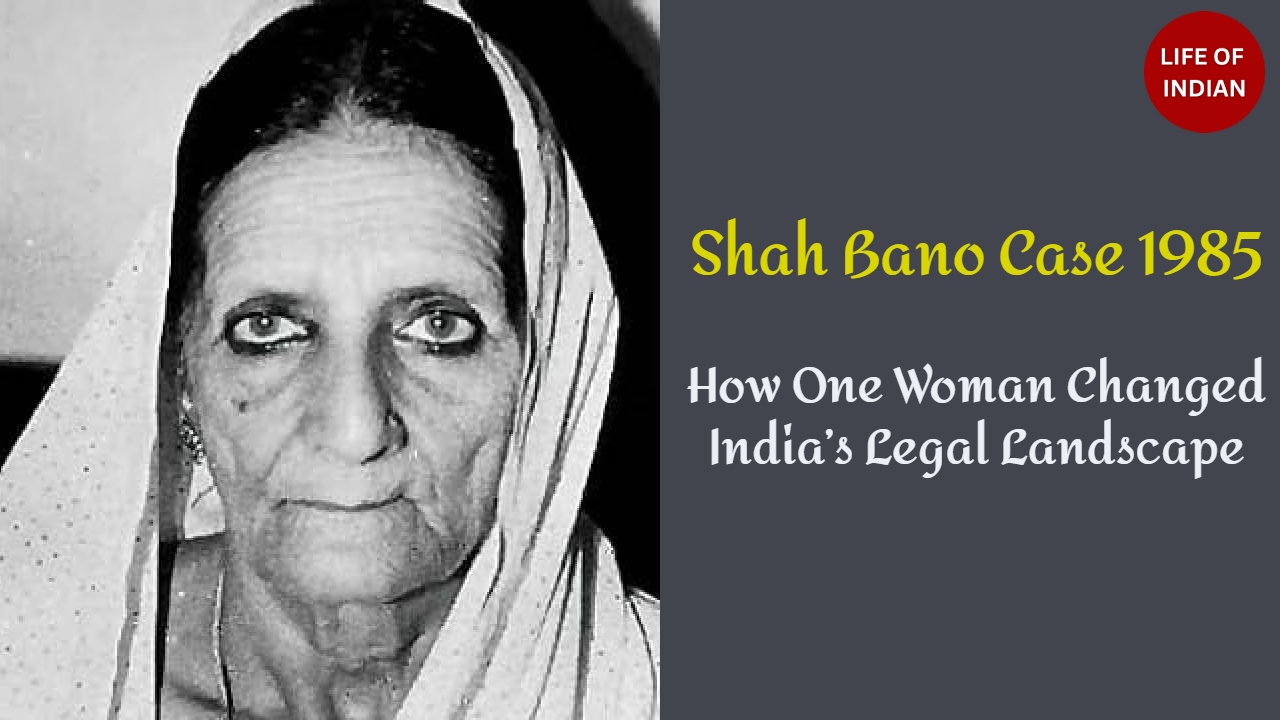
Shah Bano Case 1985: On a rainy day in Indore in 1978, a 62-year-old Muslim woman named Shah Bano Begum did something extraordinary: she challenged her husband, a prominent lawyer, seeking maintenance after divorce. Her case would escalate to the Supreme Court of India in 1985, and become a milestone in the fight for women’s rights, the clash between personal laws and secular law, and the debate over India’s Uniform Civil Code.
The Facts of the Case
Shah Bano was married in 1932 to Mohd. Ahmed Khan and together they had five children. In 1975, she was asked by her husband to move out of the household; in November 1978 he divorced her by “talaq”. With no independent source of income, she filed a petition under Section 125 of the Criminal Procedure Code 1973 (CrPC) demanding maintenance.
Section 125 is a secular provision applicable to all citizens, irrespective of religion, which empowers a magistrate to order maintenance for wives, children or parents unable to maintain themselves. The husband’s defence was that under Muslim personal law his obligation ended after the iddat period (approximately three months) following divorce.
The Supreme Court Judgment
On 23 April 1985, a five-judge bench headed by Chief Justice Y. V. Chandrachud ruled unanimously in Shah Bano’s favour. The Court held that Section 125 CrPC applies “regardless of religion” and that the husband must pay maintenance if he has means and the wife cannot support herself. It emphasized that personal laws cannot override secular law when it comes to the obligation to prevent destitution.
Justice Chandrachud remarked: “What difference would it make as to what is the religion professed by the neglected wife… Neglect by a person of sufficient means… the objective criteria which determine the applicability of section 125.”
The Fallout: Law, Politics & Society
The verdict triggered a politicised backlash. Many conservative Muslim organisations opposed it, saying it interfered with Sharia and personal law. In response, the government of Rajiv Gandhi passed the Muslim Women (Protection of Rights on Divorce) Act, 1986, limiting the husband’s liability largely to the iddat period.
While the Act was upheld by the Supreme Court in the 2001 case of Danial Latifi v. Union of India, the Act was interpreted so as to allow “fair and reasonable provision” for the divorced Muslim woman — moving closer to the original spirit of Shah Bano.
Why the Shah Bano Case Matters
-
Secular Law Supersedes Religion in Key Matters: It established that Section 125 was a tool for social justice irrespective of faith.
-
Gender Equality & Women’s Rights: It spotlighted how divorced women — even from minority communities — could claim legal rights.
-
Debate on Uniform Civil Code (UCC): The judgment lamented that Article 44 of the Constitution (calling for UCC) remained a dead letter. It fueled the discourse on a single civil code for all.
-
Legal Precedent: It paved the way for later court rulings on Muslim women’s rights, including issues like triple talaq and maintenance.
The Lasting Impact on Indian Society
Even decades later, the Shah Bano case remains relevant. In recent years, when the Supreme Court reaffirmed that Muslim women can seek maintenance under Section 125, it cited Shah Bano.
Today, the case is taught in law schools, discussed in gender justice forums and used as a reference point for reforms. Its legacy lies not only in the verdict but in the social change it triggered.
Shah Bano Begum may have walked away without much fanfare after the judgment, but her legal battle reverberated through India’s courts, legislature, and society. Her stand challenged entrenched norms, sparked political and religious debate and helped reshape the contours of justice and equality in India. The Shah Bano case is more than a court ruling — it was a turning point in modern India’s march towards gender justice and secular rights.
About the Author