
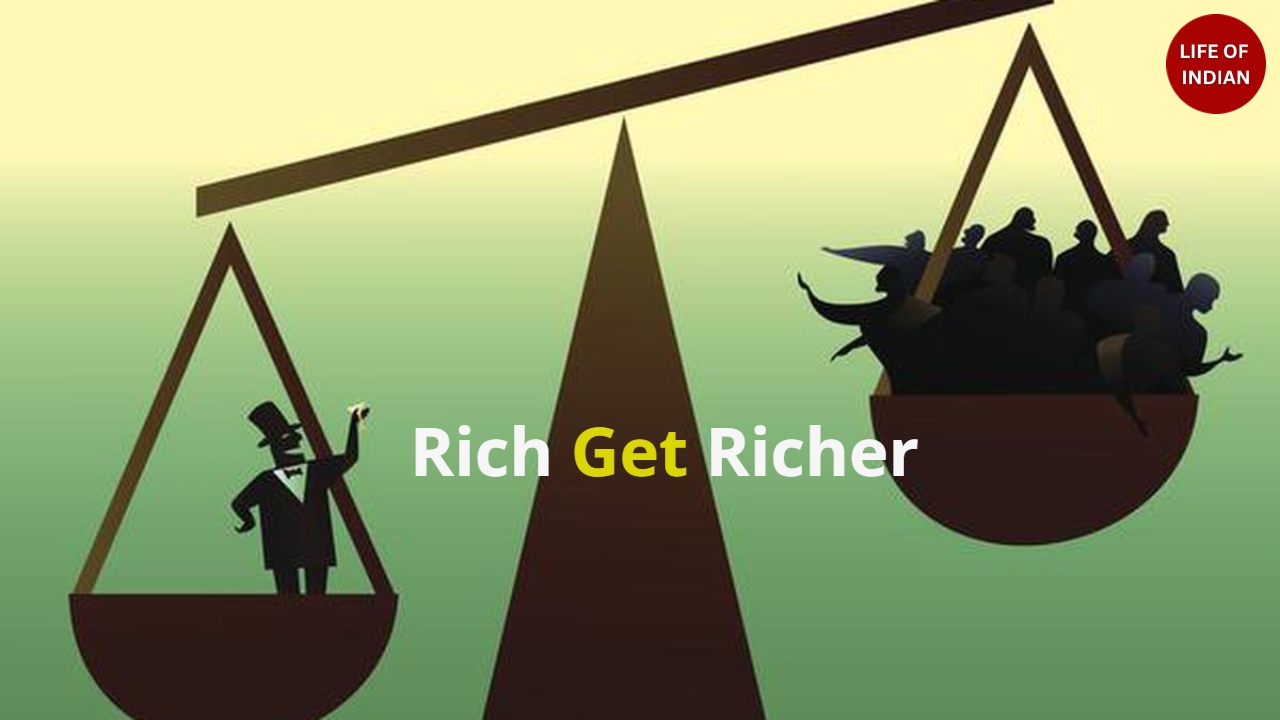
Rich Get Richer: A new report reveals a startling concentration of wealth in India — just 1,687 individuals now control wealth equivalent to nearly half of the country’s total GDP. According to the Hurun India Rich List 2025, these ultra-wealthy Indians, each worth over ₹1,000 crore, collectively own around ₹167 lakh crore, signaling one of the sharpest wealth disparities in the world.
What the Hurun Report Reveals
The Hurun India Rich List 2025 highlights that India now has 1,687 high-net-worth individuals (HNIs) with a combined net worth nearing the nation’s GDP size. The list shows not only a growing number of billionaires but also the widening wealth gap — as new entrants add to an already top-heavy pyramid.
What the Numbers Indicate: Deepening Inequality
Institutions like the World Inequality Lab and Oxfam have consistently warned about India’s growing economic disparity. The top 1% of India’s population reportedly owns over 40% of the country’s wealth, while the bottom 50% control less than 10%. The new Hurun data reinforces this reality — wealth is increasingly being concentrated among the corporate elite and business magnates.
Political Reactions and Economic Debate
Opposition parties, including the Congress, have cited the Hurun findings to criticize the government’s economic policies, arguing that “India’s billionaire boom” is widening the divide between the rich and the poor. Critics say the benefits of economic growth have been disproportionately captured by large corporations, leaving small entrepreneurs and workers behind.
Is “1,687 Owning Half the Wealth” Literally True?
Experts caution that while the claim is symbolic, it highlights a serious trend. Hurun’s valuation method estimates personal and business assets based on shareholdings, property, and other investments. The cumulative wealth of these 1,687 individuals being close to half of India’s GDP doesn’t mean they literally own half the nation — but it’s a strong indicator of how economic power is consolidating at the top.
Impact on Ordinary Indians
When wealth is concentrated in the hands of a few, several ripple effects follow:
-
Stagnant wages and limited purchasing power for the middle and lower classes.
-
Reduced public investment in health, education, and infrastructure.
-
Social unrest and political polarization due to rising inequality.
Economists warn that this kind of imbalance can threaten social harmony and long-term economic stability.
The Billionaire Boom
India’s billionaire count continues to grow at record pace. Hurun’s data shows over 350 billionaires in 2025 — the highest ever — driven by booming stock markets and new-age industries like tech, renewable energy, and pharmaceuticals. Yet, experts argue that such growth must be accompanied by inclusive policies to ensure balanced progress.
What Can Be Done: Policy Recommendations
Economists suggest several measures to reduce inequality:
-
Progressive Wealth Tax: Targeted taxation on ultra-rich individuals and large inheritances.
-
Wider Tax Base & Anti-Evasion Reforms: To generate more funds for welfare programs.
-
Public Investment in Health & Education: To build human capital and long-term equality.
-
Anti-Monopoly Regulations: Preventing excessive corporate concentration.
-
Social Security Expansion: Direct cash transfers and safety nets for the lower-income population.
The Road Ahead
Reports like Hurun and Oxfam don’t just rank billionaires — they expose the widening gap in opportunity and access. Whether India addresses this divide depends on how the government, private sector, and civil society respond. The “1,687 people owning half the wealth” headline may be symbolic — but it reflects a deep truth about modern India: growth without equity can’t be sustainable.