


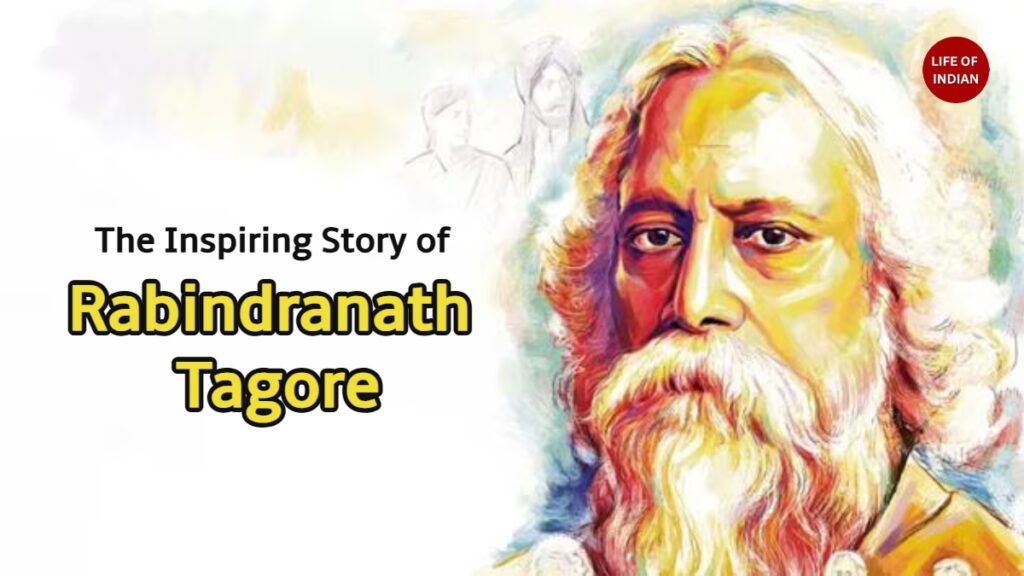
Rabindranath Tagore was not just a poet; he was the voice of India’s soul, a thinker who shaped modern Indian literature and culture and carried the spiritual fragrance of India to the world. In a time when India was struggling under colonial rule and searching for its identity, Tagore emerged as a beacon of creativity, wisdom, and humanism. His words were not merely poetry; they were emotions, philosophy, and a reflection of India’s cultural depth.
Born in the 19th century, Rabindranath Tagore became the first Asian to win the Nobel Prize in Literature, making India proud on the global stage. He was the creator of India’s national anthem, a philosopher who believed in freedom of thought, and an educationist who built one of the most unique universities in the world. Tagore was a writer, poet, philosopher, musician, painter, and visionary who dedicated his life to art, culture, and humanity.
His contribution to Indian literature and culture is unmatched. Through his poems, songs, and stories, Tagore gave India a new intellectual and emotional identity. He believed that literature and education should not only inform people but also awaken their inner consciousness. His vision was not limited to India; he wanted the world to live in harmony, peace, and unity.
Even today, Rabindranath Tagore continues to inspire millions of people across the world. His life is not just a biography; it is a journey of creativity, struggle, and spiritual awakening that represents the essence of Indian civilization. Tagore stands as a timeless symbol of knowledge, culture, and humanity — a man who shaped the soul of modern India and connected it with the wisdom of the world.
Early Life and Family Background
Rabindranath Tagore was born on 7 May 1861 in Kolkata (then Calcutta), Bengal Presidency, British India, into a highly respected and culturally rich family. The Tagore family was known for its intellectual environment, artistic influence, and deep involvement in social and cultural reforms. Growing up in such an environment played a crucial role in shaping Tagore’s personality and vision.
His father, Debendranath Tagore, was a prominent philosopher and religious reformer associated with the Brahmo Samaj movement. He was known for his spiritual thinking and strong belief in Indian traditions and values. Debendranath Tagore encouraged intellectual growth, spirituality, and cultural awareness in his children, which deeply influenced Rabindranath’s thoughts and writings.
Tagore’s mother, Sarada Devi, was a calm and religious woman who maintained the cultural and emotional environment of the household. However, Rabindranath lost his mother at a young age, which left a deep emotional impact on him. This early loss and the loneliness of childhood later reflected in many of his poems and writings, where emotions, nature, and spirituality became central themes.
The Tagore family was not an ordinary family. It was a hub of literature, music, art, and social reform. Many members of the family were poets, writers, musicians, and intellectuals. The environment at home was filled with discussions about literature, philosophy, and social issues. Instead of strict discipline, children were encouraged to think freely and express their creativity.
Rabindranath Tagore was the youngest of thirteen children, and his childhood was quite different from other children of his time. He did not enjoy traditional schooling and preferred learning through observation, nature, and self-study. His family believed in holistic development rather than rigid education, which allowed Tagore to explore literature, music, and art from an early age.
From childhood, Tagore showed a deep interest in poetry and music. He would spend hours observing nature, writing small poems, and expressing his thoughts in creative ways. The peaceful environment of his home and the cultural richness of Bengal deeply influenced his imagination. Nature, spirituality, and human emotions became the foundation of his literary journey.
His father often took him on spiritual journeys across India, including visits to places like the Himalayas. These travels exposed young Tagore to Indian culture, traditions, and natural beauty, which later became a major inspiration in his writings. The beauty of rivers, mountains, villages, and rural life shaped his understanding of India and its soul.
Unlike many children of his time, Tagore was not forced into strict academic discipline. He was given the freedom to explore his interests, which helped him develop a unique perspective on life and education. This freedom became one of the key reasons behind his creative genius and independent thinking.
The early environment of Rabindranath Tagore’s life was a blend of spirituality, creativity, and intellectual freedom. It was this environment that laid the foundation of a man who would later become one of the greatest literary figures in world history.
Education and Childhood Journey
Rabindranath Tagore’s educational journey was quite unconventional and different from the traditional system of his time. Unlike most children who followed a structured school routine, Tagore struggled to adapt to formal schooling. He found classroom education restrictive and uninspiring, which led to his dislike for traditional schools.
He was enrolled in several schools in Kolkata, including St. Xavier’s School, but he never felt comfortable in the rigid environment of formal education. Tagore believed that true learning comes from experience, observation, and creativity rather than memorizing textbooks. This belief later became the foundation of his educational philosophy.
Most of his early education took place at home under private tutors. He studied subjects like literature, history, science, and music in a relaxed and creative environment. Instead of focusing only on academics, he was encouraged to explore art, poetry, and nature. This flexible learning approach helped him develop a deep understanding of culture and human emotions.
One of the most significant influences on Tagore’s education was his father. Debendranath Tagore believed in spiritual and intellectual development rather than rigid academic discipline. He often took Rabindranath on long journeys across India, including visits to the Himalayas and other peaceful places. During these journeys, Tagore learned about Indian philosophy, culture, and nature, which shaped his worldview.
In 1878, Rabindranath Tagore was sent to England to study law, as his family wanted him to become a barrister. He enrolled at University College London and was introduced to Western literature, music, and culture. However, his interest in law was limited, and he soon realized that his true passion was literature and art.
During his stay in England, Tagore read the works of famous English poets and writers like Shakespeare, Shelley, and Wordsworth. Western literature influenced his writing style, but he never lost his connection with Indian culture and traditions. Instead, he tried to blend Indian spirituality with Western literary techniques, creating a unique and powerful style of writing.
Although he did not complete his law degree, his time in England played an important role in shaping his intellectual and cultural understanding. He returned to India with a broader vision and a deeper understanding of both Eastern and Western cultures.
Tagore’s childhood and educational journey were not about academic success but about discovering his creative identity. He believed that education should develop imagination, creativity, and moral values rather than simply preparing students for jobs. This belief later led him to establish Shantiniketan, where education was based on freedom, creativity, and harmony with nature.
His early writing journey began during his teenage years. At the age of just 16, Tagore started writing poems and essays, which were published in literary magazines. His early works showed maturity and depth, surprising many readers and critics. It was clear that a new literary genius was emerging in India.
Rabindranath Tagore’s education and childhood journey laid the foundation of a thinker who would later revolutionize literature, education, and culture in India and across the world.
FAQ
1. Who was Rabindranath Tagore?
Rabindranath Tagore was an Indian poet, writer, philosopher, and educationist who became the first Asian to win the Nobel Prize in Literature in 1913. He is also the creator of India’s national anthem Jana Gana Mana and one of the greatest literary figures in world history.
2. Why is Rabindranath Tagore famous?
Rabindranath Tagore is famous for his poetry, especially Gitanjali, for which he won the Nobel Prize. He is also known for writing India’s national anthem, founding Shantiniketan, and contributing significantly to Indian literature, education, and culture.
3. When and where was Rabindranath Tagore born?
Rabindranath Tagore was born on 7 May 1861 in Kolkata (Calcutta), Bengal Presidency, British India.
4. Which book won Rabindranath Tagore the Nobel Prize?
Rabindranath Tagore won the Nobel Prize in Literature in 1913 for his famous poetry collection Gitanjali, which was translated into English and appreciated worldwide.
5. What is Gitanjali and why is it important?
Gitanjali is a collection of spiritual and philosophical poems written by Rabindranath Tagore. It reflects human emotions, devotion, and the connection between the soul and the divine, making it one of the most important works in world literature.