


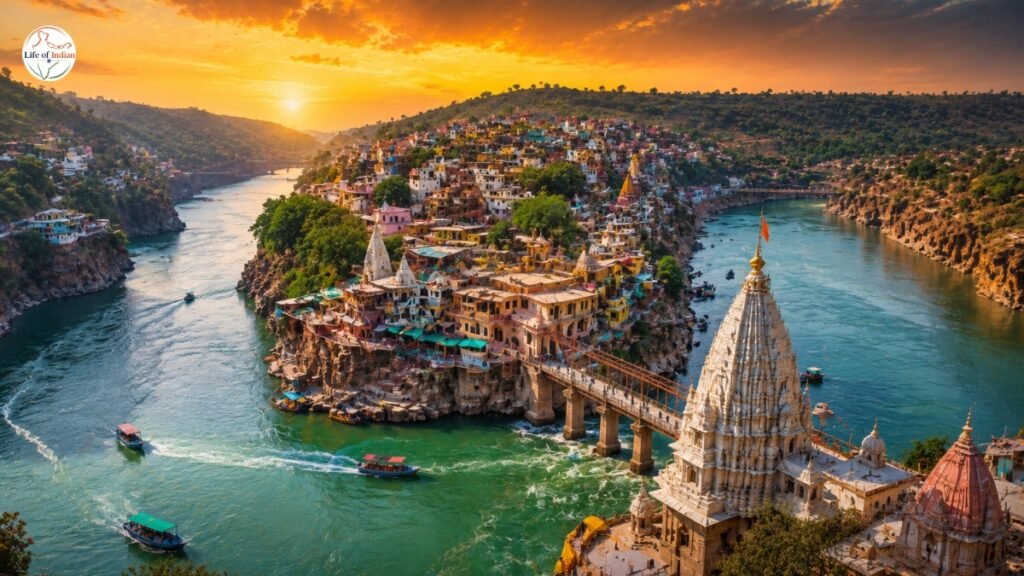
What if you could stand on an island shaped like the sacred symbol “ॐ”, surrounded by the holy waters of the Narmada River, and worship one of the twelve most sacred manifestations of Lord Shiva?
This is Omkareshwar Jyotirlinga—one of India’s most revered Shiva temples and a pilgrimage where mythology, spirituality, nature and history come together.
Located in Khandwa district of Madhya Pradesh, Omkareshwar stands on the sacred Mandhata, also known as Shivpuri, island in the Narmada River. The island is traditionally described as resembling the form of “Om”, the primordial sacred syllable from which the temple derives its name. The Narmada flows around the island, creating a remarkable spiritual landscape that has attracted pilgrims for centuries.
Omkareshwar is traditionally counted as the fourth among the 12 Jyotirlingas of Lord Shiva. The official temple website states that its glory is mentioned in ancient scriptures including the Skanda Purana, Shiva Purana and Vayu Purana.
But there is something even more fascinating about this pilgrimage.
Just across the Narmada stands Mamleshwar, whose ancient name is Amreshwar. Both shrines are deeply connected with the Jyotirlinga tradition of this sacred region, and the Khandwa district administration describes the Omkareshwar and Mamleshwar temples as having equal status, with both Shiva Lingas regarded as Jyotirlingas.
So what is the story behind Omkareshwar?
Why is the island shaped like Om?
What is the connection between Lord Shiva and the Vindhya Mountains?
Who was King Mandhata?
Why do pilgrims visit both Omkareshwar and Mamleshwar?
What makes the Narmada so sacred here?
And how can you plan a complete pilgrimage to Omkareshwar?
Let us explore the complete story of Omkareshwar Jyotirlinga.
Where Is Omkareshwar Jyotirlinga Located?
Omkareshwar is located in Khandwa district of Madhya Pradesh, on the banks of the Narmada River. The main Omkareshwar temple stands on Mandhata Island, also known as Shivpuri. According to the official temple website, the island is approximately 4 km long and 2 km wide, and the Narmada divides around it. Its natural form is traditionally associated with the sacred symbol Om.
The pilgrimage town is situated approximately 77 km from Indore according to the official temple trust, while the Khandwa district administration lists Indore Airport at about 84 km depending on the route. The sacred landscape of Omkareshwar is not limited to one temple. The island, the Narmada ghats, Omkareshwar Temple, Mamleshwar Temple, Omkar Parvat, ancient shrines and caves together form a larger pilgrimage area.
Why Is Omkareshwar Called Omkareshwar?
The name Omkareshwar is associated with the sacred syllable Om or Omkar. In Hindu spiritual traditions, “Om” is regarded as one of the most sacred sounds and is traditionally associated with the ultimate reality and the divine.
The official temple website explains that the town’s name Omkar is derived from Om, which is recited before prayers, while the island of Mandhata is traditionally believed to resemble the visual form of Om.
This creates a fascinating connection between:
Om — the sacred sound
Narmada — the sacred river
Shiva — the divine presence
and
Mandhata — the sacred island.
For devotees, Omkareshwar is therefore not merely a temple located near a river. The entire landscape itself becomes part of the sacred experience.
What Is a Jyotirlinga?
The word Jyotirlinga is formed from two Sanskrit concepts: Jyoti, meaning divine light or radiance, and Linga, the sacred symbol associated with Lord Shiva. According to Hindu tradition, there are 12 principal Jyotirlingas across India. Omkareshwar is traditionally counted as the fourth Jyotirlinga in the commonly recited sequence.
The official Shri Omkareshwar Temple website identifies it as the fourth of the twelve Jyotirlingas and notes that its glory is described in ancient Puranic traditions. The sacred Jyotirlinga tradition is associated with the belief that Shiva manifested himself as an infinite column of divine light. Each Jyotirlinga therefore represents a sacred manifestation of Shiva, while individual temples have their own legends, traditions and cultural identities.
The Main Legend of Omkareshwar: Vindhya’s Penance
One of the most famous legends associated with Omkareshwar involves Vindhya Parvat, the personified Vindhya mountain range. According to the traditional account, Vindhya wanted to please Lord Shiva through intense devotion. Vindhya performed severe penance and worshipped Shiva.
According to the temple’s traditional account, the mountain worshipped Shiva in the form of a physical Lingam, after which Shiva appeared and blessed him by manifesting as the Pranav Lingam—the sacred form associated with Om. Another popular version of the legend says that Vindhya wished to become more powerful and even surpass Mount Meru.
Pleased with the mountain’s devotion, Lord Shiva appeared before Vindhya. The gods and sages then requested Shiva to remain permanently in this sacred place. Shiva agreed. Thus, the sacred manifestation of Shiva became associated with Omkareshwar.
Why Are There Two Important Shiva Temples Here?
This is one of the most interesting aspects of the Omkareshwar pilgrimage. According to the traditional legend, after Shiva manifested here, the divine Lingam was divided into two forms at the request of the gods and sages. One became Omkareshwar. The other became Amreshwar, now popularly known as Mamleshwar. This is why devotees visiting Omkareshwar traditionally also visit Mamleshwar.
The Khandwa district administration describes both temples as having equal status and identifies both Shiva Lingas with the Jyotirlinga tradition. Madhya Pradesh Tourism similarly explains that Omkareshwar and Mamleshwar are believed to represent the same sacred divine manifestation. This makes Omkareshwar unusual among India’s major Shiva pilgrimage centres. The pilgrimage is not simply about one shrine. It is about experiencing the sacred relationship between Omkareshwar and Mamleshwar.
Another Legend: King Mandhata
Omkareshwar is also closely associated with King Mandhata, a ruler belonging to the Ikshvaku tradition. According to another traditional account, King Mandhata performed intense meditation and penance here to please Lord Shiva. Shiva was pleased with his devotion and appeared before him.
Because of this association, the sacred island became known as Mandhata. The official temple website identifies Mandhata as another important tradition explaining the sacred identity of the place. This is why you may see the pilgrimage destination described by several names:
Omkareshwar
Mandhata
Shivpuri
These names reflect different layers of its religious and cultural history.
The Legend of the Devas and Asuras
Another traditional story connects Omkareshwar with the eternal struggle between good and evil. According to this legend, the Devas were defeated by the Asuras and became helpless. The gods prayed to Lord Shiva for protection. Shiva appeared as Omkareshwar Jyotirlinga and helped restore the balance between good and evil.
The story gives Omkareshwar another important spiritual meaning:
Divine power protects righteousness when evil appears overwhelming. Different traditions preserve different versions of Omkareshwar’s origin, which is common with many ancient pilgrimage centres in India.
Omkareshwar and the Sacred Narmada River
It is impossible to understand Omkareshwar without understanding the importance of the Narmada River. Narmada is one of India’s most sacred rivers and is deeply revered in Hindu tradition. At Omkareshwar, the river does more than flow beside the temple. It becomes part of the sacred geography of the entire pilgrimage.
The river divides around Mandhata Island, creating the unique landscape associated with Omkareshwar. The official temple website also describes the meeting of the Narmada and Kaveri channels around the island. Madhya Pradesh Tourism describes Omkareshwar as the only Jyotirlinga located by the banks of the holy Narmada and highlights the sacred importance of the river and island.
The Sacred Omkar Parvat Parikrama
One of the most important spiritual activities at Omkareshwar is the Omkar Parvat Parikrama. Devotees traditionally walk around the sacred island and its pilgrimage landscape while visiting temples and other holy places along the route.
According to the official Omkareshwar Temple website, the parikrama route is approximately 7 kilometres long. Several temples and archaeological sites can be found along the way. For many devotees, the parikrama is not simply a walk.
It is an act of devotion. The journey allows pilgrims to move through the sacred landscape while chanting Shiva’s name and taking in the Narmada, temples and ancient structures surrounding the island.
Narmada Parikrama and Omkareshwar
Omkareshwar also holds an important place in the larger tradition of Narmada Parikrama, a pilgrimage in which devotees undertake a long circumambulation of the Narmada River. Because Omkareshwar is one of the most important Shiva pilgrimage centres on the Narmada, it becomes a major spiritual stop for many pilgrims undertaking this tradition.
The combination of the Narmada, Omkar Parvat and the Jyotirlinga makes Omkareshwar one of the most important sacred destinations in central India.
History of Omkareshwar
The history of Omkareshwar extends beyond mythology. The region around Omkar Mandhata has passed through several political and cultural periods. The Khandwa district’s historical record notes that the wider Nimar region saw the influence of numerous dynasties, including the Mauryas, Satavahanas, Guptas, Chalukyas, Rashtrakutas, Paramaras and Farukis, among others.
The official Omkareshwar Temple website also records that Mandhata was ruled by Bhil rulers, followed by the Paramaras of Dhar, the Sultanate of Malwa, the Scindia family of Gwalior and eventually the British. This long political history is reflected in the many layers of architecture and religious traditions found around Omkareshwar.
Ancient Temples and Archaeological Heritage
Omkareshwar is much more than the main Jyotirlinga temple. The surrounding region contains several ancient temples and archaeological remains.
Among the most important are:
- Siddhanath Temple
- Gauri Somnath Temple
- Rinmukteshwar Temple
- Mamleshwar Temple
- Govindeshwar-related sacred sites
The Khandwa district administration specifically highlights the ruins of the grand Siddhnath Temple, Gauri Somnath Temple, Rinmukteshwar Temple and the cave associated with Govind Ji, the traditional guru of Adi Shankaracharya.
These sites demonstrate that Omkareshwar developed as a larger religious and cultural centre rather than merely as a single temple town.
Omkareshwar and Adi Shankaracharya
Omkareshwar has a particularly important association with Adi Shankaracharya, the philosopher traditionally credited with consolidating the Advaita Vedanta tradition. According to local tradition, Adi Shankaracharya met his guru Govindapada in a cave at Omkareshwar.
The Khandwa district administration identifies the cave of Govind Ji, regarded as the guru of Adiguru Shankaracharya, as one of the important attractions of the region. Madhya Pradesh Tourism also highlights Omkareshwar’s association with Adi Shankaracharya and the spiritual traditions that developed along the Narmada. This connection gives Omkareshwar significance not only in Shaiva pilgrimage but also in India’s philosophical history.
Architecture of Omkareshwar Temple
The main Omkareshwar Temple is a striking example of traditional temple architecture. The official temple website describes the main temple as having a high spire and an older sanctum surrounded by later construction. The temple’s assembly hall is supported by 60 massive pillars, each approximately 14 feet high according to the temple’s description.
The temple is arranged over multiple levels, with different shrines associated with different manifestations of Shiva and other deities. The temple’s architecture reflects the fact that the complex developed over different periods rather than being constructed as a single building at one point in history.
Mamleshwar Temple: The Other Half of the Pilgrimage
Across the Narmada, on the southern bank, stands Mamleshwar Temple. Its ancient name is Amreshwar. The official Omkareshwar Temple website states that devotees visit both Omkareshwar and Mamleshwar for darshan and worship.
The temple walls contain inscriptions and sacred writings associated with 1063 CE, and the shrine has been associated with the worship of Maharani Ahilyabai Holkar. It is also listed as a protected monument under the Archaeological Survey of India. This makes Mamleshwar an essential stop for anyone who wants to understand the complete religious landscape of Omkareshwar.
Why Do Devotees Visit Both Omkareshwar and Mamleshwar?
The answer lies in the traditional origin story. According to the temple’s sacred tradition, the divine manifestation of Shiva became associated with two forms:
Omkareshwar on Mandhata Island
and
Amreshwar/Mamleshwar on the southern bank.
The Khandwa district administration explicitly states that both are considered Jyotirlingas and have equal status in the local sacred tradition. Therefore, many pilgrims consider visiting both temples an important part of their Omkareshwar pilgrimage.
Daily Rituals at Omkareshwar Temple
Omkareshwar follows a structured daily worship schedule.
According to the current official temple timetable:
- Mangal Aarti and Bhog: 4:30 AM–5:00 AM
- Mangal Darshan: 5:00 AM–12:20 PM
- Midday Bhog: 12:20 PM–1:15 PM
- Afternoon Darshan: 1:15 PM–4:00 PM
- Evening Shringar: 4:00 PM–4:30 PM
- Shringar Darshan: 4:30 PM–9:30 PM
- Shayan Aarti: 9:30 PM–10:00 PM
- Shayan Darshan: 10:00 PM–10:30 PM
The temple notes that darshan is closed during certain aarti and shringar periods and that timings can change during festivals and special occasions. Visitors should therefore check the official temple schedule immediately before travelling.
The Unique Shayan Tradition of Omkareshwar
One of the most fascinating traditions of Omkareshwar is the Shayan Darshan. According to the temple’s official website, there is a belief that after travelling through the three worlds during the day, Lord Shiva rests at Omkareshwar. Because of this belief, special sleeping arrangements and rituals are performed in the temple, and devotees can witness the Shayan Darshan.
This tradition gives Omkareshwar a particularly intimate spiritual character. The deity is not only worshipped as an eternal cosmic presence. Devotees also lovingly treat Shiva as the divine Lord who rests at the end of the day.
The Monday Palki of Omkareshwar
Every Monday, a ceremonial procession of Lord Omkareshwar takes place. The official temple website describes a golden palanquin carrying a three-faced representation of Lord Omkareshwar. The procession begins with worship near the river and then moves through different parts of the town.
During Shravan, the procession becomes especially grand, with devotees chanting and participating in the celebration. For visitors, the Monday Palki offers a chance to experience Omkareshwar beyond the temple walls.
Festivals Celebrated at Omkareshwar
Omkareshwar becomes especially vibrant during major Hindu festivals.
Maha Shivaratri
Maha Shivaratri is among the most important festivals for Shiva devotees. The temple and town attract large numbers of pilgrims, and special worship, prayers and celebrations take place.
Shravan
The month of Shravan is especially sacred to Lord Shiva. The Monday Palki of Omkareshwar becomes a major devotional event during this period.
Kartik Mela
The Kartik Mela is another major religious gathering at Omkareshwar. In 2026, Incredible India lists the Kartik Mela and Panchkroshi Yatra from 21–26 November 2026, with the pilgrimage traditionally culminating around Kartik Purnima.
The Panchkroshi Yatra includes the sacred pilgrimage circuit and Omkar Parvat parikrama and is associated with the four traditional aims of life—Dharma, Artha, Kama and Moksha.
Panchmukhi Ganesh Temple
Before entering the main Omkareshwar Temple, devotees can also visit the Panchmukhi Ganesh Temple. The official temple website describes the Panchmukhi Ganesh idol as traditionally believed to be self-manifested.
The five-faced form of Ganesha is one of the distinctive religious features of the temple complex. Devotees traditionally seek the blessings of Ganesha before proceeding with their Shiva pilgrimage.
Omkareshwar Dam
The region also has an important modern engineering landmark—the Omkareshwar Dam. According to the official temple website, the project was conceived in 1965 for electricity generation and irrigation. The concrete dam is approximately 949 metres long and 33 metres high, and began operation in 2007.
The reservoir created by the dam has also contributed to the development of tourism in the wider region, including areas such as Sailani Island and Hanuvantia.
How to Reach Omkareshwar Jyotirlinga
Omkareshwar can be reached by air, train and road.
By Air
The nearest major airport is Devi Ahilyabai Holkar International Airport in Indore. The official Omkareshwar Temple website lists the airport at approximately 77 km from Omkareshwar and notes regular flights connecting Indore with major Indian cities. From Indore, travellers can continue to Omkareshwar by taxi, private vehicle or road transport.
By Train
There are two important railway options.
Sanawad Railway Station
Sanawad is approximately 12 km from Omkareshwar.
The official temple website notes that MEMU train services connect Sanawad with Khandwa.
Khandwa Junction
Khandwa is approximately 72 km from Omkareshwar and is connected with several parts of India by express and superfast trains.
From either station, travellers can continue by taxi or bus.
By Road
Omkareshwar is well connected by road.
The official temple website lists road access from Indore, Khandwa, Burhanpur and Sanawad.
The bus stand at Mortakka is approximately 12 km away and has regular services to Indore, Ujjain, Khargone and Khandwa.
For most travellers coming from major cities, travelling first to Indore and then continuing by road is a convenient option.
Omkareshwar Temple Timings
The current official daily schedule is:
- 4:30 AM–5:00 AM: Mangal Aarti and Bhog
- 5:00 AM–12:20 PM: Mangal Darshan
- 12:20 PM–1:15 PM: Madhyanha Bhog
- 1:15 PM–4:00 PM: Afternoon Darshan
- 4:00 PM–4:30 PM: Evening Shringar
- 4:30 PM–9:30 PM: Shringar Darshan
- 9:30 PM–10:00 PM: Shayan Aarti
- 10:00 PM–10:30 PM: Shayan Darshan
The temple specifically advises that timings may change during festivals and special occasions.
Online Darshan and Booking
The official Shri Omkareshwar Temple Trust website provides online services for devotees, including darshan-related services and ticket availability.
The temple also offers Shighra Darshan, a direct darshan facility for devotees who book a fixed time slot. The current official website lists the Shighra Darshan facility as a two-hour slot with a fee of ₹300 per person.
Because temple rules, fees and availability can change, visitors should verify the latest information through the official temple portal before making travel plans.
How Much Time Do You Need at Omkareshwar?
A quick temple visit can be completed in a few hours, but that does not allow enough time to experience the complete pilgrimage landscape.
Ideally, visitors should keep one full day for Omkareshwar.
This allows time for:
- Omkareshwar Temple Darshan
- Mamleshwar Temple
- Narmada Ghat
- Omkar Parvat Parikrama
- Panchmukhi Ganesh Temple
- Siddhanath Temple
and other nearby sacred sites.
If you also want to explore the surrounding region, staying for two days can provide a more relaxed experience.
Best Time to Visit Omkareshwar
Omkareshwar can be visited throughout the year, but different seasons offer different experiences.
October to March
The cooler months are generally comfortable for temple visits, walking and sightseeing.
This is a good period for travellers who want to explore Omkareshwar and nearby attractions without the intense summer heat.
Shravan
Shravan is particularly special for Shiva devotees.
The Monday Palki and devotional activities make the town spiritually vibrant, but crowds can also be very large.
Maha Shivaratri
Maha Shivaratri is an especially important time for Shiva devotees.
However, pilgrims should expect heavy crowds and make accommodation and travel arrangements well in advance.
Kartik
Kartik is another significant period because of the Kartik Mela and Panchkroshi Yatra.
Places to Visit Near Omkareshwar
A trip to Omkareshwar can be combined with several important spiritual and historical sites.
1. Mamleshwar Temple
Located across the Narmada, this is one of the most important shrines associated with the Omkareshwar pilgrimage.
2. Siddhanath Temple
The ruins of this historic temple showcase detailed medieval stone craftsmanship and are an important part of Omkareshwar’s heritage.
3. Gauri Somnath Temple
Dedicated to Shiva and Parvati, this temple is known for its distinctive architecture and is one of the important shrines around Omkareshwar.
4. Govindapada Cave
Traditionally associated with Govindapada, the guru of Adi Shankaracharya, this cave is an important spiritual attraction.
5. Omkar Parvat
The sacred hill and island landscape around the temple is central to the Omkareshwar parikrama.
6. Omkareshwar Dam
The dam and its surrounding landscape offer a different perspective on the region beyond its temple heritage.
Why Is Omkareshwar So Famous?
Omkareshwar is famous because several unique elements come together in one pilgrimage destination.
- It is one of the 12 Jyotirlingas.
- It is situated on the Narmada River.
- Its sacred island is traditionally associated with the shape of Om.
- It is connected with the legends of Vindhya Parvat and King Mandhata.
- It has a close spiritual relationship with Mamleshwar.
- It is associated with Adi Shankaracharya and Govindapada.
- It has ancient temples and archaeological remains.
- It is an important centre of Narmada pilgrimage.
- It has a traditional 7-km Omkar Parvat parikrama.
- It hosts major festivals such as Maha Shivaratri, Shravan celebrations and Kartik Mela.
10 Interesting Facts About Omkareshwar Jyotirlinga
1. It Is the Fourth Jyotirlinga
Omkareshwar is traditionally counted as the fourth among the twelve Jyotirlingas of Lord Shiva.
2. It Stands on an Island
The temple is located on Mandhata or Shivpuri Island in the Narmada River.
3. The Island Resembles “Om”
The island’s shape is traditionally associated with the sacred symbol Om, giving the pilgrimage its distinctive identity.
4. Mamleshwar Is Part of the Sacred Tradition
The Omkareshwar pilgrimage is closely connected with Mamleshwar or Amreshwar on the opposite bank.
5. The Temple Is Linked With Ancient Scriptures
The official temple website cites the Skanda Purana, Shiva Purana and Vayu Purana in connection with the glory of Omkareshwar.
6. Adi Shankaracharya Is Associated With the Region
Govindapada’s cave, traditionally linked with Adi Shankaracharya’s guru, is one of Omkareshwar’s important spiritual sites.
7. The Parikrama Is About 7 Kilometres
The official temple website describes the Omkar Parvat parikrama route as approximately 7 km.
8. Shayan Darshan Is Special
A tradition at Omkareshwar holds that Shiva rests here after travelling through the three worlds, leading to special Shayan rituals.
9. The Monday Palki Is an Important Tradition
Every Monday, a ceremonial procession of Omkareshwar takes place, becoming especially grand during Shravan.
10. It Is a Major Narmada Pilgrimage Centre
Omkareshwar’s location on the sacred Narmada makes it an important stop for pilgrims connected with Narmada worship and pilgrimage traditions.
What Makes Omkareshwar Different from Other Jyotirlingas?
Every Jyotirlinga has its own identity. Somnath is associated with the western coast and the legends of the Moon. Mahakaleshwar represents Mahakal, the Lord of Time, in Ujjain. Kedarnath stands high in the Himalayas. Rameshwaram connects Shiva worship with the sacred geography of the Ramayana. But Omkareshwar has a particularly distinctive combination:
- A Jyotirlinga on an island.
- An island shaped like Om.
- The sacred Narmada surrounding it.
- A second major Shiva shrine, Mamleshwar, across the river.
- The traditions of Vindhya and Mandhata.
- The spiritual legacy associated with Adi Shankaracharya.
This combination makes Omkareshwar one of the most visually and spiritually distinctive Jyotirlinga pilgrimages in India.
A Suggested One-Day Omkareshwar Pilgrimage
If you have only one day, you can structure your visit around the major sacred sites. Begin your morning with Omkareshwar Temple Darshan. After the main temple, visit Panchmukhi Ganesh and the surrounding shrines. Then cross towards the southern bank and visit Mamleshwar Temple. Spend some time at the Narmada ghats.
If your fitness and time permit, undertake the Omkar Parvat Parikrama, which is approximately 7 km. Later, explore Siddhanath Temple and Gauri Somnath Temple. End the day with the Shayan Darshan at Omkareshwar if the official schedule and crowd conditions allow. This itinerary gives you a glimpse of the religious, historical and cultural sides of Omkareshwar in one day.
The Spiritual Meaning of Omkareshwar
The deepest meaning of Omkareshwar may lie in the word Om itself. Before countless Hindu prayers, the sound “Om” is traditionally uttered. It represents the sacred vibration of existence. And at Omkareshwar, that sacred sound is connected with a landscape shaped by nature itself.
- The Narmada flows around the island.
- The temple rises within the sacred landscape.
- The Jyotirlinga represents Shiva.
- The Omkar Parikrama turns the landscape into a pilgrimage path.
For devotees, this creates an experience where sound, river, mountain, temple and deity become part of one spiritual journey.
Omkareshwar: Where Nature Becomes Sacred
Perhaps one of the most beautiful things about Omkareshwar is that nature and spirituality are impossible to separate.
- The Narmada is not simply scenery.
- The island is not simply geography.
- The mountains are not simply landscape.
- The temples are not isolated monuments.
Together, they form a sacred environment that has been shaped by centuries of faith.
This is why standing on the banks of the Narmada at Omkareshwar can feel very different from visiting an ordinary temple.
The river flows.
The bells ring.
Devotees chant Shiva’s name.
Boats move across the water.
Ancient temples rise among the hills.
And somewhere at the centre of it all is the Jyotirlinga of Omkareshwar.
Omkareshwar Jyotirlinga is much more than one of India’s twelve sacred Shiva temples. It is a story of faith, mythology, philosophy, history and nature woven together around the Narmada River. It is the place where the sacred symbol Om becomes part of the landscape.
- It is where the legends of Vindhya Parvat and King Mandhata continue to live through tradition.
- It is where Omkareshwar and Mamleshwar form two connected centres of Shiva worship.
- It is where the memory of Adi Shankaracharya and Govindapada adds a philosophical dimension to the pilgrimage.
And it is where pilgrims continue to walk the ancient Omkar Parvat Parikrama, bathe at the Narmada ghats and seek the blessings of Lord Shiva. Perhaps the most beautiful lesson of Omkareshwar is that spirituality does not always require us to search for the divine somewhere far away. Sometimes, the river itself becomes sacred.
- The land becomes sacred.
- The sound becomes sacred.
- And a simple symbol—ॐ—becomes a reminder of the eternal.
- For millions of devotees, Omkareshwar is not merely a destination.
- It is a journey towards Shiva.
Om Namah Shivaya.
FAQ
Where is Omkareshwar Jyotirlinga located?
Omkareshwar Jyotirlinga is located in Khandwa district of Madhya Pradesh, on Mandhata or Shivpuri Island in the Narmada River.
Which number Jyotirlinga is Omkareshwar?
Omkareshwar is traditionally counted as the fourth among the 12 Jyotirlingas of Lord Shiva.
Why is Omkareshwar called Omkareshwar?
The name is associated with Om or Omkar, the sacred syllable. The Mandhata Island on which the temple stands is traditionally believed to resemble the shape of Om.
What is the story of Omkareshwar Jyotirlinga?
One major legend says that Vindhya Parvat performed intense penance to Lord Shiva, who appeared and manifested as Omkareshwar. Another tradition connects the site with King Mandhata’s penance.
Why do devotees visit Mamleshwar along with Omkareshwar?
According to the traditional account, Shiva’s divine manifestation became associated with two forms—Omkareshwar and Amreshwar, now known as Mamleshwar. Both are therefore important to the pilgrimage.
What is the Omkar Parvat Parikrama?
It is a traditional circumambulation of the sacred Omkareshwar-Mandhata pilgrimage landscape. The official temple website describes the route as approximately 7 km long.
What are the current Omkareshwar Temple timings?
The current official schedule begins with Mangal Aarti and Bhog at 4:30 AM and continues through Shayan Darshan until 10:30 PM, with breaks for bhog, shringar and aarti. Timings may change on special occasions.
How far is Omkareshwar from Indore?
The official Omkareshwar Temple website lists Indore Airport at approximately 77 km from Omkareshwar.
What is the nearest railway station?
Sanawad Railway Station is approximately 12 km away, while Khandwa Junction is approximately 72 km away.
When is the best time to visit Omkareshwar?
October to March is generally comfortable for sightseeing and walking. Shravan, Maha Shivaratri and Kartik are especially significant religious periods but can attract very large crowds.
Is Omkareshwar connected with Adi Shankaracharya?
Yes. Local tradition associates Omkareshwar with Govindapada, regarded as Adi Shankaracharya’s guru, and the Govindapada cave is an important spiritual attraction in the region.
What is Omkareshwar famous for?
Omkareshwar is famous for its Jyotirlinga, Om-shaped Mandhata Island, Narmada River, Mamleshwar Temple, Omkar Parvat Parikrama, ancient temples, Adi Shankaracharya traditions and major Shiva festivals.