


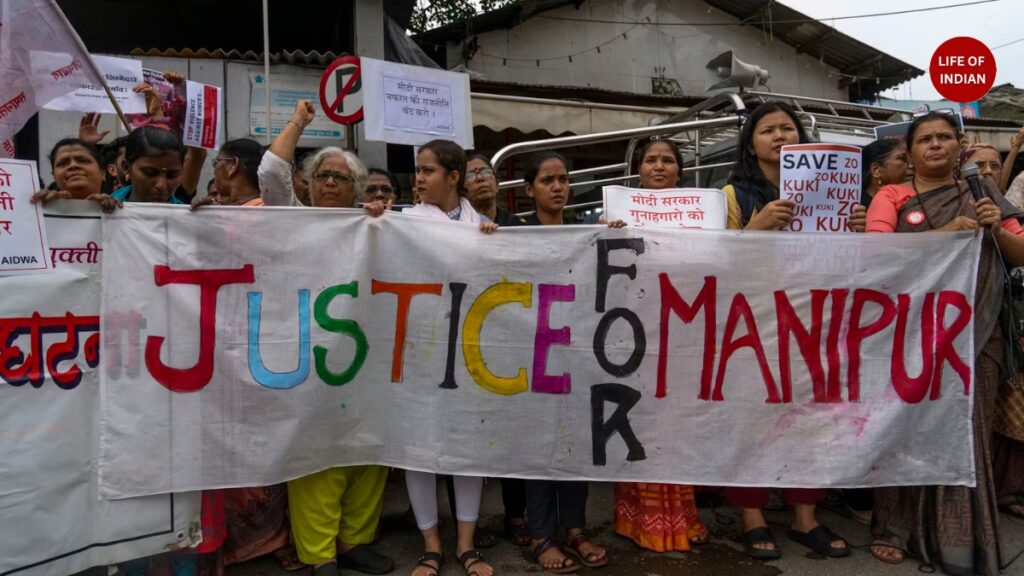
The ongoing violence in Manipur between the Meitei and Kuki communities is one of the most serious internal conflicts India has witnessed in recent years. What began as a protest in 2023 has evolved into a prolonged ethnic confrontation marked by displacement, mistrust, and deep social divisions. To understand the crisis fully, it is important to look beyond headlines and examine its roots, triggers, and long-term implications.
Understanding Manipur’s Social and Geographic Divide
Manipur is geographically and socially divided into two distinct regions. The Imphal Valley is home to the Meitei community, which forms a significant portion of the state’s population and holds political influence. In contrast, the surrounding hill districts are inhabited mainly by tribal groups, including the Kukis and Nagas.
This divide is not just geographical—it is also administrative and cultural. Tribal communities in the hills enjoy constitutional protections over land ownership, which restrict non-tribals, including Meiteis, from purchasing land in these areas. Over time, this separation has created competing claims over land, identity, and political power.
How the Violence Began in 2023
The current phase of violence erupted on 3 May 2023, following a tribal solidarity march organized to protest a court recommendation. The recommendation suggested granting Scheduled Tribe (ST) status to the Meitei community.
For the Meiteis, ST status meant access to affirmative action benefits and land rights in the hill areas. However, for the Kuki and other tribal groups, it raised fears of losing their protected land and cultural identity. What started as a protest quickly escalated into violent clashes between the two communities, spreading across multiple districts.
The Deeper Causes Behind the Conflict
The violence in Manipur cannot be attributed to a single cause. It is the result of several overlapping factors that have built up over decades.
One of the most significant issues is the struggle over land and resources. The valley, where Meiteis reside, is densely populated and limited in area, while the hills cover a larger portion of the state but are legally inaccessible to them. This imbalance has created long-standing resentment.
Another critical factor is the debate over Scheduled Tribe status. Tribal communities fear that granting this status to Meiteis would dilute their existing benefits in education, employment, and governance. For them, it is not just a policy change but a threat to their socio-economic survival.
Historical tensions also play a major role. Ethnic conflicts in Manipur date back decades, with periodic clashes between different communities. The 2023 violence acted as a trigger, reigniting unresolved grievances.
The issue of illegal immigration has further complicated the situation. Sections of the Meitei community allege that migration from neighboring Myanmar has increased the population of Kuki groups, intensifying competition over land and resources. Kuki leaders, however, reject these claims and argue that they are being unfairly targeted.
Additionally, the government’s crackdown on poppy cultivation and alleged drug networks in hill areas has created friction. While authorities claim the action is necessary to curb illegal activities, some Kuki groups see it as discriminatory.
Militarization and Escalation of Violence
One of the most alarming developments in the conflict has been the rapid militarization of civilians. During the early days of the violence, large numbers of weapons were looted from police armories. Armed groups and local militias began to form, leading to an escalation in the scale and intensity of clashes.
What might have remained localized violence quickly turned into a situation resembling a low-intensity civil conflict, with both sides establishing strongholds and restricting movement across regions.
Humanitarian Impact of the Conflict
The consequences of the violence have been devastating. Hundreds of people have lost their lives, and tens of thousands have been displaced from their homes. Entire villages have been burned, and communities that once coexisted are now separated by fear and hostility.
Relief camps have been set up across the state, but living conditions remain difficult for displaced families. The psychological impact, especially on children and women, is profound and long-lasting.
Why the Violence Continues
Despite security deployments and government interventions, the conflict has not fully subsided. One of the main reasons is the complete breakdown of trust between the two communities. Dialogue has become difficult, and each side views the other with suspicion.
The widespread availability of weapons has made it easier for violence to flare up again. At the same time, there is no clear political resolution in sight. Demands such as separate administration for tribal areas have added another layer of complexity.
Without a comprehensive approach that addresses both immediate security concerns and long-term political issues, the chances of lasting peace remain uncertain.
The Larger Reality Behind the Conflict
The Manipur crisis is not just an ethnic clash—it is a multi-layered conflict involving identity, land rights, political representation, and economic opportunities. Each of these elements reinforces the others, making the situation extremely complex.
It highlights how unresolved historical grievances, when combined with policy changes and socio-economic pressures, can lead to prolonged instability.
The ongoing violence in Manipur serves as a stark reminder of the fragile balance between communities in diverse societies. The Meitei–Kuki conflict is not merely about two groups in confrontation; it reflects deeper structural challenges that require careful and inclusive solutions.
For lasting peace, efforts must focus on rebuilding trust, ensuring fair governance, and addressing the root causes that have fueled the conflict for decades. Without such measures, the cycle of violence risks continuing, affecting not just Manipur but the broader social fabric of the country.
FAQ
Q1. What is the Manipur violence about?
The Manipur violence refers to ongoing clashes between the Meitei and Kuki communities over land rights, identity, political power, and government policies.
Q2. When did the current violence in Manipur start?
The present phase of violence began on 3 May 2023, following protests over the demand to grant Scheduled Tribe (ST) status to the Meitei community.
Q3. Why are Meiteis demanding ST status?
Meiteis believe ST status will help protect their culture, provide access to reservations, and allow them to buy land in hill areas.
Q4. Why are Kukis opposing ST status for Meiteis?
Kuki communities fear losing their land rights, reservation benefits, and cultural identity if Meiteis are included in the Scheduled Tribe category.
Q5. Why is the Manipur violence still continuing?
The conflict continues due to deep mistrust between communities, widespread availability of weapons, political tensions, and lack of a long-term solution.