


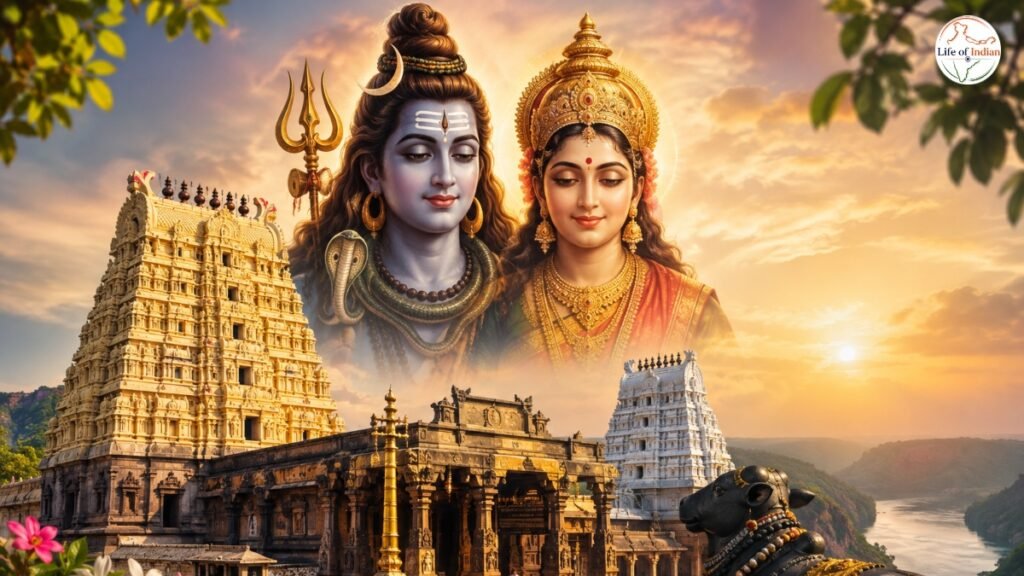
Have you ever wondered if there is a place in India where Lord Shiva and Goddess Shakti are worshipped together as one of the country’s most important pilgrimage centres?
Deep inside the ancient Nallamala Hills of Andhra Pradesh, beside the sacred Krishna River, lies Srisailam—a land where mythology, spirituality, history and nature come together.
Here, Lord Shiva is worshipped as Mallikarjuna Swamy, one of the 12 revered Jyotirlingas, while Goddess Parvati is worshipped as Bhramaramba Devi, associated with the Shakti Peetha tradition. The official Srisaila Devasthanam describes Srisailam as the abode of Sri Bhramarambika Devi and Mallikarjuna Swamy and highlights its exceptional significance as a place where Shiva and Shakti are worshipped within the same temple complex.
But Srisailam is much more than a famous temple.mIt is a place associated with the emotional story of Lord Shiva and his son Kartikeya, centuries of royal patronage, ancient Shaiva traditions, magnificent temple architecture and the enduring belief that a pilgrimage to this sacred mountain can transform the inner life of a devotee.
Surrounded by forests and mountains, Srisailam has been revered for centuries. Ancient inscriptions and literary traditions connect the region with several ruling dynasties and with generations of saints, kings and pilgrims. The Srisaila Devasthanam itself traces inscriptional evidence to the Satavahana period and records the contributions of later dynasties including the Chalukyas, Reddis and Vijayanagara rulers, as well as Chhatrapati Shivaji.
So, what makes Mallikarjuna Jyotirlinga so special?
Why is Srisailam regarded as Kailasa on Earth and Dakshina Kailasam, the Kailash of the South?
And what is the story behind the name Mallikarjuna?
Let us explore the history, mythology, spiritual significance, architecture, festivals and travel details of this extraordinary Jyotirlinga.
Where Is Mallikarjuna Jyotirlinga Located?
Mallikarjuna Jyotirlinga is located in Srisailam, in present-day Nandyal district of Andhra Pradesh.
The temple stands in the Nallamala hill range at an elevation of more than 1,500 feet above sea level and overlooks the Krishna River. The surrounding landscape is characterised by forested hills, winding roads and dramatic natural scenery, making the pilgrimage itself part of the spiritual experience.
Srisailam is approximately:
- 180 km from Kurnool
- 220–230 km from Hyderabad
- Around 91 km from Markapur, the nearest railway connection identified by the Srisaila Devasthanam
The nearest major airport is Rajiv Gandhi International Airport in Hyderabad. The temple is officially known as Sri Bhramaramba Mallikarjuna Swamy Temple.
Why Is Mallikarjuna Called a Jyotirlinga?
The word Jyotirlinga is derived from two Sanskrit words—Jyoti, meaning divine light or radiance, and Linga, referring to the symbolic form of Lord Shiva. According to Hindu tradition, the Jyotirlingas represent sacred manifestations of Shiva’s infinite divine presence. Twelve locations across India are traditionally revered as the principal Jyotirlingas. Mallikarjuna at Srisailam is traditionally counted as the second Jyotirlinga in the commonly recited list.
The famous Jyotirlinga verse includes:
“Saurashtre Somanatham cha
Shrishaile Mallikarjunam…”
The verse places Mallikarjuna at Srisaila among the twelve sacred manifestations of Shiva. The official Srisaila Devasthanam also identifies Mallikarjuna Swamy as the second among the 12 Jyotirlingas.
The Story Behind Mallikarjuna Jyotirlinga
One of the most popular legends connected with Srisailam revolves around Lord Ganesha and Lord Kartikeya, the two sons of Shiva and Parvati. According to the traditional story, a question arose over which of the two brothers should be married first. Lord Shiva and Goddess Parvati proposed a challenge. Whoever could travel around the world and return first would be considered the winner.
Kartikeya immediately mounted his peacock and began his journey around the universe. Ganesha, however, understood that competing physically against his brother would be difficult. Instead, he used wisdom. He walked around Lord Shiva and Goddess Parvati seven times and explained that his parents represented the entire universe for him.
Pleased with his devotion and wisdom, Shiva and Parvati declared Ganesha the winner. Kartikeya eventually returned and discovered what had happened. Feeling hurt, he left his parents and went to Mount Krauncha, according to the traditional account. Shiva and Parvati were deeply concerned about their son. They followed Kartikeya and remained at the sacred region to comfort him.
It is this divine association of Shiva and Parvati with the sacred mountain that forms one of the most cherished traditions surrounding Srisailam. The story is more than a tale of sibling rivalry. It conveys a deeper message: wisdom does not always come from physical strength, and the love of parents can transcend every distance.
Why Is Shiva Called “Mallikarjuna”?
The name Mallikarjuna itself has a fascinating traditional explanation. “Mallika” is associated with jasmine, while “Arjuna” is associated with the Arjuna tree. One traditional explanation connects the name with the sacred association of Shiva and Parvati at Srisailam. Over time, the deity came to be revered as Sri Mallikarjuna Swamy.
The Srisaila tradition also contains several other local legends explaining the name and identity of the deity. What remains constant across these traditions is the central belief that Shiva’s divine presence is permanently associated with Srisailam.
Mallikarjuna and Bhramaramba: Where Shiva and Shakti Meet
Perhaps the most remarkable feature of Srisailam is that the sacred complex is associated with both Jyotirlinga and Shakti worship. Lord Shiva is worshipped as Mallikarjuna Swamy, while Goddess Parvati is worshipped as Bhramaramba Devi.
The official Srisaila Devasthanam describes Srisailam as the place where the Shiva and Shakti traditions come together and states that Mallikarjuna represents Shiva while Bhramaramba represents Shakti. The temple’s official darshan information goes even further, describing Srisailam as a unique sacred complex where the Jyotirlinga form of Shiva and the Shakti form of Parvati are worshipped within the same temple premises.
This combination gives Srisailam an extraordinary spiritual identity. In Hindu philosophy, Shiva is often understood as consciousness, while Shakti represents the dynamic power of creation. Together, they symbolise the complementary forces of existence. That is why a pilgrimage to Srisailam is not simply a journey to worship Shiva. It is also an opportunity to experience the sacred tradition of Shiva-Shakti together.
Bhramaramba Devi and the Shakti Peetha Tradition
The shrine of Goddess Bhramaramba is traditionally associated with the Shakti Peetha tradition. Shakti Peethas are sacred places associated in Hindu mythology with the story of Goddess Sati. According to the traditional narrative, after Sati’s self-immolation at the yajna of her father Daksha, Lord Shiva carried her body and wandered in grief. To restore cosmic balance, Lord Vishnu is said to have used his Sudarshana Chakra to separate the body into different parts, and the places associated with those parts became sacred Shakti Peethas.
Srisailam is traditionally counted among the important Shakti Peetha sites, with Goddess worshipped here as Bhramaramba. The exact body-part association varies across traditional lists and texts, so it is better understood as part of the wider Shakti Peetha tradition rather than treated as a universally agreed historical fact. The official Srisaila Devasthanam identifies Bhramaramba Devi among the 18 Maha Shakti Peethas. This gives Srisailam a rare spiritual distinction: the same sacred landscape is revered in both the Jyotirlinga tradition of Shiva and the Shakti Peetha tradition of Devi.
Why Is Srisailam Called the “Kailash of the South”?
Srisailam is often described as Dakshina Kailasam, meaning the Kailash of the South. The comparison is not based simply on geography. Mount Kailash is traditionally regarded as the supreme abode of Lord Shiva. Srisailam, meanwhile, has been revered for centuries as one of the most important Shiva pilgrimage centres of South India.
The official Srisaila Devasthanam describes the wider Srisaila Mahakshetram as “Kailasa on Earth.” The combination of mountains, forests, the Krishna River and the ancient Shiva-Shakti temples gives the region a landscape that naturally reinforces this spiritual association.
The Ancient History of Mallikarjuna Temple
The history of Srisailam stretches deep into India’s religious and cultural past. It is important to distinguish between mythological antiquity and historically documented evidence. The Srisaila Devasthanam notes that the site is extremely ancient and that inscriptional evidence connects Srisailam with the Satavahana period. It also records references to Srisailam in ancient sources and the contributions of several dynasties over time.
The region received patronage from different ruling houses, including:
Satavahanas
The Satavahanas are among the earliest dynasties associated with documented references to the Srisailam region. The temple’s official history mentions Satakarni as a devotee of Mallikarjuna Swamy and connects the early history of Srisailam with the Satavahana period.
Ikshvakus and Other Dynasties
After the Satavahanas, the region came under the influence of other South Indian dynasties, including the Ikshvakus and later rulers who contributed to the development and preservation of Srisailam as a pilgrimage centre.
Chalukyas
The Chalukyas also played a significant role in the development of the temple complex and Shaiva traditions associated with the region.
Reddi Dynasty
The Reddi rulers contributed to important structures and pilgrimage infrastructure around Srisailam.
Vijayanagara Empire
The Vijayanagara period was particularly significant for the architectural development of Srisailam.
The official temple history records the contributions of Harihara Raya II and Sri Krishnadevaraya, including the construction and development of important halls, mandapas and gopurams.
Chhatrapati Shivaji
The great Maratha ruler Chhatrapati Shivaji was also associated with Srisailam.
According to the temple’s official history, Shivaji, a devotee of Mallikarjuna Swamy and Bhramarambika Devi, ordered the construction of the northern gopuram.
Thus, the temple we see today is not the work of a single ruler or one historical period. It is the result of centuries of religious devotion, architectural development and royal patronage.
Architecture of Mallikarjuna Temple
The Mallikarjuna temple complex is an impressive example of South Indian temple architecture. The complex contains massive walls, ornate gateways, pillared halls and numerous subsidiary shrines. The official temple website describes the main temple as an architectural masterpiece containing large halls, beautiful carvings and numerous sacred images, reflecting contributions from different historical periods.
Among the important features of the temple complex are:
The Gopurams
The temple has monumental gateway towers or gopurams, which form an important part of its Dravidian architectural character.
Different rulers contributed to the construction and development of these gateways over the centuries. The official history particularly records the involvement of Vijayanagara rulers and Chhatrapati Shivaji.
Mukha Mandapam
The temple’s pillared halls contain elaborate stonework and sculptural details.
These spaces were not merely architectural additions. Mandapas traditionally served as important areas for religious ceremonies, gatherings and temple rituals.
Sacred Shrines Within the Complex
The main temple complex contains numerous shrines and sacred installations.
The official temple listing includes:
- Mallikarjuna Swamy
- Bhramaramba Devi
- Pancha Pandava Lingas
- Sahasra Lingam
- Ardhanareeswara Devi
- Raja Rajeshwari Devi
- Veerabhadra Swamy
- Kumara Swamy
- Uma Maheswara Swamy
- Vrudha Mallikarjuna Swamy
The temple precincts also include several sacred trees, water bodies and traditional holy spots.
The Sacred Sahasra Lingam and Pandava Lingas
The Mallikarjuna temple complex contains several smaller but highly revered Shiva shrines. Among them are the Sahasra Lingam and the Pancha Pandava Lingas. The temple’s official listing specifically identifies the Rama Prathistitha Sahasra Lingam and Pancha/Pandava Lingalu among its sacred installations.
These shrines add another layer to Srisailam’s rich mythological landscape, where traditions connect the sacred mountain with figures from different ages of Hindu sacred history.
The Mystery and Legend of Bhramaramba Devi
The name Bhramaramba is associated with Bhramara, meaning a bee. One traditional legend says that Goddess Parvati took the form of a divine bee to defeat demonic forces. This story gives Bhramaramba Devi her distinctive identity.
A popular local belief also speaks of a mysterious buzzing sound associated with the shrine. Devotees have traditionally connected this sound with the goddess’s bee form. Such stories are part of the rich oral and devotional traditions surrounding Srisailam and are best understood within the temple’s sacred folklore rather than as scientifically established phenomena.
Spiritual Significance of Mallikarjuna Jyotirlinga
For devotees, Mallikarjuna is much more than an architectural monument. It is a place of darshan, prayer, meditation and spiritual renewal. The official temple describes darshan as a spiritually significant encounter with the deity and offers both darshan and various forms of seva for pilgrims.
Devotees visit Srisailam for many reasons. Some come seeking peace during difficult periods of life. Some pray for family well-being and prosperity. Others undertake the pilgrimage as an expression of devotion or as part of a religious vow.
For Shaiva devotees, touching or seeing the sacred Jyotirlinga is itself regarded as an extraordinary blessing. The spiritual importance of Srisailam therefore cannot be reduced to one particular “benefit.” Its significance lies in the centuries-old belief that devotion, darshan and pilgrimage bring a person closer to Shiva and Shakti.
What Is the Significance of Srisaila Shikharam?
One of the most important sacred traditions of Srisailam is associated with Sikharam, the highest point of the Srisaila hills. A traditional belief holds that simply seeing the sacred summit of Srisailam has immense spiritual merit.
This is one reason pilgrims have historically considered the journey to Srisailam itself a sacred undertaking. The region’s elevated landscape, forest roads and mountain scenery make the approach to the temple feel like a gradual transition from the ordinary world into a sacred space.
Important Rituals at Mallikarjuna Temple
Devotees can participate in various forms of worship and seva at Srisailam.
Some important forms of devotion include:
Abhishekam
Abhishekam is the ritual bathing of the Shiva Lingam with sacred substances according to prescribed temple traditions.
Milk, water and other ritual offerings may be used depending on the particular seva.
The temple administration offers different Pratyaksha Sevas, allowing devotees to participate in prescribed forms of worship.
Bilva Patra Offering
Bilva leaves hold a special place in Shiva worship.
Devotees traditionally offer bilva leaves to Lord Shiva while reciting prayers and mantras.
“Om Namah Shivaya”
The Panchakshara mantra—
Om Namah Shivaya
—is among the most widely revered mantras associated with Shiva.
Devotees may chant it during darshan, meditation or personal worship.
Rudrabhishek
Rudra worship and abhishekam are important Shaiva practices. Specific rituals and available sevas can vary according to temple rules and schedules, so pilgrims should check the current official temple information before planning a particular seva.
Major Festivals Celebrated at Srisailam
Srisailam becomes especially vibrant during major Hindu festivals.
Maha Shivaratri
Maha Shivaratri is among the most important festivals at Mallikarjuna Temple.
The temple hosts the Maha Shivaratri Brahmotsavam, attracting large numbers of devotees.
In 2026, the festival was observed as a multi-day celebration featuring special pujas, flag-hoisting, processions and other religious ceremonies.
Ugadi
Ugadi, the Telugu New Year, is another major occasion at Srisailam.
The temple celebrates the festival with special religious programmes and rituals.
Navratri and Dasara
Because Goddess Bhramaramba is worshipped alongside Mallikarjuna, Navratri and Dasara have special importance at Srisailam.
The temple becomes an important centre of Devi worship during this period.
Karthika Masam
The Hindu month of Kartika is also considered highly sacred for Shiva devotees.
Special worship, lamps and religious observances add to the spiritual atmosphere of Srisailam during this period.
How to Reach Mallikarjuna Jyotirlinga
Srisailam is well connected by road, although the final journey passes through the scenic Nallamala forest and ghat roads.
By Air
The nearest major airport is Rajiv Gandhi International Airport, Hyderabad.
The Srisaila Devasthanam places Hyderabad at approximately 230 km from Srisailam. Regular road transport connects Hyderabad with Srisailam.
By Train
There is no railway station directly at Srisailam.
According to the official temple website, Markapur is the nearest railway connection, located approximately 91 km away, from where visitors can continue by road.
Other railway options may be useful depending on the traveler’s origin.
By Road
Road travel is one of the most common ways of reaching Srisailam.
The temple administration lists approximate distances of:
Hyderabad – 220 km
Kurnool – 180 km
Bangalore – 530 km
Vijayawada – 272 km
The final approach includes winding ghat roads through the Nallamala landscape, so travellers should drive carefully.
Important Travel Information for Pilgrims
Because Srisailam lies within the Nallamala forest region, visitors should be aware that forest gates have restricted timings.
The Srisaila Devasthanam states that gates at Dornala and Sikharam on the Andhra Pradesh side and Mannanur and Domalapenta on the Telangana side are closed from 9:00 PM to 6:00 AM for safety reasons. Pilgrims are therefore advised to plan their journey accordingly.
This is particularly important for people travelling by private vehicle.
Mallikarjuna Temple Darshan Timings
Temple timings can change during festivals and special occasions, so visitors should always verify the latest schedule before travelling.
The current official tourism information lists general temple timings as:
6:00 AM to 3:30 PM
and
6:00 PM to 10:00 PM.
The official Srisaila Devasthanam’s darshan page states that darshan starts from 6:00 AM onwards and also provides online and offline options for certain darshan and seva tickets.
During major festivals, timings may be extended or modified because of the large number of pilgrims.
Dress Code and Temple Etiquette
Devotees visiting the temple should respect the temple’s dress and conduct requirements. The official Srisaila Devasthanam states that devotees offering seva are required to wear traditional Hindu attire and specifically notes restrictions on modern and sleeveless clothing.
Visitors should also:
- Maintain cleanliness inside the temple.
- Follow instructions from temple authorities.
- Avoid photography wherever prohibited.
- Keep phones and belongings according to temple rules.
- Respect queues and fellow devotees.
- Check official rules before booking special sevas.
Places to Visit Around Mallikarjuna Temple
A trip to Srisailam can easily become a broader pilgrimage and nature journey.
Pathala Ganga
Pathala Ganga is associated with the Krishna River and is one of the most important sacred spots near Srisailam.
Many pilgrims visit the area as part of their traditional pilgrimage.
Sikhareswaram
Sikhareswaram is another important spiritual destination associated with the highest point of the Srisaila hills.
Sakshi Ganapati
The Sakshi Ganapati temple is another popular pilgrimage stop in the Srisailam region.
Akka Mahadevi Caves
The Akka Mahadevi Caves are a striking natural attraction accessible through the Krishna River region.
Incredible India lists the caves among the important attractions around Srisailam and notes that reaching them involves a boat journey.
Srisailam Dam
The Srisailam Dam offers spectacular views of the Krishna River and surrounding hills.
It provides an opportunity to experience the natural side of the region alongside its religious heritage.
Srisailam Tiger Reserve
The surrounding forest landscape is part of one of India’s important wildlife regions and provides habitat for a wide range of wildlife.
Thus, Srisailam offers a rare combination of pilgrimage, history, architecture, rivers, forests and wildlife.
Best Time to Visit Mallikarjuna Jyotirlinga
Srisailam can be visited throughout the year, but the experience varies with the season.
October to February
The cooler months are generally more comfortable for sightseeing and travelling through the hills.
This period is particularly suitable for people who want to explore both the temple and surrounding attractions.
March to May
Summer can be hot, especially during the daytime.
Visitors travelling during this period should plan temple visits and outdoor activities carefully and remain hydrated.
June to September
The monsoon transforms the Nallamala landscape into a lush green region.
However, rain can affect road travel and outdoor plans, so visitors should check weather and road conditions.
Maha Shivaratri
For devotees seeking the most intense religious atmosphere, Maha Shivaratri is one of the most significant occasions to visit.
However, this is also one of the busiest periods, so accommodation, transportation and darshan planning should be done well in advance.
What Makes Mallikarjuna Jyotirlinga Different From Other Jyotirlingas?
Every Jyotirlinga has its own spiritual identity. But Srisailam stands apart because of the close association of Shiva and Shakti within the same sacred complex.
Here, devotees can seek the darshan of:
Lord Mallikarjuna — Shiva
and
Goddess Bhramaramba — Shakti
The official temple itself highlights this distinctive combination and describes the opportunity to receive darshan of both deities within the same pilgrimage experience.
This makes Srisailam particularly meaningful for devotees who worship both Shiva and Devi traditions.
10 Fascinating Facts About Mallikarjuna Jyotirlinga
1. It is one of the 12 Jyotirlingas
Mallikarjuna at Srisailam is traditionally recognised as the second Jyotirlinga in the commonly recited list.
2. Shiva and Shakti are worshipped together
The temple complex is dedicated to Mallikarjuna Swamy and Bhramaramba Devi.
3. It is associated with the Shakti Peetha tradition
Bhramaramba Devi is traditionally counted among the important Shakti Peetha shrines.
4. Srisailam has very ancient roots
The temple’s official history records inscriptional evidence connected with the Satavahana period.
5. Several dynasties contributed to the temple
Satavahanas, Chalukyas, Reddis and Vijayanagara rulers are among the dynasties associated with Srisailam’s historical development.
6. Chhatrapati Shivaji is associated with the temple
The temple’s official history credits Shivaji with ordering the construction of the northern gopuram.
7. It is surrounded by the Nallamala Hills
The temple’s location gives the pilgrimage a spectacular natural setting.
8. The Krishna River flows through the sacred landscape
The river is closely connected with several pilgrimage sites around Srisailam.
9. The temple complex contains numerous shrines
Apart from Mallikarjuna and Bhramaramba, the complex contains several Shiva, Shakti and other sacred installations.
10. Srisailam is regarded as “Kailasa on Earth”
The official Srisaila Devasthanam itself uses this sacred description for Srisaila Mahakshetram.
Mallikarjuna Jyotirlinga: A Journey Beyond a Temple Visit
A pilgrimage to Mallikarjuna Jyotirlinga is not simply about reaching a destination. It is about travelling through the Nallamala Hills, approaching an ancient sacred landscape, hearing the bells of the temple, standing before the Jyotirlinga and remembering stories that have been passed from one generation to another.
The story of Kartikeya reminds us that even divine families experience moments of hurt and separation—and that a parent’s love knows no distance. The presence of Mallikarjuna and Bhramaramba reminds devotees of the eternal relationship between Shiva and Shakti, consciousness and energy, stillness and creation.
The ancient temple walls remind us that India’s sacred heritage was built over centuries, with generations of rulers, craftsmen, saints and ordinary devotees contributing to its survival.
And the mountains surrounding Srisailam remind us of something even simpler:
Sometimes, spirituality begins with stepping away from the noise of everyday life.
Perhaps that is why Srisailam continues to attract pilgrims after centuries.
The temple may be ancient, but the questions people bring with them remain timeless—questions about faith, family, suffering, hope, devotion and the search for inner peace.
Whether you visit Srisailam as a devoted pilgrim, a lover of history, an admirer of architecture or simply a traveller searching for a deeper connection with India’s spiritual heritage, Mallikarjuna Jyotirlinga offers an experience that goes far beyond ordinary tourism.
In the heart of the Nallamala Hills, where the Krishna River flows through the ancient landscape, Lord Mallikarjuna and Goddess Bhramaramba continue to stand as symbols of an enduring spiritual tradition.
Har Har Mahadev!
FAQ
Is Mallikarjuna a Jyotirlinga?
Yes. Mallikarjuna Swamy at Srisailam is one of the 12 traditionally recognised Jyotirlingas of Lord Shiva and is commonly listed as the second Jyotirlinga.
Where is Mallikarjuna Jyotirlinga located?
Mallikarjuna Jyotirlinga is located at Srisailam in present-day Nandyal district of Andhra Pradesh, in the Nallamala Hills near the Krishna River.
Is Mallikarjuna also a Shakti Peetha?
Srisailam is traditionally associated with the Shakti Peetha tradition, with Goddess Bhramaramba worshipped here. The official Srisaila Devasthanam identifies Bhramaramba among the 18 Maha Shakti Peethas.
Who is Goddess Bhramaramba?
Bhramaramba is the form of Goddess Shakti worshipped at Srisailam alongside Lord Mallikarjuna. The name is associated with the Sanskrit word Bhramara, meaning bee, and several traditional legends are connected with her form.
What is Mallikarjuna famous for?
Mallikarjuna is famous for being one of the 12 Jyotirlingas, its association with Bhramaramba Devi and the Shakti Peetha tradition, its ancient history, magnificent temple architecture and its location in the Nallamala Hills.
What are the current temple timings?
The current general timings listed by Incredible India are 6:00 AM–3:30 PM and 6:00 PM–10:00 PM. Timings may change during festivals and special occasions, so visitors should verify the latest schedule with the temple administration before travelling.
How far is Srisailam from Hyderabad?
Srisailam is approximately 220–230 km from Hyderabad, depending on the route. The official Srisaila Devasthanam lists Hyderabad at about 230 km.
Which is the nearest airport to Srisailam?
The nearest major airport is Rajiv Gandhi International Airport in Hyderabad.
Which is the nearest railway station?
The Srisaila Devasthanam identifies Markapur as the nearest railway connection, approximately 91 km from Srisailam.
India’s Jyotirlingas are not merely a collection of temples. Each one carries a distinct story, landscape and spiritual tradition. And among them, Mallikarjuna Jyotirlinga holds a particularly special place because Srisailam brings together the traditions of Shiva and Shakti in one sacred landscape. From the ancient Nallamala Hills to the flowing Krishna River, from the story of Kartikeya to the shrine of Bhramaramba, from centuries-old inscriptions to the prayers of today’s pilgrims, Srisailam represents a living connection between India’s past and present. For centuries, devotees have climbed these sacred hills carrying nothing more than faith.
And perhaps that is the real essence of Mallikarjuna Jyotirlinga:
You may arrive at Srisailam looking for Lord Shiva, but somewhere along the journey, you may discover a quieter version of yourself.
Har Har Mahadev. 🙏