


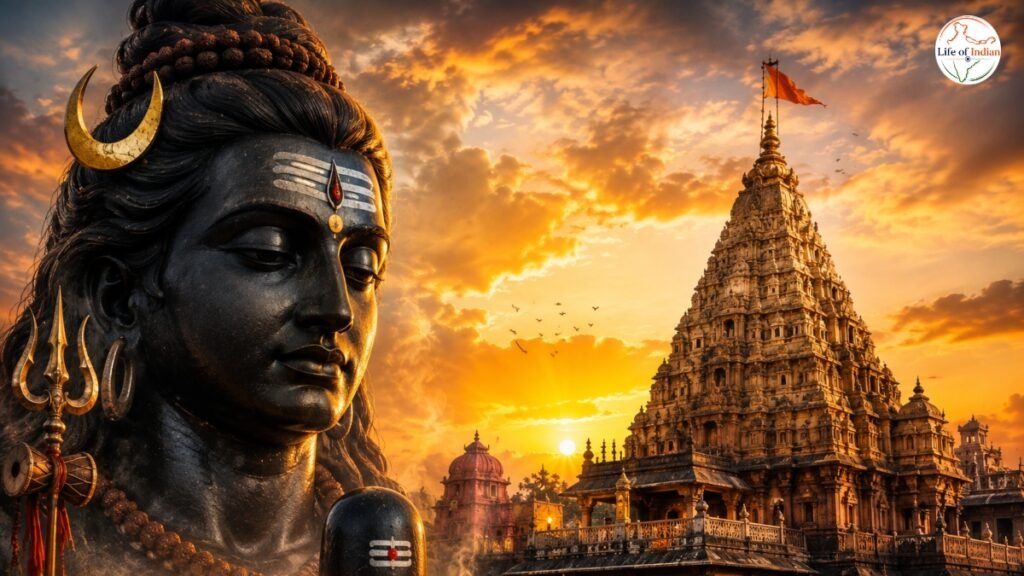
There are temples where people go to pray. And then there are places where time itself seems to stand still. In the ancient city of Ujjain, on the banks of the sacred Shipra River, stands one of the most powerful Shiva temples in India—Mahakaleshwar Jyotirlinga.
Here, Lord Shiva is worshipped as Mahakal—the Lord of Time and Death.
Unlike any other Jyotirlinga, the sacred Shiva Lingam at Mahakaleshwar is traditionally described as Dakshinamukhi, meaning it faces south. It is also believed to be Swayambhu, or self-manifested. These distinctive features have made Mahakaleshwar one of the most revered Shiva shrines in India.
But the importance of Mahakaleshwar goes far beyond the temple itself. Ujjain has been an important centre of religion, astronomy, literature and learning for centuries. Ancient texts praise Mahakala, poets such as Kalidasa celebrated Ujjain, and generations of kings and devotees contributed to the city’s sacred landscape.
The temple is also famous for the extraordinary Bhasma Aarti, performed in the early hours of the morning, and the grand Mahakal Sawari, when the deity is taken through the streets of Ujjain during the sacred month of Shravan.
So, what exactly is a Jyotirlinga?
Why is Mahakaleshwar called Mahakal?
What is the story behind the demon Dushana?
Why does this Jyotirlinga face south?
What happened to the temple during the medieval period?
And why do millions of devotees travel to Ujjain every year?
Let us explore the complete story of Mahakaleshwar Jyotirlinga.
Where Is Mahakaleshwar Jyotirlinga Located?
Mahakaleshwar Jyotirlinga is located in Ujjain, Madhya Pradesh, one of India’s most ancient sacred cities. The temple stands close to the Shipra River and is approximately 2 km from Ujjain Railway Station.
Ujjain itself has a unique place in India’s religious and cultural history. It has traditionally been associated with Shaivism, Shaktism, Vaishnavism, Jainism and Buddhism and has remained an important pilgrimage and cultural centre for centuries. The city is also famous for the Simhastha Kumbh Mela, which takes place in Ujjain once every 12 years.
What Is a Jyotirlinga?
The word Jyotirlinga comes from the Sanskrit words Jyoti, meaning light or radiance, and Linga, representing Lord Shiva. According to Hindu tradition, the Jyotirlingas are sacred manifestations of Shiva’s infinite divine presence. There are traditionally 12 principal Jyotirlingas spread across India. Mahakaleshwar of Ujjain is one of these twelve.
The traditional Jyotirlinga verse includes:
“Ujjainyam Mahakalam…”
which identifies Mahakala at Ujjain among the sacred Jyotirlinga sites. The Ujjain district administration and Madhya Pradesh Tourism both identify Mahakaleshwar as one of India’s 12 celebrated Jyotirlingas.
Why Is Lord Shiva Called Mahakaleshwar?
The name Mahakaleshwar carries a profound meaning. “Mahakala” can be understood as the Great Time or the one beyond time. In Hindu philosophy, Kala represents time, but it can also be associated with death and the inevitable transformation of life.
Everything that is born eventually changes.
Everything that exists eventually passes away.
But Mahakala represents the divine reality that transcends this cycle. This is why devotees associate Mahakaleshwar with Shiva as the Lord of Time. Ujjain’s own historical and religious tradition is deeply connected with this concept. The district administration describes Mahakala as the presiding deity of Ujjain and notes the city’s historic importance as a centre for the calculation of Indian time.
The Most Unique Feature: The South-Facing Jyotirlinga
One of the most fascinating things about Mahakaleshwar is the orientation of the Shiva Lingam. The Mahakaleshwar Lingam is traditionally described as Dakshinamukhi, meaning south-facing. According to the official Ujjain district website, this is considered a unique feature among the 12 Jyotirlingas and is associated with tantric traditions.
Why is the south significant?
In traditional Hindu symbolism, the south is associated with Yama, the deity connected with death. Mahakaleshwar facing south therefore carries a powerful symbolic meaning: Shiva is understood as the one who stands beyond and above death. This is one reason Mahakal worship is traditionally associated with overcoming fear of death and seeking divine protection. Incredible India similarly highlights the south-facing orientation as one of the temple’s distinctive spiritual features.
Is Mahakaleshwar Swayambhu?
Yes, The Mahakaleshwar Lingam is traditionally believed to be Swayambhu, meaning self-manifested. According to the religious tradition, it was not created and installed by human beings in the ordinary manner. The Ujjain district administration states that the Mahakal Lingam is believed to be Swayambhu and is understood as deriving its spiritual power from within itself. This belief is one of the central reasons devotees consider Mahakaleshwar especially sacred.
The Legend of Mahakaleshwar Jyotirlinga
The most famous story associated with Mahakaleshwar tells of a devoted child, a powerful king and a terrifying demon. According to the traditional legend, King Chandrasena ruled Ujjain and was a devoted worshipper of Lord Shiva. One day, while the king was absorbed in Shiva worship, a young boy named Shrikhar saw him praying. The child was fascinated by the king’s devotion and wanted to join him in worship.
However, he was sent away. Shrikhar went to the outskirts of the city and began praying to Lord Shiva with complete devotion. Meanwhile, enemies of Ujjain—Ripudamana and Singhaditya—were preparing to attack the city with the help of a powerful demon named Dushana.
The danger to Ujjain grew. Shrikhar continued praying to Shiva for the protection of the city. A learned priest named Vriddhi also joined the prayers. Then the attack began. Dushana and the invading forces moved towards Ujjain and threatened to destroy the city. The devotees desperately called upon Lord Shiva. And according to the sacred legend, Shiva appeared in a magnificent and terrifying form as Mahakala.
The demon Dushana was defeated, and Ujjain was saved. The devotees then requested Shiva to remain in Ujjain permanently. Moved by their devotion, Lord Shiva agreed. He manifested himself as Mahakaleshwar, becoming the eternal guardian and presiding deity of Ujjain. This is the central legend that explains why Mahakal is worshipped in Ujjain as a powerful protector. Madhya Pradesh Tourism and Incredible India both preserve this traditional account of King Chandrasena, Shrikhar, Vriddhi and the demon Dushana.
What Does the Story of Mahakal Teach Us?
The legend is not simply a story about a demon and a divine battle. At its heart is the power of devotion. Shrikhar was only a child. He had neither political power nor physical strength. But his faith was unwavering. When Ujjain faced danger, his prayer became an expression of complete surrender to Shiva.
The story therefore carries a timeless message:
True devotion does not depend on age, status or power.
Mahakaleshwar and the Concept of Time
Ujjain’s connection with time is much older and broader than the Mahakaleshwar temple itself. For centuries, Ujjain was an important reference point in Indian astronomical traditions. The city’s religious identity became deeply connected with Kala—Time.
This relationship between Ujjain and time gives the name Mahakala an especially powerful meaning. The Ujjain district administration notes that Ujjain historically served as a central point for the calculation of Indian time, while Mahakala was regarded as the city’s distinctive presiding deity. In other words, Ujjain was associated with measuring time, while Mahakal represented the divine power beyond time.
History of Mahakaleshwar Temple
The history of Mahakaleshwar needs to be understood on two levels. There is the sacred history, preserved through Puranic traditions and legends. And there is the documented architectural history, which reflects centuries of reconstruction and royal patronage. The present temple is not a structure that has remained physically unchanged since ancient times. Instead, it has been built, damaged, restored and renewed across different historical periods.
Mahakaleshwar in Ancient Traditions
The glory of Mahakaleshwar is described in various Puranic traditions. The Ujjain district administration notes that the temple’s glory has been vividly described in the Puranas and that Sanskrit poets, beginning with Kalidasa, celebrated Mahakaleshwar in their writings.
The Avanti Khanda of the Skanda Purana is particularly important in the religious history of Ujjain and contains descriptions associated with the city’s sacred geography.
Mahakaleshwar and the Paramara Period
The temple also has important connections with the Paramara period. Incredible India notes that the present complex contains architectural remnants reflecting the grandeur of the earlier temple associated with the Paramaras.
The temple underwent significant reconstruction in the medieval period, including during the reigns of King Udayaditya and King Naravarman in the 12th century. This period is important in understanding why the Mahakaleshwar temple cannot be attributed to a single historical ruler or century. Its architectural identity evolved over time.
The Destruction of the Medieval Temple
One of the most difficult chapters in the temple’s history came in the 13th century. In 1235 CE, Sultan Iltutmish of the Delhi Sultanate invaded Ujjain and destroyed the existing Mahakaleshwar temple structure. The official Mahakaleshwar temple history records this event and notes that the site nevertheless remained an important spiritual centre for devotees in the centuries that followed.
The physical destruction of the temple did not erase its religious importance. The tradition of Mahakal worship continued.
The Maratha Reconstruction
The present form of the Mahakaleshwar temple largely emerged during the 18th-century Maratha revival. After the Marathas established their influence in Malwa, Ranoji Rao Shinde entrusted the administration of Ujjain to his Diwan, Ramchandra Baba Shenvi.
The temple was reconstructed during the fourth decade of the 18th century. Incredible India also records major renovations under Ranoji Shinde and identifies the temple’s architecture as a combination of Bhumija, Chalukya and Maratha influences. Thus, the Mahakaleshwar temple that pilgrims see today carries the architectural legacy of several historical periods.
Architecture of Mahakaleshwar Temple
The present Mahakaleshwar temple is a remarkable combination of different architectural influences.
The temple complex reflects elements of:
- Bhumija architecture
- Chalukyan traditions
- Maratha architectural style
Incredible India describes the present temple as a five-storey structure. The sacred complex also contains several important shrines and installations.
The Three Important Lingams
One of the distinctive features of the temple is its vertical arrangement of important Shiva shrines.
The temple contains:
Mahakaleshwar
The main Jyotirlinga is situated in the subterranean sanctum.
Omkareshwar
The Omkareshwar Shiva Lingam is located above the Mahakaleshwar shrine.
Nagchandreshwar
The Nagchandreshwar shrine occupies the upper level.
The Nagchandreshwar idol is traditionally opened for public darshan only on Nag Panchami.
This multi-level arrangement is one of the most distinctive architectural and religious features of the temple.
The Bhasma Aarti: Mahakaleshwar’s Most Famous Ritual
If there is one ritual that has made Mahakaleshwar famous across India and beyond, it is the Bhasma Aarti. Performed in the early hours before sunrise, this sacred ritual is dedicated to Mahakal. The ceremony is traditionally associated with sacred ash, symbolising the impermanence of the physical world.
Everything ultimately becomes ash. Everything is subject to time. And Mahakal—the Lord beyond time—is worshipped at the centre of this profound symbolism.
Madhya Pradesh Tourism describes Bhasma Aarti as one of the temple’s most significant attractions and explains that the ritual traditionally involved cremation ash, while the ash used today is prepared from cow dung according to current practice. The ritual includes ceremonial bathing and adornment of the Shiva Lingam before the sacred ash is applied.
Bhasma Aarti Timings
According to the current official Mahakaleshwar Temple website, Bhasma Aarti is scheduled from 4:00 AM to 6:00 AM.
The temple also lists other daily worship schedules, including:
Dadyodak Aarti: approximately 7:00–7:45 AM or 7:30–8:15 AM depending on the seasonal schedule.
Bhog Aarti: approximately 10:00–10:45 AM or 10:30–11:15 AM.
Sandhya Aarti: approximately 7:00–7:45 PM or 6:30–7:15 PM.
Shayan Aarti: 10:30–11:00 PM.
Timings can vary according to the temple’s seasonal calendar and special occasions, so pilgrims should always check the official temple website before travelling.
How to Attend Bhasma Aarti
Bhasma Aarti is not simply an ordinary temple darshan. Because of its popularity and the limited capacity of the ritual space, devotees need to follow the temple’s booking and registration process.
The official Mahakaleshwar Temple website currently provides online services for Bhasma Aarti booking, darshan, pujan and abhishek, among other services. Devotees planning their trip specifically for Bhasma Aarti should complete the required registration in advance and verify the latest rules, reporting time, identity requirements and dress regulations through the official temple portal.
Why Is Mahakaleshwar So Famous?
Mahakaleshwar is famous for several reasons.
1. It Is One of the 12 Jyotirlingas
This alone makes it one of India’s most important Shiva pilgrimage sites.
2. The Lingam Is Swayambhu
The deity is traditionally believed to be self-manifested.
3. It Is South-Facing
The Dakshinamukhi orientation is considered unique among the Jyotirlingas.
4. The Bhasma Aarti
The early-morning Bhasma Aarti has become one of India’s most distinctive Shiva rituals.
5. Its Connection With Time
Ujjain’s historic association with time and astronomy gives the worship of Mahakala an additional symbolic dimension.
6. Its Ancient Literary Heritage
The temple and Mahakala are celebrated in Sanskrit literary traditions, including the works associated with Kalidasa.
7. Mahakal Sawari
During Shravan, the deity is taken through the city in a grand procession known as Mahakal Sawari.
8. Ujjain’s Simhastha Kumbh
Ujjain is one of the four major Kumbh pilgrimage centres and hosts the Simhastha Kumbh Mela once every 12 years.
Mahakal Sawari: The Lord Who Visits His City
During the holy month of Shravan, Ujjain comes alive with Shiva devotion. Every Monday during the sacred month, the Mahakal Sawari procession takes place. The ceremonial procession begins at the Mahakaleshwar Temple and moves through the city.
One of its important stops is Ramghat on the Shipra River, where traditional rituals are performed. Madhya Pradesh Tourism describes the procession as one of the major attractions of Ujjain during Shravan. For devotees, the symbolism is beautiful: The Lord of Ujjain leaves the temple and travels through the streets of his city.
Mahakaleshwar During Maha Shivaratri
Maha Shivaratri is one of the most important festivals at Mahakaleshwar.
On this occasion, thousands of devotees gather in Ujjain for special worship and celebrations.
The Ujjain district administration notes that a large fair is held near the temple on Maha Shivaratri and that worship continues through the night.
The spiritual atmosphere becomes particularly intense as devotees remain awake, chant Shiva mantras and participate in night-long worship.
Nag Panchami and Nagchandreshwar
Another unique occasion at Mahakaleshwar is Nag Panchami.
The temple’s third level houses the shrine of Nagchandreshwar, which is traditionally opened for darshan only on Nag Panchami.
This makes Nag Panchami a particularly significant day in the Mahakaleshwar temple calendar.
Mahakal Lok: The Modern Face of Ujjain’s Ancient Heritage
Ujjain’s sacred landscape has also received major modern infrastructure development.
One of the most prominent projects is Mahakal Lok, a large pilgrimage corridor created to improve visitor facilities and showcase the stories associated with Lord Shiva.
Madhya Pradesh Tourism states that the corridor extends for more than 900 metres and includes 108 pillars, around 200 statues and murals depicting Shiva-related stories.
For modern visitors, Mahakal Lok provides a visual introduction to the mythology and cultural heritage surrounding Mahakaleshwar.
Other Important Places to Visit in Ujjain
A visit to Mahakaleshwar can easily become a complete spiritual journey through Ujjain.
Some important places include:
Kal Bhairav Temple
Kal Bhairav is one of the most important Shaiva deities of Ujjain and is traditionally regarded as a powerful guardian figure associated with the city.
Harsiddhi Temple
One of Ujjain’s ancient Shakti shrines, Harsiddhi Temple occupies an important place in the city’s sacred geography.
Mangalnath Temple
Located on the banks of the Shipra, Mangalnath is traditionally associated with Mars and has an important place in Ujjain’s religious traditions.
Sandipani Ashram
Sandipani Ashram is associated with the traditional account of Lord Krishna’s education and is one of Ujjain’s important pilgrimage sites.
Gopal Mandir
Located in the heart of Ujjain, Gopal Mandir is an important Vaishnava shrine and is also associated with the city’s distinctive Hari-Hara traditions.
Ramghat
The sacred Shipra River and Ramghat are central to Ujjain’s pilgrimage culture and become especially important during major religious festivals.
How to Reach Mahakaleshwar Jyotirlinga
Ujjain is well connected by air, rail and road.
By Air
The nearest major airport is Devi Ahilyabai Holkar International Airport in Indore, approximately 53–55 km from Ujjain.
Regular flights connect Indore with major Indian cities.
From the airport, travellers can take a taxi, cab or other road transport to Ujjain.
By Train
Ujjain Junction (UJN) is the city’s main railway station.
It is well connected with major cities across Madhya Pradesh and other parts of India.
The Mahakaleshwar Temple is approximately 2 km from Ujjain Railway Station.
By Road
Ujjain is connected by road with several major cities.
Approximate road distances include:
Indore — 53 km
Bhopal — 183 km
Ahmedabad — 402 km
Delhi — 774 km
Mumbai — 655 km
The city has regular bus services as well as taxis and private vehicles.
Best Time to Visit Mahakaleshwar
Ujjain can be visited throughout the year, but the experience differs according to the season and festival calendar.
October to February
The cooler months are generally comfortable for temple visits and sightseeing.
This is a good period for visitors who want to explore Mahakaleshwar as well as other attractions around Ujjain.
March to May
The weather can become hot, particularly during the daytime.
Visitors should plan outdoor sightseeing accordingly.
June to September
The monsoon brings greenery and a different atmosphere to Ujjain.
The Shravan season during this period is especially important for Shiva devotees, although the city can become extremely crowded.
Maha Shivaratri
For devotees seeking a major religious celebration, Maha Shivaratri is one of the most significant times to visit.
However, it is also among the busiest periods, so advance planning is essential.
Simhastha Kumbh
Ujjain hosts the Simhastha Kumbh once every 12 years, attracting enormous numbers of pilgrims.
Travelling during this period offers a unique spiritual experience but requires extensive advance planning.
Mahakaleshwar Temple Timings
According to the current official Mahakaleshwar Temple website, the major daily aarti schedules include:
Bhasma Aarti: 4:00 AM–6:00 AM
Dadyodak Aarti: around 7:00/7:30 AM
Bhog Aarti: around 10:00/10:30 AM
Sandhya Aarti: around 6:30/7:00 PM
Shayan Aarti: 10:30 PM–11:00 PM
The exact schedule changes according to the temple’s seasonal calendar.
Devotees should check the official temple website before travelling because festival days and special occasions can bring changes to the normal schedule.
Important Things to Know Before Visiting
A pilgrimage to Mahakaleshwar is much easier when planned in advance.
If you want to attend Bhasma Aarti, complete the official booking process before your trip.
Keep a valid identity document with you if required for your booking.
Follow the temple’s current dress and entry rules.
During festivals such as Maha Shivaratri and Shravan Mondays, expect very large crowds.
Avoid relying on unofficial websites for special darshan or puja bookings. Use the temple administration’s official services for current information and reservations.
The Spiritual Meaning of Mahakal
Perhaps the most profound aspect of Mahakaleshwar is the idea represented by the word Mahakal.
Time never stops. Youth becomes old age. Day becomes night. Creation moves towards destruction. And yet, in the middle of all this change, devotees turn towards Shiva—the one who represents the eternal reality beyond time. The Bhasma Aarti makes this symbolism especially powerful. Sacred ash reminds devotees of the temporary nature of the physical body.
The south-facing Mahakal reminds them of the inevitability of death. And the Jyotirlinga represents divine light. Together, these traditions encourage a deeper reflection: If everything in life is temporary, what is truly eternal?
For devotees, Mahakal is the answer.
10 Interesting Facts About Mahakaleshwar Jyotirlinga
1. One of the 12 Jyotirlingas
Mahakaleshwar is one of India’s twelve principal Jyotirlingas.
2. The Lingam Is Swayambhu
The Shiva Lingam is traditionally believed to be self-manifested.
3. It Faces South
Mahakaleshwar is traditionally described as the only south-facing Jyotirlinga.
4. Bhasma Aarti Begins Before Sunrise
The famous ritual is currently scheduled from 4:00 AM to 6:00 AM.
5. Nagchandreshwar Opens on Nag Panchami
The shrine on the upper level is traditionally opened for darshan on Nag Panchami.
6. Ujjain Is Linked With Time
The city historically held an important position in Indian astronomical and timekeeping traditions.
7. Kalidasa Celebrated Mahakala
Mahakaleshwar appears in the literary tradition associated with the great Sanskrit poet Kalidasa.
8. The Present Temple Is Mainly 18th Century
The current structure emerged from Maratha-era reconstruction and later development.
9. Mahakal Sawari Takes Place During Shravan
The deity is taken through Ujjain in a grand procession during the sacred month.
10. Ujjain Hosts Simhastha Kumbh
The city becomes the centre of one of India’s largest pilgrimage gatherings once every 12 years.
Mahakaleshwar Jyotirlinga: More Than a Temple
Mahakaleshwar is not simply one more destination on India’s long list of ancient temples. It is a place where mythology meets history. Where the story of a child’s devotion lives alongside the memory of ancient kings. Where the architecture of different centuries stands together. Where the sacred Shipra flows beside a city that has been associated with astronomy and time for generations.
And where, before dawn, thousands of devotees gather to witness the Bhasma Aarti of Mahakal. The story of Mahakaleshwar begins with fear—the fear that Ujjain might be destroyed. But it ends with faith. A child prayed. A city called upon Shiva. And according to the sacred tradition, Shiva appeared as Mahakala. That is why devotees continue to come to Ujjain. Some come seeking blessings. Some come seeking peace. Some come to perform a ritual. Some come because their family has been visiting Mahakal for generations.
And some simply come to stand before the Jyotirlinga and experience the atmosphere of a place where India’s spiritual history has remained alive for centuries. Perhaps the deepest lesson of Mahakal is also the simplest:
Time changes everything, but faith can survive through time.
The temple was destroyed. It was rebuilt. Dynasties changed. Cities changed. Centuries passed. Yet Mahakal remained at the heart of Ujjain. And even today, when the first bells of the morning ring through the temple and the sacred Bhasma Aarti begins, devotees remember the same eternal truth: Mahakal is the Lord beyond Time.
Har Har Mahadev.
FAQ
Where is Mahakaleshwar Jyotirlinga located?
Mahakaleshwar Jyotirlinga is located in Ujjain, Madhya Pradesh, near the sacred Shipra River. The temple is around 2 km from Ujjain Railway Station.
Why is Mahakaleshwar famous?
Mahakaleshwar is famous because it is one of the 12 Jyotirlingas, its Lingam is traditionally believed to be Swayambhu and south-facing, and the temple is renowned for its Bhasma Aarti and Mahakal Sawari.
Why does Mahakaleshwar face south?
The Mahakaleshwar Lingam is traditionally described as Dakshinamukhi, or south-facing. The south is symbolically associated with death, making the orientation especially significant for Mahakal, the Lord of Time and Death.
What is Bhasma Aarti?
Bhasma Aarti is the famous early-morning ritual performed at Mahakaleshwar in which the Shiva Lingam is ceremonially worshipped and adorned with sacred ash. The current official schedule places it from 4:00 AM to 6:00 AM.
Can anyone attend Bhasma Aarti?
Devotees can attend subject to the temple’s booking, registration, entry and other rules. The official Mahakaleshwar Temple website currently provides online Bhasma Aarti booking services.
Who rebuilt the present Mahakaleshwar Temple?
The present structure emerged during the Maratha period. Ranoji Rao Shinde entrusted its reconstruction to his Diwan Ramchandra Baba Shenvi in the 18th century.
How far is Mahakaleshwar from Indore Airport?
Devi Ahilyabai Holkar International Airport in Indore is approximately 53–55 km from Ujjain.
What is the nearest railway station to Mahakaleshwar?
Ujjain Junction is the main railway station and is approximately 2 km from the Mahakaleshwar Temple.
When is the best time to visit Mahakaleshwar?
Ujjain can be visited throughout the year. Cooler months are generally comfortable for sightseeing, while Shravan, Maha Shivaratri and Simhastha offer especially significant religious experiences but also bring very large crowds.