


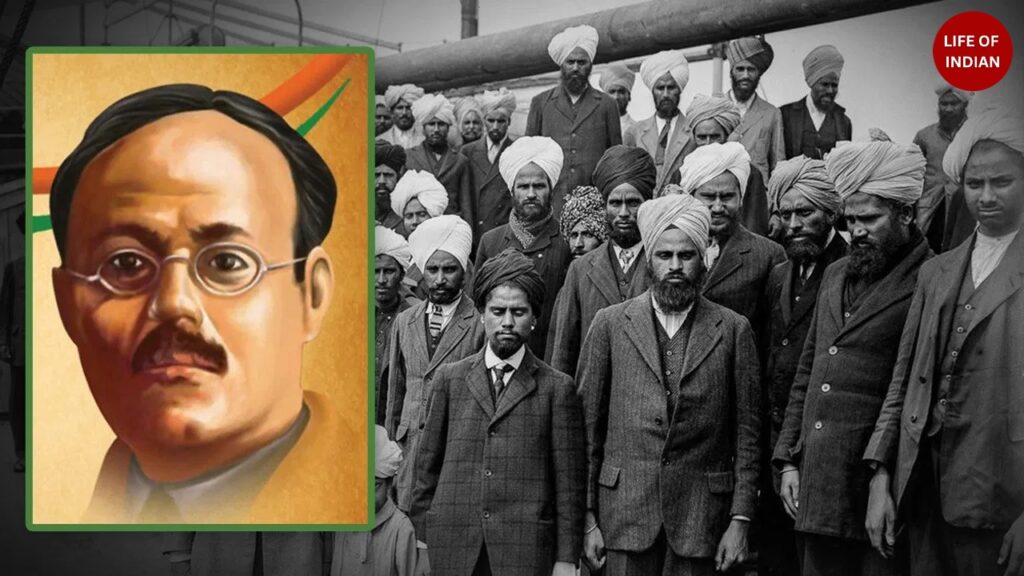
Lala Har Dayal Jayanti 2025: On October 14, India celebrates the birth anniversary of Lala Har Dayal — a great freedom fighter, thinker, scholar, and revolutionary.
Born on October 14, 1884, in Delhi, he was among the few Indians whose extraordinary intellect, rebellious spirit, and visionary ideas shook the very foundation of the British Empire. He not only gave a new direction to India’s freedom movement but also left a profound impact on Buddhist philosophy, education, social reform, and international politics. Lala Har Dayal’s life stands as a remarkable example of struggle, revolution, and wisdom, continuing to inspire every Indian even today. Early Brilliance and Reputation
But what shaped this extraordinary life — and why is he still not widely remembered in Indian textbooks?
Early Brilliance and Reputation
In 1904, in downtown Lahore, a young 20-year-old student overwhelmed onlookers. He simultaneously:
-
Played chess with ease
-
Solved complex mathematics
-
Counted temple bells being rung
-
Recited long passages in Pashto after hearing them only once
Spectators dubbed him “The Great Har Dayal” — a name that would echo through revolutionary circles for decades. Oral histories recall elders reverently referring to him as a paragon of scholarship, patriotism, and genius.
His intellect was matched by his ambition. Lala Har Dayal studied at St. Stephen’s College (Delhi), later ventured to Oxford, and then to the United States (Berkeley), where he immersed himself in radical politics and pan-Asian thought.
Ideals, Sacrifices, and the Turning Points
Har Dayal’s life was marked by bold decisions and relentless activism:
-
He resigned from an Oxford scholarship and declined entry into the Indian Civil Service (ICS), rejecting colonial pathways.
-
Long before Gandhi’s civil disobedience campaigns, Har Dayal advocated civil disobedience and self-resistance as core strategies against empire.
-
He founded the Ghadar Party in 1913 in California — a global network advocating armed revolution against the British.
-
His activism spanned continents: coordinating protests in London’s India House, influencing the Berlin-Baghdad axis, raising voices in the Komagata Maru trial, pushing for a provisional government of Free India in Istanbul–Kabul, and engaging in the Indo-German conspiracy trial in San Francisco.
-
In India, he played a role in the Lahore conspiracy cases and was associated (though indirectly) with events like the 1915 Singapore mutiny.
His network included luminaries such as Lala Lajpat Rai, Aurobindo, Bhagat Singh, Udham Singh, Bhikaji Cama, M.N. Roy, Rash Behari Bose, and many others — activists who drew inspiration from his bold, far-reaching vision.
British intelligence recognized him as a formidable threat. Archives reveal that colonial authorities regarded Har Dayal as one of the most dangerous revolutionaries. Sir David Petrie, later Director-General of MI5, wrote that Har Dayal was among those who had profoundly “sinned” against the British monarchy. Even in exile, the British sought to stifle his influence — barring him from meeting family, censoring his writings, and erasing his name from many colonial narratives.
Later Years, Decline, and Oblivion
From the late 1920s onward, Har Dayal lived in exile. He resided in London (Edgware), continued his scholarship, and maintained correspondence with students and intellectuals across the world. But ill health, isolation, and political pressure weighed heavily.
On March 4, 1939, he passed away. The British establishment ensured minimal coverage back in India. Post-independence, many textbooks relegated his legacy to footnotes. The Ghadar narrative, once central to the diaspora’s freedom struggle, was sidelined in official historiography.
Reinvival & Legacy
Today, scholars, activists, and institutions are reclaimed Har Dayal’s memory:
-
Universities like Oxford, Berkeley, and Stanford preserve his archived letters and reflections.
-
St. John’s College at Oxford has held commemorative events honoring his revolutionary commitment.
-
The Ghadr Memorial Museum in San Francisco and the Jallianwala Bagh Museum in Amritsar include his life in their exhibits.
-
In India, Jasola (Delhi) features a DDA Park named after him; libraries and public institutions increasingly reference him.
-
In 2022, Har Dayal’s name surfaced on Who Wants to Be a Millionaire (KBC) — introducing a new generation to his life and ideas.
His work in political philosophy, anti-colonial thought, Asian solidarity, and historical scholarship is being re-evaluated. Modern scholars like Mark Juergensmeyer call him a “pioneer” in India’s freedom movement and a remarkable mind whose ideas resonated far beyond his era.
Why Har Dayal Matters Today
-
He demonstrated that intellect can be weaponized — resisting empire not only with arms, but with ideas, networks, transnational alliances.
-
His vision of decolonized knowledge, Asian unity, and revolutionary internationalism remains remarkably prescient in today’s globalized world.
-
Rediscovering Har Dayal corrects our history: it injects nuance, reclaims marginalized voices, and builds a richer freedom narrative beyond the usual canon.
Har Dayal’s story is no mere biography — it is a bridge between multiple worlds: colonial and modern, East and West, intellect and action. In commemorating his 140+ years after birth, we revive a legacy that insists: brilliance, courage, and belief can outlast empires.