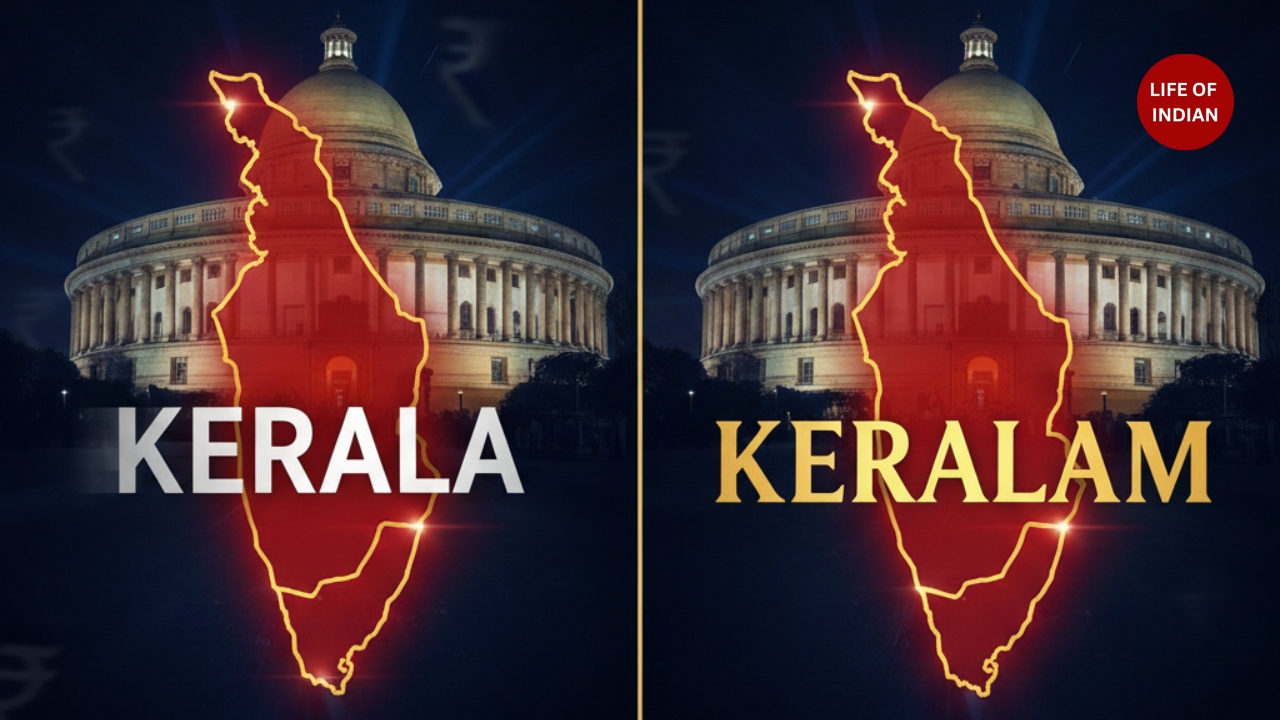
Kerala to Keralam: India’s Union Cabinet has reportedly approved a long-pending proposal to officially rename Kerala as “Keralam.” While the change may appear minor at first glance, it carries deep historical, linguistic, political, and financial implications. The debate has once again drawn attention to Kerala’s journey from princely states to a linguistically unified state—and now possibly toward reclaiming its original name.
The proposed change is not merely about spelling. It touches questions of identity, constitutional procedure, administrative complexity, and cultural pride.
World Hindi Day 2026: History, Global Impact & Why Hindi Is Rising Worldwide
From Princely States to the Indian Union
When India became independent in 1947, the country faced the enormous task of integrating more than 560 princely states into the newly formed Indian Union. Under the leadership of Sardar Vallabhbhai Patel, most rulers agreed to merge their territories with India.
In the region that would later become Kerala, two major princely states dominated—Travancore and Cochin. On July 1, 1949, these two entities were merged to form Travancore-Cochin, also known as Thiru-Kochi. The Maharaja of Travancore, Chithira Thirunal Balarama Varma, became the Rajpramukh (constitutional head) of the new administrative unit.
Travancore did not disappear overnight. Instead, it transitioned from a sovereign princely state into a constitutional entity within democratic India. Its administrative structures, social reforms, and educational foundations would later influence the character of modern Kerala.
The Aikya Kerala Movement and Linguistic Reorganization
The early years after independence witnessed strong public demands for reorganizing Indian states based on language rather than princely boundaries. Across India, linguistic identity became central to regional aspirations.
In Kerala’s case, the Aikya Kerala (United Kerala) Movement demanded the unification of all Malayalam-speaking regions under one administrative unit. At that time, Malayalam-speaking areas were divided between Travancore-Cochin and the Madras Presidency.
The movement gained political momentum and eventually found success with the implementation of the States Reorganisation Act in 1956. On November 1, 1956, the modern state of Kerala was officially formed.
Under this reorganization, the Malabar district of the former Madras Presidency and the Kasaragod region were merged with Travancore-Cochin. At the same time, Tamil-speaking regions such as Kanyakumari were transferred to Madras State (now Tamil Nadu). The post of Rajpramukh was abolished, and Kerala adopted the standard constitutional structure with a Governor and an elected Legislative Assembly.
Thus, Kerala emerged as a linguistically unified state, marking a significant milestone in India’s federal evolution.
Why “Keralam” Instead of Kerala?
The current proposal to rename Kerala as “Keralam” is rooted primarily in linguistic authenticity. In Malayalam, the state’s name has always been pronounced as “Keralam,” with the final “m” sound clearly articulated. Supporters of the change argue that “Kerala” reflects an anglicized version introduced during colonial administration.
Advocates believe that restoring “Keralam” in official usage acknowledges the original pronunciation and strengthens cultural identity. They argue that several Indian cities and states have corrected colonial-era spellings over the years, and this move follows a similar pattern of linguistic assertion.
The name itself carries deep historical roots. References to “Keralaputra” appear in Emperor Ashoka’s inscriptions dating back to the 3rd century BCE. Many historians link the term to the ancient Chera dynasty, one of the three major Tamil dynasties of early South Indian history. Another popular interpretation suggests that the name derives from “Kera” (coconut) and “Alam” (land), meaning “Land of Coconuts,” a description that continues to resonate with Kerala’s lush landscape.
Over centuries, the word evolved linguistically into “Keralam,” while colonial usage standardized the English spelling as “Kerala.”
The Constitutional Process of Renaming a State
Changing the name of an Indian state is not a simple executive decision. It falls under Article 3 of the Constitution of India.
The process begins when a state legislative assembly passes a resolution recommending the name change. The proposal is then forwarded to the Union Government. The Ministry of Home Affairs examines administrative implications and consults various departments such as Railways, Postal Services, and other national agencies.
Following these consultations, the President recommends the introduction of a Bill in Parliament. Both Houses must pass the Bill with a simple majority. Once approved, the President grants final assent, and the new name becomes legally effective.
This structured procedure ensures that any such change is carefully evaluated at multiple administrative and constitutional levels.
The Financial Implications of a Name Change
Although a name change may seem symbolic, its administrative impact can be extensive and expensive. Based on past experiences of renaming states and major cities in India, estimates suggest the cost could range between ₹200 crore and ₹500 crore.
The expenses extend far beyond replacing signboards. Road signage, highway markers, railway station nameplates, airport displays, and government building boards would all need updating. When Bombay was renamed Mumbai in 1995, Indian Railways reportedly spent several crores on signage and ticket modifications alone.
Government documentation would also require large-scale revisions. Official letterheads, seals, identification cards, archived records, and legal documents across thousands of offices would need updating at both state and central levels.
In the digital era, additional costs arise from updating government portals, land records, tax systems, navigation databases, postal directories, and legal registries. The private sector would also bear expenses in modifying business registrations, contracts, branding materials, packaging, and institutional documentation.
Previous renaming exercises, such as Allahabad to Prayagraj, reportedly involved hundreds of crores in administrative adjustments.
Symbolism, Identity, and Political Context
Beyond administration and finances, the proposed change carries symbolic significance. It reflects a broader trend in India of revisiting colonial-era names and restoring indigenous linguistic forms.
For supporters, adopting “Keralam” strengthens regional identity and honors historical continuity. For critics, the debate centers on whether the economic and administrative burden justifies what may largely be a symbolic correction.
The timing of the proposal also adds political dimensions, as discussions around identity often intersect with electoral narratives and regional pride.
The Continuing Legacy of Travancore
The story of Kerala cannot be told without acknowledging Travancore’s legacy. Rather than vanishing, Travancore evolved into a foundational component of modern Kerala. Its early investments in education, social reforms, and administrative modernization played a crucial role in shaping Kerala’s later achievements in literacy, healthcare, and human development.
Even today, the imprint of Travancore’s governance traditions can be seen in the state’s institutions and social framework.
More Than a Name
The debate over Kerala versus Keralam highlights how names carry layers of history, identity, and politics. What appears to be a small linguistic adjustment reflects centuries of cultural evolution, post-independence reorganization, constitutional process, and modern governance realities.
If implemented, the transition from Kerala to Keralam would represent not just a change in spelling, but a reaffirmation of linguistic authenticity and historical consciousness. Whether symbolic or transformative, the discussion itself underscores the living, evolving nature of India’s federal structure.
FAQ
1. Why is Kerala being renamed to Keralam?
The proposal aims to reflect the original Malayalam pronunciation “Keralam” instead of the anglicized spelling “Kerala.” Supporters argue that the change restores linguistic authenticity and aligns the state’s name with its cultural and historical roots.
2. Has Kerala officially been renamed to Keralam?
The Union Cabinet has approved the proposal, but the name change must follow the constitutional process under Article 3. The bill must be passed by Parliament and receive Presidential assent before becoming official.
3. What is the legal process to rename a state in India?
Under Article 3 of the Constitution of India, a state assembly must first pass a resolution. The proposal is reviewed by the Union Government, introduced as a bill in Parliament, and must be approved by both Houses. The President then gives final assent.
4. How much does it cost to rename a state?
Based on past examples, renaming a state can cost between ₹200 crore and ₹500 crore. Expenses include updating signage, railway stations, airports, official documents, digital databases, and administrative systems.
5. When was modern Kerala formed?
Modern Kerala was formed on November 1, 1956, under the States Reorganisation Act, which unified Malayalam-speaking regions including Travancore-Cochin and the Malabar district.
6. What was the Aikya Kerala Movement?
The Aikya Kerala Movement was a political and social campaign demanding the unification of all Malayalam-speaking regions into a single state, which ultimately led to the formation of Kerala in 1956.
About the Author