


IIT Bombay: India is steadily moving toward sustainable and self-reliant energy solutions, and a remarkable innovation by the Indian Institute of Technology (IIT) Bombay has brought a new ray of hope in this direction. The institute has successfully developed an indigenous biomass gasification technology that converts dry leaf waste into cooking gas, offering an environmentally friendly and cost-effective alternative to traditional LPG.
This patented technology is not only helping reduce LPG consumption but also addressing waste management and carbon emissions, making it a significant milestone in India’s journey toward energy independence and sustainability.
A Sustainable Innovation by IIT Bombay
The Indian Institute of Technology (IIT) Bombay has developed a unique biomass gasification system that converts dry leaves and organic waste into cooking gas. This technology has already received a patent and is being actively used on the IIT Bombay campus for cooking purposes.
The innovation is particularly important in the current global energy scenario, where geopolitical tensions in West Asia and disruptions in LPG supply from Gulf countries have raised concerns about fuel availability and rising costs. IIT Bombay’s technology offers a reliable and locally available alternative that reduces dependency on imported LPG and promotes self-reliance under the vision of “Atmanirbhar Bharat.”
The institute has been using this technology for nearly a decade, and it has successfully reduced LPG consumption on campus by 30 to 40 percent, demonstrating its practical effectiveness and long-term sustainability.
How the Idea Started
The concept of converting campus waste into cooking fuel was first proposed in 2014 by Professor Sanjay Mahajani from the Department of Chemical Engineering at IIT Bombay. His idea was to utilize dry leaf waste generated within the campus and convert it into usable cooking fuel using biomass gasification technology.
Initially, the project faced several technical and operational challenges. Designing an efficient gasifier, ensuring stable gas production, and maintaining consistent fuel quality were major hurdles. However, the research team continued working on the project with determination and innovation.
By 2016, the team successfully developed a patented gasifier capable of converting dry leaf waste into cooking gas efficiently.
Later, Professor Sandeep Kumar from the Department of Energy Science and Engineering designed an improved burner system that enhanced thermal efficiency and reduced emissions, making the system more practical for large-scale use.
How the Biomass Gasification Technology Works

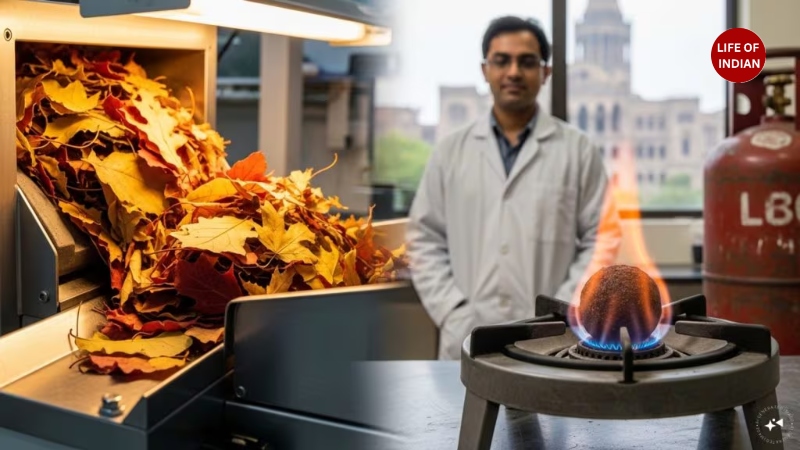
The technology developed by IIT Bombay is based on the biomass gasification process, which converts organic waste into combustible gas through controlled heating in a low-oxygen environment.
Step-by-Step Process
1. Collection of Dry Leaves
Dry leaves and organic biomass waste are collected from the campus and surrounding areas.
2. Shredding and Processing
The collected leaves are cut into smaller pieces to ensure uniform processing and efficient gas production.
3. Pellet Formation
The shredded leaves are compressed into pellets, which act as fuel for the gasifier.
4. Heating in Low-Oxygen Chamber
The pellets are heated in a specially designed chamber with limited oxygen supply.
5. Pyrolysis and Gasification
During heating, pyrolysis and gasification processes take place, breaking down the biomass into combustible gases.
6. Production of Cooking Gas
The generated gas is then directed to burners, where it is used for cooking in kitchens and canteens.
This process produces clean and efficient fuel while minimizing harmful emissions.
Efficiency and Environmental Benefits
The biomass gasification system developed by IIT Bombay has shown impressive results in terms of efficiency and environmental impact.
Key Performance Highlights
- LPG consumption reduced by 30–40%
- Thermal efficiency reaches 60%
- Emissions remain below 20 ppm
- Annual savings of ₹50 lakh in large hostels
- Reduction of 300 tons of CO₂ emissions per year
- Efficient waste management solution
These results clearly show that the technology is not only economically beneficial but also environmentally sustainable.
Use in IIT Bombay Campus
Currently, the technology is being used in IIT Bombay’s staff canteen and large hostel kitchens. The gas produced from dry leaf waste is used for cooking food, reducing the need for LPG cylinders.
The system has proven to be reliable and cost-effective in daily operations, making it a practical solution for large institutions such as:
- Universities
- Hostels
- Industrial canteens
- Large kitchens
- Government facilities
The success of this technology on campus demonstrates its scalability and potential for nationwide implementation.
Importance in the Current Global Energy Scenario
The development of this technology comes at a crucial time when global energy markets are facing uncertainty. Conflicts in West Asia and disruptions in LPG supply from Gulf countries have highlighted India’s dependency on imported energy resources.
In such a situation, indigenous technologies like biomass gasification can play a vital role in:
- Reducing LPG imports
- Ensuring energy security
- Promoting renewable energy
- Lowering fuel costs
- Supporting environmental sustainability
This innovation aligns with India’s long-term goals of achieving clean energy and reducing carbon emissions.
Contribution to Atmanirbhar Bharat
IIT Bombay’s biomass gasification technology is a perfect example of how research and innovation can contribute to national development.
Key Contributions
Energy Self-Reliance
The technology reduces dependence on imported LPG and promotes local fuel production.
Waste Management
Dry leaves and biomass waste are converted into useful energy instead of being burned or dumped.
Cost Reduction
Institutions can save significant money on cooking fuel.
Environmental Protection
Lower carbon emissions and cleaner fuel production help combat climate change.
Scalable Model
The system can be implemented in cities, towns, and rural areas.
This innovation reflects India’s growing capability in developing sustainable and indigenous technologies.
Future Potential and Expansion
The technology developed by IIT Bombay has enormous potential for expansion across India.
Possible Future Applications
- Smart cities waste-to-energy systems
- Rural community kitchens
- Government hostels and schools
- Industrial food processing units
- Municipal waste management projects
- Village-level energy solutions
With proper government support and industry collaboration, this technology can be deployed on a large scale to create a sustainable energy ecosystem in India.
Challenges and Scope for Improvement
Although the technology has shown promising results, there are still some challenges that need attention.
Key Challenges
- Initial setup cost
- Training for operation and maintenance
- Collection and processing of biomass
- Infrastructure development
- Large-scale implementation
However, with continuous research and government support, these challenges can be addressed effectively.
A Model for Green and Clean Energy
IIT Bombay’s innovation sets a strong example of how scientific research can solve real-world problems. Converting dry leaf waste into cooking gas is not just a technological achievement but a sustainable solution for energy, waste management, and environmental protection.
This technology proves that India has the capability to develop innovative and practical solutions that can reduce dependency on fossil fuels and promote green energy.
As the country moves toward a cleaner and self-reliant future, such innovations will play a crucial role in shaping India’s energy landscape.
FAQ
1. What is IIT Bombay’s dry leaf cooking gas technology?
IIT Bombay has developed a patented biomass gasification technology that converts dry leaves and organic waste into cooking gas, reducing LPG consumption and promoting clean energy.
2. How does biomass gasification work?
Dry leaves are collected, converted into pellets, and heated in a low-oxygen chamber, where pyrolysis and gasification processes produce combustible gas that can be used for cooking.
3. How much LPG can be saved using this technology?
The system reduces LPG consumption by 30 to 40 percent in large kitchens and can save up to ₹50 lakh annually in hostels and institutions.
4. Who developed this technology at IIT Bombay?
The project was proposed by Professor Sanjay Mahajani in 2014, and Professor Sandeep Kumar contributed by designing an improved burner system.
5. What are the environmental benefits of this technology?
It reduces carbon dioxide emissions by about 300 tons per year, manages dry leaf waste efficiently, and produces clean and sustainable cooking fuel.
6. Where can this technology be used?
It can be used in universities, hostels, industrial kitchens, rural areas, community kitchens, and government institutions.