


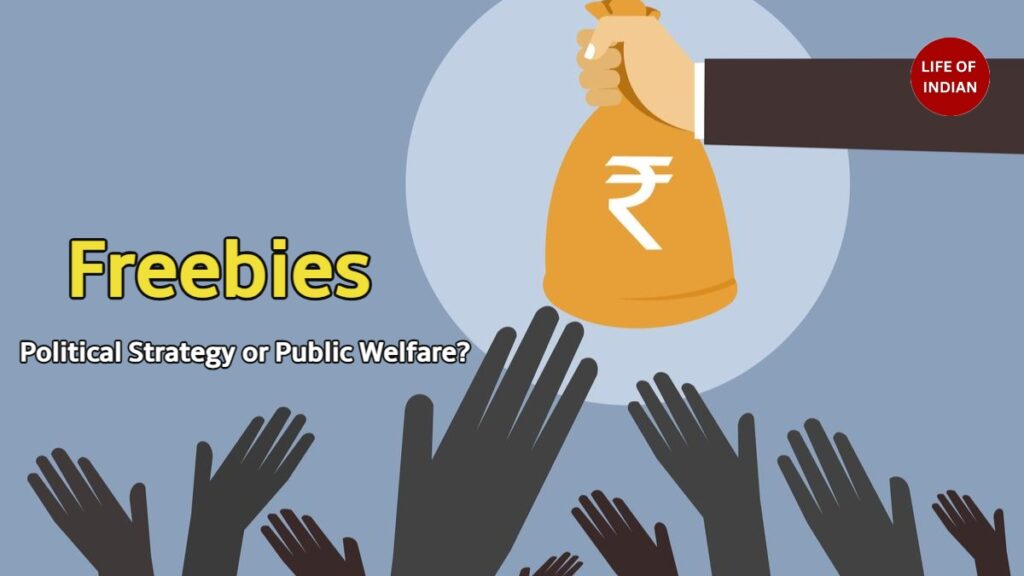
Freebies: It has been 1 year and 28 days since Delhi chose Rekha Gupta from the Bharatiya Janata Party (BJP) as the chief ministerial face. Before the elections and during the campaign, the party offered a number of promises, one of which was to provide financial support to women under the name of the “Mahila Samman Yojana.”
The scheme, Mahila Samriddhi Yojana, aims to provide ₹2,500 to eligible women in Delhi for their financial independence. It was approved in March 2025, with a budgetary provision of ₹5,100 crore to support women. However, no such amount has been disbursed so far, leaving beneficiaries disappointed and raising questions about the government’s commitments.
What are freebies?
According to the Cambridge Dictionary, freebies are things that are offered without the expectation of anything in return. Generally, such provisions are meant for education, food, and healthcare, areas where people lack access. However, since the late 1990s, political parties in India have increasingly adopted freebies as part of their electoral narrative.
The Election Commission of India has stated that the term “freebies” is open to subjective interpretation and does not have a clear legal definition. For example, during natural disasters, providing life-saving medicines or financial aid may also be categorised as freebies.
Freebies—Traced from history
The culture of freebies can be traced back to the then Madras State (now Tamil Nadu), where such welfare measures first gained prominence. The former Chief Minister, K. Kamaraj (1954–1963), introduced free education and mid-day meals for school students to improve attendance and access to education.
Following this, C.N. Annadurai, founder of the Dravida Munnetra Kazhagam (DMK), expanded the concept by promising subsidised rice if elected. Since then, the nature of freebies has evolved. For instance, during the 2006 state elections, the DMK promised free colour televisions, items not considered essential, indicating a shift in the nature of such schemes.
Freebies – Different parties, different schemes
Over time, the definition of freebies has evolved and taken the shape of a political tool to gain public support.
In 2015, the Aam Aadmi Party (AAP) emerged in Delhi, promising subsidised electricity and free water supply. It also introduced free bus travel for women.
Across states, governments have introduced their own versions of welfare schemes. In West Bengal, women receive financial support under schemes like Lakshmi Bhandar. Similarly, in Madhya Pradesh (Mukhyamantri Ladli Behna Yojana), Tamil Nadu (Kalaignar Magalir Urimai Thittam), and Karnataka (Gruha Lakshmi), cash assistance is provided to women under different names. In some states, students receive smartphones after completing secondary education and bicycles after Class 10.
What began as welfare initiatives to support citizens has gradually turned into a means of electoral appeal. While such schemes provide temporary financial relief, concerns remain about long-term employment and economic stability. Many beneficiaries receive monthly assistance ranging from ₹1,000 to ₹12,000, yet unemployment continues to be a significant issue.