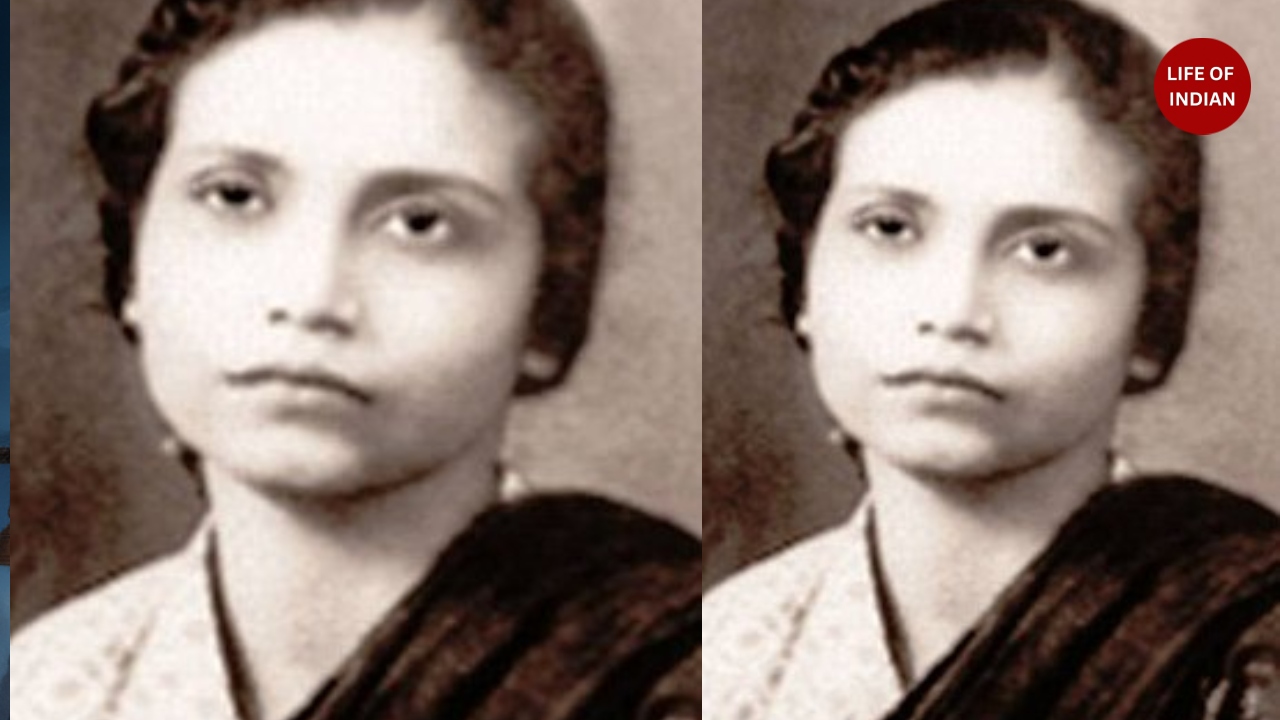
Dr. Bibha Chowdhuri: In the early decades of the twentieth century, when science was overwhelmingly dominated by men, a young Indian physicist quietly dedicated her entire life to research. She chose not to marry, once remarking that she was “wedded to physics.” That physicist was Bibha Chowdhuri—a pioneer of cosmic ray research whose contributions were decades ahead of their time.
Throughout her life, she was repeatedly told, “You will not be able to do physics. You should give it up.” But she did not give up. Instead, she became the first Indian woman to earn a PhD in Physics from abroad and went on to accomplish work that is today considered foundational to modern dark matter research. We are talking about Dr. Bibha Chowdhuri, and her story deserves to be known by every woman in this country.
In the history of Indian science, there are many names that never received the recognition they truly earned. Bibha Chowdhuri is one of them. Her contributions to the fields of cosmic rays and particle physics were so significant that, had circumstances been more favorable, her name might have achieved far greater global recognition. Today, through a new biography, her legacy is once again being brought to light.
Early Life and Academic Excellence
Born in 1913 in Calcutta (now Kolkata), Bibha Chowdhuri grew up in an intellectually stimulating environment that valued education. At a time when very few Indian women entered scientific fields, she chose physics — one of the most demanding disciplines.
In 1936, she completed her MSc in Physics from the University of Calcutta, reportedly as the only woman in her cohort. Her academic performance earned her a position at the Bose Institute, where she worked under physicist Debendra Mohan Bose.
At the institute, she began research on cosmic rays using photographic emulsion techniques — an advanced experimental method used to detect subatomic particle tracks. The research she co-authored led to three papers published in Nature, a remarkable achievement for an Indian scientist in the 1930s, and even more extraordinary for a woman in that era.
The Meson Observation and a Lost Opportunity
One of the most significant aspects of Chowdhuri’s early work involved the detection of particle tracks that strongly indicated the presence of mesons — subatomic particles whose discovery later became central to particle physics.
However, the timing proved unfortunate. During World War II, high-quality photographic plates required for advanced experiments were difficult to obtain in India. Limited access to refined materials restricted further verification of the findings.
In 1950, physicist C. F. Powell received the Nobel Prize for the discovery of mesons using improved photographic emulsion techniques. Scientific historians have since noted that the earlier work by D. M. Bose and Bibha Chowdhuri pointed in the same direction. While Powell acknowledged their pioneering observations, formal recognition did not extend to them.
This episode remains one of the most debated “what-if” moments in Indian scientific history.
Doctoral Research in the United Kingdom
Determined to continue her scientific journey, Bibha Chowdhuri moved to the United Kingdom. In 1945, she completed her PhD at the University of Manchester under Nobel laureate Patrick Blackett.
For an Indian woman in the 1940s, international doctoral research in experimental physics was exceptionally rare. Her doctoral work further strengthened her expertise in cosmic rays and high-energy particle studies, positioning her among the serious researchers in the field at a global level.
Role in Building India’s High-Energy Physics Research
After returning to India in 1949, she was invited by Homi J. Bhabha to join the Tata Institute of Fundamental Research (TIFR) as its first woman research scientist. This appointment itself marked a historic milestone.
Later, she became associated with the Physical Research Laboratory (PRL) and contributed to experiments at the Kolar Gold Fields. These underground experiments were crucial in studying cosmic rays and became internationally respected in high-energy physics research.
Even when institutional priorities shifted and recognition remained limited, Chowdhuri continued her research independently from Kolkata. She maintained collaborations and kept contributing scholarly work well into her later years.
Who Is Sunita Williams? The Inspiring Space Journey of a Woman Who Touched the Stars
Why Was She Forgotten?
Unlike many of her male contemporaries, Bibha Chowdhuri did not receive major national awards or widespread institutional honors. The reasons are complex:
-
Wartime scientific limitations
-
Resource constraints in colonial India
-
Structural gender bias in academia
-
Limited documentation of early contributions
Her absence from mainstream scientific textbooks reflects broader historical patterns in which women’s work was often minimized or overlooked.
Renewed Recognition
In recent years, historians such as Rajinder Singh and Suprakash C. Roy have worked to restore her legacy through biographical research. Their efforts have helped bring Bibha Chowdhuri back into public discussion as a pioneering figure in Indian physics.
Today, she is increasingly recognized as one of the early architects of India’s cosmic ray research tradition.
A Legacy of Quiet Determination
Bibha Chowdhuri’s life challenges simplistic narratives of scientific success. She was not a media figure, nor did she seek public acclaim. Instead, she chose a life devoted entirely to research.
Her statement that she was “wedded to physics” was not symbolic — it defined her life.
As India continues to celebrate its scientific milestones, acknowledging pioneers like Bibha Chowdhuri is not merely about honoring the past. It is about correcting historical omissions and inspiring future generations of women in science.
Her legacy reminds us that progress is often built on the dedication of those who worked without recognition — but whose impact endures nonetheless.
Frequently Asked Questions (FAQs)
Who was Bibha Chowdhuri?
Bibha Chowdhuri was one of India’s earliest woman particle physicists and a pioneer in cosmic ray research. She conducted groundbreaking experiments in the 1930s and 1940s and later became the first woman research scientist at TIFR.
What was Bibha Chowdhuri’s contribution to physics?
She made early observations related to mesons using photographic emulsion techniques. Her work in cosmic ray research laid important groundwork for high-energy particle physics studies in India. Scientific historians consider her research foundational to later developments in particle physics.
Did Bibha Chowdhuri win a Nobel Prize?
No, Bibha Chowdhuri did not receive a Nobel Prize. However, her early experimental findings were closely related to research that later earned international recognition for other scientists.
Where did Bibha Chowdhuri complete her PhD?
She completed her PhD in 1945 from the University of Manchester in the United Kingdom under Nobel laureate Patrick Blackett.
Why is Bibha Chowdhuri called a “forgotten scientist”?
She is often described as a forgotten scientist because, despite her pioneering contributions, she did not receive major awards or widespread recognition during her lifetime. Her work remained underrepresented in mainstream scientific history for many years.
What is Bibha Chowdhuri’s legacy today?
Today, Bibha Chowdhuri is increasingly recognized as a pioneer of cosmic ray and particle physics research in India. Recent biographies and historical research have helped restore her rightful place in the history of Indian science.