


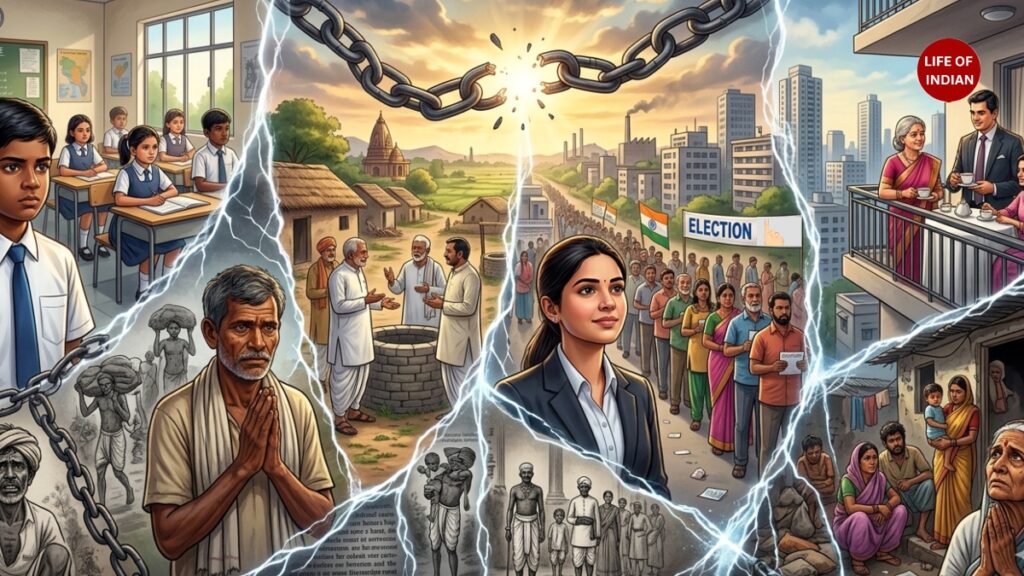
A child takes birth in India, and before that child even understands the world, society often gives them an identity they never chose. Not based on talent, dreams, intelligence, or humanity—but based on caste.
For generations, caste has silently shaped the lives of millions of Indians. It has decided who people marry, where they live, how society treats them, which communities get respect, and sometimes even whose pain gets heard. Even today, in an India that speaks of technology, global power, digital growth, and modernization, caste continues to exist like an invisible wall between people.
What makes this reality even more heartbreaking is that many young Indians today do not personally want to hate anyone because of caste, yet they grow up inside a system where caste remains deeply connected to family identity, social acceptance, politics, and opportunity. In villages, towns, cities, colleges, offices, and even on social media, caste still finds ways to survive.
And perhaps the biggest irony is this: India abolished untouchability decades ago. The Constitution promised equality to every citizen. Laws were created against discrimination. Education spread across the country. Urbanization changed lifestyles. Yet casteism still refuses to disappear completely.
Why?
Why do people still hold onto caste identities so strongly?
How did caste become so powerful in Indian society?
Why is reservation still linked to caste after so many years?
And can India ever truly become a society where a person is known only by character and capability instead of caste?
To understand this, one has to go far deeper than politics or social media debates. The roots of casteism are buried inside centuries of history, social structure, inequality, economic control, fear, power, and identity.
How Did the Caste System Begin in India?
From Occupation to Social Hierarchy
The origins of caste in India are extremely old and complex. Historians, sociologists, and scholars have debated for decades about exactly how the caste system evolved, but most agree that early Indian society was originally organized around occupation and social responsibilities.
Ancient Hindu texts mention the Varna system, which broadly divided society into four categories:
- Brahmins associated with knowledge and rituals
- Kshatriyas associated with warfare and protection
- Vaishyas associated with trade and agriculture
- Shudras associated with service and labor
However, many historians believe that the original Varna system was more flexible than the rigid caste structure that later developed. Over centuries, these divisions slowly transformed into thousands of caste groups and sub-castes connected by birth rather than profession. What may once have been a social arrangement gradually became a strict hereditary hierarchy.
A person’s caste started determining:
- Social status
- Occupation
- Marriage options
- Access to education
- Religious participation
- Economic opportunities
This transformation changed Indian society deeply. Over time, caste stopped being only about work and became about power, purity, privilege, and exclusion.
How Caste Became a Tool of Social Control
The Birth of Untouchability and Exclusion
As caste divisions hardened, some communities faced severe discrimination and social isolation. Entire groups of people were pushed to the margins of society and forced into occupations considered “impure” by dominant social groups. These communities were denied:
- Temple entry
- Access to education
- Land ownership
- Equal social treatment
- Basic human dignity
Untouchability became one of the darkest realities of Indian social history. People from oppressed castes were often forced to live separately from upper-caste communities. In many places, they could not use the same wells, roads, or public spaces. Even physical touch was considered “polluting” by some sections of society. This was not just social inequality — it became a system that affected generations. The impact was psychological, economic, educational, and emotional. Many communities remained trapped in poverty and exclusion for centuries because the system prevented upward mobility.
Why Casteism Still Exists in Modern India
Because Caste Is No Longer Just a Tradition — It Became an Identity
One of the biggest reasons casteism survives is because caste gradually became deeply connected to identity.
Even today, many Indians grow up hearing questions like:
“What is your caste?”
“Which community do you belong to?”
“Can you marry outside your caste?”
For many families, caste is still linked to:
- Marriage alliances
- Social reputation
- Community networks
- Political loyalty
- Economic relationships
In rural India especially, caste often continues to influence social structure and local power dynamics. Even in cities, where people from different backgrounds live together, caste frequently survives indirectly through:
- Surnames
- Matrimonial preferences
- Political mobilization
- Social circles
- Housing discrimination
This is why casteism does not disappear easily. It is not surviving only because of ancient beliefs. It survives because generations continue passing caste identity forward socially and emotionally.
Politics and the Strengthening of Caste Identity
Why Political Parties Continue Using Caste
One major reason caste remains powerful is Indian politics. India is one of the world’s largest democracies, and caste often influences voting patterns in many states. Political parties understand that caste communities can become strong voting groups, so caste identities are frequently used during elections. Instead of weakening caste divisions, politics sometimes reinforces them.
Leaders often:
- Build caste-based vote banks
- Promise benefits to specific communities
- Mobilize support through caste identity
- Use historical injustice or community pride during campaigns
As a result, caste remains politically relevant. For many communities, caste-based politics also became a way to demand representation and rights after centuries of exclusion. This makes the issue even more complicated because caste politics is seen by some people as empowerment, while others see it as division.
Why Reservation Was Introduced in India
Reservation Was Created to Correct Historical Injustice
One of the most debated topics in India is reservation. To understand reservation properly, it is important to understand why it was introduced. When India became independent, leaders of the country recognized that certain communities had faced centuries of discrimination, exclusion, and lack of access to education and opportunities. Because of this historical disadvantage, simply declaring “equality” was not considered enough. The Indian Constitution therefore introduced reservation policies for Scheduled Castes (SC), Scheduled Tribes (ST), and later Other Backward Classes (OBCs).
Reservation aimed to:
- Increase representation in education and government jobs
- Provide opportunities to historically marginalized groups
- Reduce social inequality
- Help communities that had been excluded for generations
Dr. Bhimrao Ramji Ambedkar strongly supported constitutional protections because he himself had experienced caste discrimination and understood how deeply inequality was rooted in society. For many disadvantaged communities, reservation became a pathway toward education, government employment, dignity, and social mobility.
Why Reservation Remains Controversial
The Debate Between Equality and Historical Justice
Reservation remains controversial because different sections of society see it differently.
Some people argue that:
- Reservation is necessary because social inequality still exists
- Many communities continue facing discrimination and lack of opportunity
- Historical injustice cannot disappear within a few decades
Others argue that:
- Reservation sometimes affects merit-based competition
- Economic conditions should matter more than caste today
- Some communities continue benefiting repeatedly while others remain excluded
This debate has become emotionally and politically sensitive across India. The reality is that caste-based inequality has reduced in many areas compared to the past, but it has not disappeared entirely. Studies and social reports continue to show that caste still affects:
- Access to quality education
- Economic opportunities
- Land ownership
- Social mobility
- Representation in institutions
Because of this, reservation continues to remain part of India’s social and political system.
Why Educated Society Still Practices Casteism
Education Alone Does Not Automatically Remove Social Conditioning
Many people assume casteism exists only among uneducated communities. But reality is more complicated. Even highly educated people sometimes continue caste-based thinking when it comes to:
- Marriage
- Family acceptance
- Social reputation
- Community identity
This happens because caste is often learned socially from childhood.
Children grow up hearing:
- Which communities are “ours”
- Which marriages are “acceptable”
- Which traditions must be protected
As a result, caste becomes emotionally normalized inside families. Sometimes people who publicly oppose caste discrimination still privately prefer caste-based marriages or community boundaries. This contradiction is one reason casteism survives even in modern urban society.
Social Media and the New Face of Casteism
In recent years, social media has created a new dimension of caste identity. On one hand:
- Marginalized voices now speak openly
- Discrimination gets exposed publicly
- Awareness about caste injustice has increased
But on the other hand:
- Online caste hate has also increased
- Community polarization spreads quickly
- Caste pride movements sometimes become aggressive
Digital platforms did not eliminate caste identity. In many cases, they amplified it.
Can Casteism Ever End in India?
The Real Solution Is Bigger Than Laws Alone
India already has laws against caste discrimination. But laws alone cannot fully remove social prejudice. Real change requires transformation at multiple levels:
- Education that teaches equality and empathy
- Inter-caste social interaction
- Economic opportunity for all communities
- Reduction of political exploitation of caste
- Ending social discrimination inside families
- Encouraging inter-caste marriages
- Focusing on humanity over inherited identity
Most importantly, society must stop attaching human worth to caste. Because casteism survives when people continue believing that birth determines value.
The Younger Generation and Hope for Change
There is also another side to modern India — one that gives hope. Many young Indians today:
- Build friendships beyond caste
- Question old prejudices
- Support equality
- Reject discriminatory traditions
- Focus more on education and individuality
Urbanization, internet exposure, migration, and modern workplaces are slowly changing social attitudes in many parts of the country. The change is gradual, uneven, and incomplete — but it exists. And perhaps that is where the real possibility of transformation lies.
Casteism in India did not appear overnight, and it cannot disappear overnight either. It evolved over centuries through social hierarchy, economic control, inherited identity, political use, and cultural conditioning. Even after independence and constitutional reforms, its influence continues because caste became deeply embedded in society itself.
Reservation was introduced as an attempt to repair historical injustice and create opportunities for communities that had been denied equality for generations. But the larger challenge remains much deeper than policy debates. The real battle is not only against discrimination in institutions.
It is against discrimination inside human thinking. India’s future will ultimately depend on whether society learns to value people for their humanity, capability, and character rather than the caste they were born into. Because no child chooses their caste. But society chooses whether to continue judging them for it.
FAQ
1. What is casteism?
Casteism refers to discrimination, prejudice, or social division based on caste identity.
2. How did the caste system begin in India?
The caste system evolved gradually from ancient social and occupational divisions that later became hereditary and hierarchical.
3. Why does casteism still exist in India?
Casteism survives due to social conditioning, political influence, traditional practices, economic inequality, and community identity.
4. Why was reservation introduced in India?
Reservation was introduced to provide educational and employment opportunities to historically marginalized communities that faced centuries of discrimination.
5. Is caste discrimination illegal in India?
Yes. The Indian Constitution prohibits caste discrimination and abolished untouchability under Article 17.
6. Can casteism end completely in India?
Experts believe casteism can reduce significantly through education, equality, economic opportunity, social reform, and changing social attitudes over time.