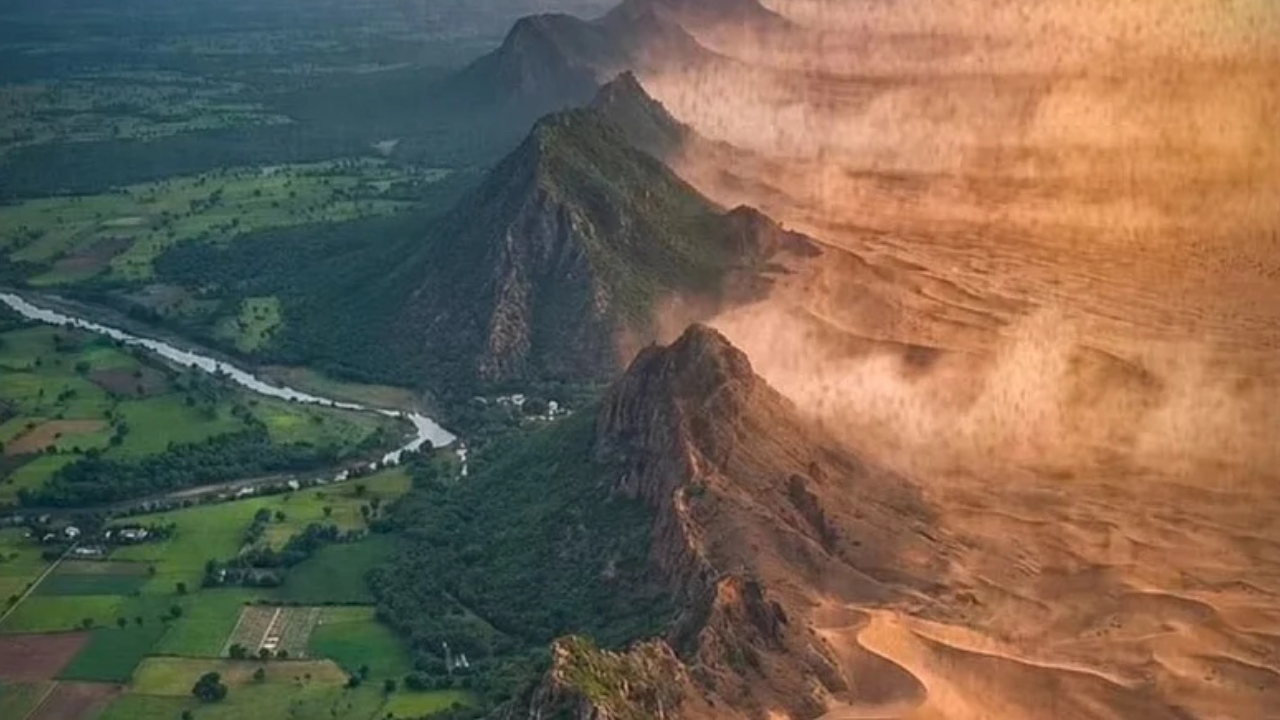
Aravalli Hills to Remain Protected: The Central government has firmly rejected allegations that a new definition of the Aravalli Hills will open the ecologically sensitive mountain range to large-scale mining. Clarifying its position, the Ministry of Environment, Forest and Climate Change (MoEFCC) asserted that over 90 per cent of the Aravalli region will remain protected, with a Supreme Court-mandated freeze on new mining leases in place.
The clarification comes amid political controversy, with opposition parties, including the Congress, alleging that the revised definition could weaken environmental safeguards and lead to irreversible damage to one of India’s oldest mountain systems.
What Is the New Definition of the Aravalli Hills?
According to the Supreme Court-approved framework, an “Aravalli Hill” is defined as any landform located in designated Aravalli districts that rises 100 metres or more above its local relief. An “Aravalli Range” consists of two or more such hills located within 500 metres of each other.
The Centre has emphasised that this definition does not permit mining below the 100-metre elevation, as claimed by critics. Instead, the protection extends to the entire hill system, including the lowest bounding contour that encloses the hills.
Why Was the Definition Revised?
The revision follows long-standing concerns over illegal and unregulated mining in the Aravalli region. While Rajasthan had a clear definition in place since 2006, other states such as Haryana, Gujarat, and Delhi followed inconsistent criteria, leading to ambiguity and misuse.
To address this, the Supreme Court, in May 2024, constituted a high-level committee under the MoEFCC to recommend a uniform, scientific definition applicable across states. The committee included representatives from Rajasthan, Haryana, Gujarat, Delhi, and technical bodies.
On November 20, the Supreme Court accepted the committee’s recommendations.
How Much of the Aravalli Is Open to Mining?
Environment Minister Bhupender Yadav stated that the total area of the Aravalli landscape is around 1.44 lakh square kilometres, spread across 37 districts in four states. Of this, only about 0.19 per cent of the area is legally eligible for mining, while the remaining over 90 per cent stands preserved and protected.
Delhi, which has five Aravalli districts, does not permit mining at all.
Supreme Court’s Role and Mining Restrictions
Under the Supreme Court’s directions:
-
No new mining leases will be granted in the Aravalli region
-
A comprehensive Management Plan for Sustainable Mining must be prepared by the Indian Council of Forestry Research and Education (ICFRE)
-
Existing mines may continue only if they strictly comply with sustainable mining norms
-
Core and inviolate areas—including protected forests, eco-sensitive zones, tiger reserves, wetlands, and surrounding buffer zones—are completely off-limits
Limited exemptions may be allowed only for critical and strategic minerals in the national interest.
Government Rejects Misinformation Claims
Responding to allegations, Bhupender Yadav accused critics of spreading misinformation. In a post on X, he urged people to “stop spreading lies” and clarified that the revised framework actually strengthens protection rather than diluting it.
The government also highlighted initiatives like the ‘Green Aravalli’ movement, aimed at restoring degraded forest land, increasing green cover, and conserving biodiversity across the region.
Focus on Tackling Illegal Mining
Officials have stressed that the real threat to the Aravallis is illegal mining, not the revised definition. The committee has recommended:
-
Mandatory Survey of India mapping of hills and ranges
-
Clear identification of core and no-mining zones
-
Use of drones, satellite surveillance, and technology-based monitoring
-
Stronger enforcement mechanisms at the district level
According to the government, these steps will bring greater transparency and curb environmental violations.
While political debate continues, the Centre maintains that the new, Supreme Court-approved definition of the Aravalli Hills is designed to remove ambiguity, prevent misuse, and enhance ecological protection. With more than 90 per cent of the region safeguarded and a freeze on new mining leases, the government insists that fears of widespread mining are unfounded.
About the Author