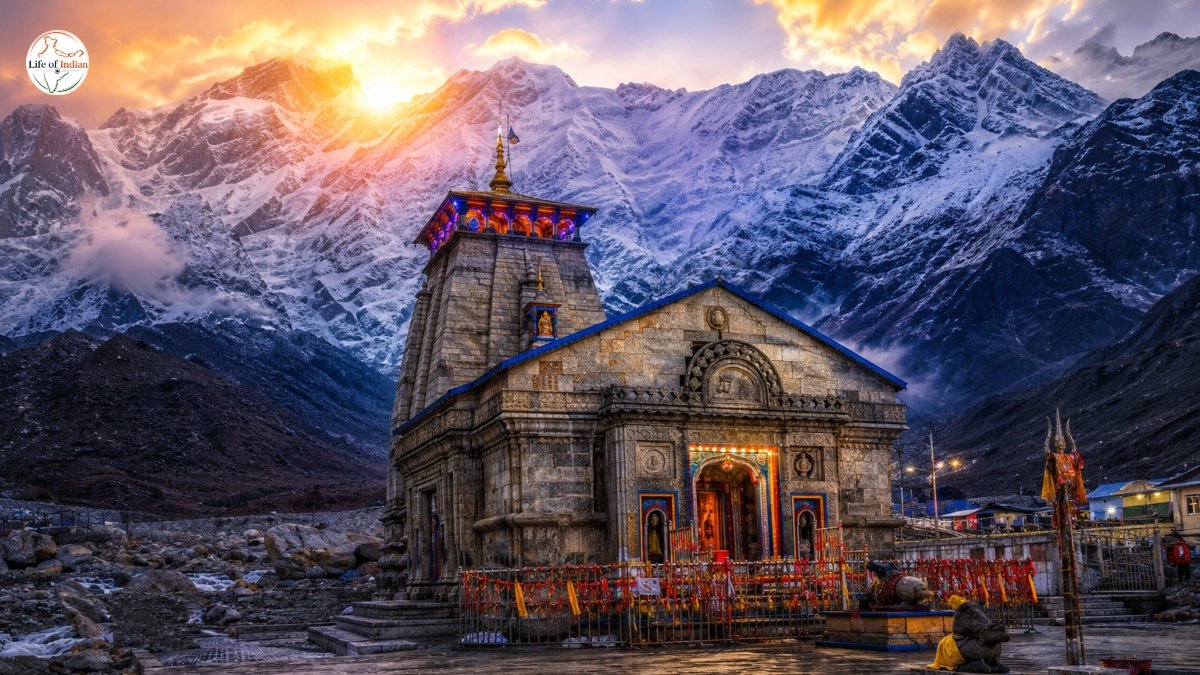
Imagine walking through the mighty Himalayas, surrounded by snow-covered peaks, freezing winds and the sound of the Mandakini River—until, after a long and challenging journey, a centuries-old stone temple suddenly appears before you. This is Kedarnath.
A temple where Lord Shiva is worshipped not in the usual cylindrical form of a Shiva Lingam, but as a natural conical rock formation believed to represent the hump of Lord Shiva.
At an altitude of around 3,580 metres, in the Garhwal Himalayas of Uttarakhand, stands one of India’s most revered Shiva temples—the Kedarnath Temple. It is one of the 12 Jyotirlingas of Lord Shiva and one of the four major pilgrimage destinations of Uttarakhand’s Char Dham circuit.
But Kedarnath is much more than an ancient temple. It is the place where mythology meets the Himalayas. It is associated with the Pandavas and the Mahabharata, the legendary appearance of Shiva as a bull, the sacred Panch Kedar tradition and the spiritual legacy of Adi Shankaracharya. It is also a place that witnessed the devastating floods of 2013, yet the ancient temple continued to stand.
- So what makes Kedarnath one of the most powerful Shiva pilgrimage sites in India?
- Why is Lord Shiva worshipped here in the form of a hump?
- What is the connection between Kedarnath and the five Panch Kedar temples?
- Who built the present temple?
- What happened during the catastrophic 2013 floods?
- And how can you reach this remote Himalayan shrine?
- Let us discover the complete story of Kedarnath Jyotirlinga.
Where Is Kedarnath Jyotirlinga Located?
Kedarnath is located in Rudraprayag district of Uttarakhand, deep inside the Garhwal Himalayas. The temple stands at an elevation of approximately 3,580 metres above sea level, surrounded by some of the most dramatic mountain scenery in India. The Kedarnath peak, Kedar Dome and other Himalayan mountains form the backdrop of the temple.
The town is situated near the Chorabari glacier, from which the Mandakini River originates. This remote Himalayan location is one of the reasons why Kedarnath has traditionally been considered a difficult pilgrimage. The journey itself is an important part of the spiritual experience.
What Is Kedarnath Jyotirlinga?
Kedarnath is traditionally recognised as one of the 12 Jyotirlingas of Lord Shiva. The Shri Badrinath–Kedarnath Temple Committee identifies Kedarnath as the eleventh of the twelve Jyotirlingas. In Hindu tradition, a Jyotirlinga represents the divine manifestation of Shiva as an infinite column of cosmic light. The word Jyoti means light or radiance, while Linga refers to the sacred symbol of Shiva.
Kedarnath is particularly unique because the sacred manifestation worshipped inside the temple is a natural conical rock formation. This formation is traditionally believed to be the hump of Lord Shiva, who is said to have appeared here in the form of a bull.
Why Is Kedarnath Called “Kedarnath”?
The name Kedarnath is associated with the ancient region of Kedar Khand. The word Kedar is traditionally associated with Lord Shiva and the sacred Himalayan landscape. Uttarakhand Tourism notes that the historical name of the region is Kedar Khand, while the wider area has been associated with Shiva worship for centuries. Kedarnath is therefore not simply the name of a town. It represents an entire sacred Himalayan region connected with Lord Shiva.
The Most Famous Legend of Kedarnath
The most popular legend of Kedarnath is connected with the Pandavas of the Mahabharata. According to Hindu tradition, after the great Kurukshetra war, the Pandavas were deeply troubled by the deaths and destruction caused by the conflict. Although they had won the war, they wanted to seek forgiveness and blessings from Lord Shiva.
They travelled in search of Shiva. But Lord Shiva did not want to appear before them easily. According to the legend, Shiva took the form of a bull and tried to hide among the other cattle. However, Bhima, one of the Pandavas, recognised him. When Bhima attempted to catch the divine bull, Shiva began disappearing into the ground. The hump remained visible at Kedarnath. This sacred hump became the form in which Shiva is worshipped at Kedarnath. The rest of Shiva’s body is believed to have appeared at four other Himalayan locations. Together, these five sacred places became known as the Panch Kedar.
The Story of Panch Kedar
The Panch Kedar pilgrimage consists of five important Shiva temples in Uttarakhand:
- Kedarnath — the hump of Shiva
- Madhyamaheshwar — the middle or navel portion
- Tungnath — the arms
- Rudranath — the face
- Kalpeshwar — the matted hair
This traditional story explains why these five temples are collectively known as Panch Kedar. The five temples are scattered across the Garhwal Himalayas, making the Panch Kedar pilgrimage considerably more challenging than visiting a single shrine. Kedarnath is generally regarded as the first and most prominent temple of this sacred circuit.
The Spiritual Significance of the Kedarnath Legend
The Pandava story carries a deeper spiritual message. The Mahabharata war was fought in the name of justice and duty, yet the Pandavas still sought divine forgiveness after the destruction caused by the war. The legend therefore reflects an important idea in Hindu philosophy:
Even victory does not erase the consequences of one’s actions.
Seeking forgiveness, accepting responsibility and turning towards the divine become part of the journey toward spiritual liberation. This is one reason why Kedarnath is considered not only a place of worship but also a place of atonement and inner transformation.
Kedarnath and Adi Shankaracharya
Kedarnath also has a deep association with Adi Shankaracharya, one of India’s most influential philosophers. The Shri Badrinath–Kedarnath Temple Committee states that the present temple is traditionally associated with Adi Shankaracharya and dates it to approximately the 8th century AD.
A samadhi site dedicated to Adi Shankaracharya is located behind the Kedarnath Temple. According to the local tradition, this is where Shankaracharya attained Moksha. The association is significant because Shankaracharya is traditionally credited with reviving and organising several important pilgrimage traditions across India. Kedarnath became an important northern centre in this wider spiritual landscape.
Who Built Kedarnath Temple?
The answer requires an important distinction between legend and historical tradition. Local religious tradition says that the original temple was built by the Pandavas. However, the present stone temple is traditionally attributed to Adi Shankaracharya, around the 8th century CE. The official temple committee describes the existing structure as standing beside the site of an earlier temple associated with the Pandavas.
Therefore, it is more accurate to say:
The Pandava connection belongs to the sacred tradition and legend, while the present historic structure is traditionally associated with Adi Shankaracharya.
The temple has also been renovated and maintained over the centuries.
The Architecture of Kedarnath Temple
One of the most remarkable things about Kedarnath Temple is its architecture. Unlike many elaborate North Indian temples decorated with colourful materials, Kedarnath appears almost austere. The temple is constructed from huge, evenly cut grey stone slabs. The stones are massive and appear to have been fitted together with extraordinary precision. The official temple committee notes that the construction of such a structure at such altitude is itself a remarkable achievement.
The temple stands on a large rectangular platform.
Inside are two major architectural spaces:
- Garbha Griha — the sanctum where the main deity is worshipped.
- Mandap — the assembly hall where devotees gather.
- Large stone steps lead towards the temple entrance.
- The steps also contain inscriptions in Pali script, adding another historical layer to the monument.
- Outside the entrance stands a large statue of Nandi, the sacred bull and vehicle of Lord Shiva.
The Unique Shiva Lingam of Kedarnath
The most distinctive feature of Kedarnath is the form of Shiva worshipped inside the sanctum. Instead of the conventional smooth cylindrical Shiva Lingam seen in many temples, Kedarnath’s sacred manifestation is a natural conical rock formation. According to the traditional legend, it represents the hump of Shiva in his bull form. The temple committee describes this formation as the manifestation of Shiva in his Sadashiva form. This unusual form is one of the reasons Kedarnath occupies such a special place among the Jyotirlingas.
Kedarnath and the Mandakini River
The temple is located near the source region of the Mandakini River, one of the sacred rivers of Uttarakhand. The river flows through the Kedarnath Valley and eventually joins the Alaknanda at Rudraprayag. The sound of the Mandakini flowing through the valley forms an inseparable part of the Kedarnath experience. For pilgrims, the river, mountains and temple together create a sacred Himalayan landscape.
Bhairavnath Temple: The Guardian of Kedarnath
A short distance from the main Kedarnath Temple is the Bhairavnath Temple. Bhairav is regarded as a powerful manifestation of Lord Shiva. According to local belief, Bhairavnath protects Kedarnath and the surrounding valley, particularly during the winter months when the main temple remains closed because of heavy snowfall. Uttarakhand Tourism describes Bhairavnath as the guardian of Kedarnath Temple. The temple is located roughly 500 metres from Kedarnath Temple and offers spectacular views of the surrounding Himalayan landscape.
Why Does Kedarnath Temple Close in Winter?
Kedarnath sits at an extreme Himalayan altitude. During winter, the region receives heavy snowfall and temperatures can fall far below freezing. The temple town becomes covered in snow, making regular pilgrimage extremely difficult. As a result, the main shrine closes for the winter season.
But worship of Lord Kedarnath does not stop. According to the Shri Badrinath–Kedarnath Temple Committee, the symbolic representation of Lord Shiva is carried from Kedarnath to Ukhimath, where it is worshipped during the winter months. In spring, it is ceremonially brought back to Kedarnath before the temple reopens. This makes Ukhimath the winter seat associated with Lord Kedarnath.
Kedarnath Temple Opening and Closing
The exact opening date of Kedarnath changes every year according to the traditional Hindu calendar and the temple’s annual schedule. For 2026, the official Uttarakhand pilgrimage portal lists the Kedarnath Dham opening date as 22 April 2026. The temple generally remains open during the warmer pilgrimage season and closes before winter sets in.
Because snowfall, weather and administrative decisions can affect access, travellers should always check the latest official announcement before planning a trip.
Kedarnath Temple Rituals and Puja
Kedarnath has a rich daily worship tradition. Devotees can participate in or book several pujas through the official temple committee, subject to availability.
Some important rituals include:
Mahabhishek Puja
A special early-morning worship of Lord Shiva.
Abhishek Puja
Devotees can participate in the traditional worship of the sacred manifestation of Shiva.
Rudrabhishek
A powerful Shiva worship ritual involving Vedic prayers and offerings.
Evening Aarti
The temple conducts several evening worship rituals, including Kapoor Aarti, Chandi Aarti and Swaran Aarti.
The official temple committee currently lists early-morning Mahabhishek and Abhishek pujas between 4:30 AM and 6:30 AM, while evening aartis are scheduled from around 6:00 PM onward, subject to temple rules and changes. Pilgrims should check the official schedule before visiting because timings may change.
The 2013 Kedarnath Flood Disaster
- In June 2013, Uttarakhand witnessed one of the most devastating natural disasters in its modern history.
- Heavy rainfall triggered massive floods and landslides across the region.
- Kedarnath Valley was among the worst affected areas.
- The disaster destroyed homes, roads, bridges and much of the surrounding settlement.
- Thousands of people lost their lives across the affected region.
- Yet the ancient Kedarnath Temple remained standing.
- This survival became one of the most extraordinary chapters in the temple’s modern history.
The Mysterious Bheem Shila
Behind the temple stands a massive rock known locally as Bheem Shila. According to local belief, this enormous rock came down from the mountain during the 2013 floods and stopped behind the temple. It is believed to have helped divert the force of the floodwater away from the main shrine.
Uttarakhand Tourism records this local belief and notes that the rock stopped near the temple, helping protect the shrine from the worst impact of the floodwaters. For devotees, Bheem Shila has become a symbol of divine protection. It is important, however, to distinguish the religious interpretation from a scientific explanation of the disaster.
Why Did the Kedarnath Temple Survive?
The survival of the temple has been widely discussed.
Its massive stone construction, elevated platform and structural design undoubtedly played an important role in its resilience.
The placement of the large rock behind the temple also became significant during the flood.
For devotees, however, the survival has a deeply spiritual meaning.
Many believe that Mahadev himself protected his own abode.
Whether viewed through faith, architecture or geology, the survival of Kedarnath Temple remains one of the most remarkable stories associated with the shrine.
Kedarnath as a Char Dham Pilgrimage
Kedarnath is one of the four major pilgrimage destinations of Uttarakhand’s Char Dham circuit.
The four sites are:
- Yamunotri
- Gangotri
- Kedarnath
- Badrinath
Uttarakhand Tourism identifies these four destinations as the state’s Char Dham pilgrimage centres. Among them, Kedarnath is dedicated to Lord Shiva, while Badrinath is dedicated to Lord Vishnu. For many pilgrims, completing the Char Dham journey represents a profound spiritual undertaking.
Kedarnath and Panch Kedar: What Is the Difference?
These two terms are sometimes confused.
Char Dham refers to the four major pilgrimage destinations of Uttarakhand.
Panch Kedar refers specifically to five important Shiva temples in the Garhwal Himalayas.
Panch Kedar consists of:
- Kedarnath
- Madhyamaheshwar
- Tungnath
- Rudranath
- Kalpeshwar
The five temples are connected through the traditional legend of Shiva appearing in different forms after the Pandavas sought him.
How to Reach Kedarnath
Reaching Kedarnath is an important part of the pilgrimage. The final approach is not by ordinary road. Pilgrims must reach Gaurikund, from where the trek to Kedarnath begins.
By Air
- The nearest major airport is Jolly Grant Airport near Dehradun.
- From Dehradun, travellers can continue by road towards the Kedarnath route.
- Because the journey involves mountain roads and changing weather, travellers should allow sufficient time rather than treating the airport-to-temple journey as a simple point-to-point trip.
By Train
- The nearest major railway connections are generally through Rishikesh or Haridwar.
- From there, pilgrims continue by road towards the Kedarnath region.
- Rishikesh is an important gateway for the Char Dham pilgrimage.
By Road
- The road journey generally follows the route through important pilgrimage towns such as:
- Rishikesh → Devprayag → Srinagar → Rudraprayag → Guptkashi → Sonprayag → Gaurikund
- From Gaurikund, the final journey to Kedarnath is completed by trekking or authorised alternative services.
Kedarnath Trek
The traditional trek to Kedarnath begins at Gaurikund. The official temple committee lists the trek at approximately 16 km, while Uttarakhand Tourism’s Panch Kedar page describes it as around 19 km, reflecting differences in route measurement and trail references.
The practical lesson for pilgrims is simple:
Be prepared for a long, steep Himalayan trek rather than relying on a single distance figure.
The trail passes through spectacular mountain scenery, waterfalls, valleys and high-altitude terrain.
The trek is physically demanding, particularly for first-time visitors.
Can You Reach Kedarnath Without Trekking?
Yes. Apart from trekking, pilgrims can use authorised helicopter services, subject to weather, government rules, operational conditions and availability. The official Uttarakhand pilgrimage portal includes helicopter services among the pilgrimage facilities, while the Shri Badrinath–Kedarnath Temple Committee specifically states that helicopter shuttle tickets for Kedarnath should be booked through the official IRCTC-authorised Heli Yatra system. Pilgrims should avoid unofficial agents or random websites claiming to provide helicopter tickets.
Do You Need Registration for Kedarnath?
Yes. The Uttarakhand Government’s official Char Dham registration portal lists compulsory registration among its pilgrimage requirements. It also advises pilgrims to keep their registration certificate, valid identification and necessary travel items ready.
The official portal provides:
- Yatra Registration
- Yatra Letter
- Darshan Certificate
- Helicopter information
- Health Registration
- Vehicle Registration
and other pilgrimage services. Before travelling, visitors should check the latest registration rules and available slots.
Best Time to Visit Kedarnath
Kedarnath is a seasonal pilgrimage destination. The main pilgrimage season is generally from late spring to autumn, when the temple is accessible. Uttarakhand Tourism describes May to October as a suitable period, while also noting that weather and seasonal conditions can vary.
May to June
- This is one of the most popular periods.
- The weather is comparatively pleasant, but the opening season can bring enormous crowds.
July to August
- The monsoon can make mountain travel more challenging.
- Heavy rainfall may lead to landslides, road disruptions and sudden weather changes.
- Pilgrims should check route conditions before travelling.
September to October
- The post-monsoon period can offer clearer mountain views and cooler weather.
- However, the pilgrimage season is limited and the temple eventually closes for winter.
Winter
- Kedarnath becomes heavily snowbound.
- The main temple closes, and the winter worship shifts to Ukhimath according to the traditional annual cycle.
What Makes Kedarnath So Famous?
Kedarnath’s fame comes from an extraordinary combination of spiritual and geographical significance.
It is:
- One of the 12 Jyotirlingas of Lord Shiva.
- One of Uttarakhand’s Char Dham pilgrimage destinations.
- The most prominent temple of the Panch Kedar tradition.
- Located at around 3,580 metres in the Himalayas.
- Associated with the Pandavas and the Mahabharata.
- Traditionally linked with Adi Shankaracharya.
- Home to a unique natural conical Shiva manifestation.
- Surrounded by spectacular Himalayan peaks.
- Associated with the dramatic survival of the 2013 floods.
These elements make Kedarnath one of India’s most recognisable pilgrimage destinations.
Important Places to Visit Around Kedarnath
A Kedarnath pilgrimage can include several sacred and natural attractions.
1. Bhairavnath Temple
Located approximately 500 metres from the main temple, Bhairavnath is traditionally regarded as the guardian of Kedarnath.
2. Adi Shankaracharya Samadhi
Located behind the temple, this site is associated with the final spiritual journey of Adi Shankaracharya.
3. Gandhi Sarovar
Also known as Chorabari Lake, this glacial lake lies near the Chorabari Bamak Glacier.
It is associated with the immersion of some of Mahatma Gandhi’s ashes in 1948.
4. Gaurikund
Gaurikund is the traditional starting point of the Kedarnath trek.
It is also associated with Goddess Parvati and contains a temple dedicated to her.
5. Sonprayag
Sonprayag is an important settlement on the Kedarnath route and lies near the confluence of the Basuki and Mandakini rivers.
6. Rudra Meditation Cave
Located near Kedarnath, this underground meditation facility became widely known after Prime Minister Narendra Modi meditated there in 2019.
7. Kedarnath Peak
The towering Kedarnath Peak rises behind the temple and creates one of the most spectacular backdrops in the Himalayas. Uttarakhand Tourism lists its elevation at around 6,940 metres.
Kedarnath: A Temple Built to Endure
Perhaps the most powerful image of Kedarnath is not simply the temple itself. It is the contrast between the temple and its surroundings. A massive stone structure stands in a high-altitude Himalayan valley, surrounded by mountains that are thousands of metres high. Snow, rain, landslides and extreme winter conditions have challenged pilgrims for centuries.
- Yet the temple continues to draw devotees.
- Its architecture reflects endurance.
- Its mythology reflects devotion.
- Its location reflects the majesty of nature.
- And its survival through the 2013 disaster has added another powerful chapter to its modern identity.
10 Fascinating Facts About Kedarnath Jyotirlinga
1. Kedarnath Is the 11th Jyotirlinga
The Shri Badrinath–Kedarnath Temple Committee identifies Kedarnath as the eleventh of the twelve Jyotirlingas.
2. It Is One of the Char Dhams
Kedarnath is one of the four major Char Dham pilgrimage sites of Uttarakhand.
3. It Stands at Around 3,580 Metres
The temple is situated high in the Garhwal Himalayas at approximately 3,580 metres.
4. Shiva Is Worshipped as a Hump
The natural conical rock formation inside the sanctum is traditionally regarded as Shiva’s hump in his bull form.
5. It Is the First of Panch Kedar
Kedarnath is the most prominent of the five Panch Kedar temples.
6. The Temple Is Made of Massive Stone Blocks
The ancient structure is constructed from enormous, carefully cut grey stone slabs.
7. Adi Shankaracharya Is Traditionally Associated With the Temple
The present temple structure is traditionally associated with Adi Shankaracharya and the 8th century CE.
8. Kedarnath Has a Winter Seat
During winter, the symbolic representation of Lord Kedarnath is worshipped at Ukhimath.
9. Bheem Shila Became Famous After 2013
A massive rock behind the temple became associated with the temple’s survival during the 2013 floods.
10. The Journey Is Part of the Pilgrimage
Unlike most easily accessible temples, Kedarnath requires pilgrims to undertake a significant Himalayan journey to reach the shrine.
Kedarnath Travel Tips
A pilgrimage to Kedarnath requires more preparation than an ordinary temple visit. Carry warm clothing even during summer because temperatures can drop rapidly. Wear comfortable trekking shoes with good grip. Keep rain protection with you because Himalayan weather can change quickly. Carry essential medicines and personal prescriptions.
Stay hydrated and take adequate rest during the trek. Do not underestimate the altitude. Complete the mandatory government registration before beginning the journey. Check road, weather and temple conditions before departure. If travelling by helicopter, use only officially authorised booking channels. Most importantly, avoid rushing. Kedarnath is a high-altitude pilgrimage, not simply a tourist destination.
The Deeper Meaning of Kedarnath
The spiritual significance of Kedarnath goes beyond the belief that Lord Shiva resides here.
It is also about the journey.
- The climb.
- The cold.
- The mountains.
- The uncertainty of weather.
- The physical exhaustion.
- And finally, the moment when the temple comes into view.
For many devotees, this difficult journey becomes symbolic. You leave behind the comfort of everyday life. You walk through nature. You face physical limitations. And after hours of effort, you stand before the ancient form of Shiva. Perhaps that is why Kedarnath feels different. The pilgrimage itself becomes part of the prayer.
Kedarnath Jyotirlinga: More Than a Temple
Kedarnath is a place where several layers of India’s spiritual heritage come together.
- The Mahabharata tradition connects the shrine with the Pandavas.
- The Jyotirlinga tradition connects it with Shiva’s cosmic manifestation.
- The Panch Kedar tradition connects it with four other sacred Himalayan temples.
- The Adi Shankaracharya tradition connects it with India’s philosophical heritage.
- The Char Dham tradition makes it one of Uttarakhand’s most important pilgrimage destinations.
- And the 2013 disaster added a modern story of survival and resilience.
Few temples in India carry so many layers of mythology, history, geography and devotion within one sacred landscape.
Kedarnath is not simply a temple hidden in the Himalayas. It is a journey into one of the most powerful spiritual landscapes of India. Here, Lord Shiva is worshipped in a natural form traditionally believed to be his hump.
- Here, the legends of the Pandavas continue to live through the Panch Kedar tradition.
- Here, the ancient stone temple stands beneath towering Himalayan peaks.
- Here, the Mandakini flows through the valley.
- Here, the memory of Adi Shankaracharya remains alive.
- And here, the story of the 2013 floods has become a modern symbol of resilience.
Perhaps the greatest lesson of Kedarnath is that faith does not always make the journey easy. Sometimes, faith gives you the strength to make the journey anyway.
- You climb.
- You struggle.
- You continue.
And finally, when the ancient temple appears against the Himalayan sky, you understand why generations of devotees have travelled so far to stand before Mahadev.
Kedarnath is not merely a destination. It is a pilgrimage of the body, the mind and the soul.
Har Har Mahadev.
Where is Kedarnath Jyotirlinga located?
Kedarnath Jyotirlinga is located in Rudraprayag district of Uttarakhand, in the Garhwal Himalayas, at an altitude of approximately 3,580 metres.
Which Jyotirlinga number is Kedarnath?
Kedarnath is traditionally identified as the eleventh of the 12 Jyotirlingas.
Why is Kedarnath considered a Jyotirlinga?
Kedarnath is traditionally regarded as one of the twelve sacred manifestations of Lord Shiva known as Jyotirlingas.
What is the story of Kedarnath?
According to Hindu tradition, the Pandavas searched for Lord Shiva after the Mahabharata war. Shiva took the form of a bull and disappeared into the ground, leaving his hump at Kedarnath. The remaining parts appeared at four other locations, forming the Panch Kedar tradition.
Who built Kedarnath Temple?
Religious tradition attributes the original shrine to the Pandavas, while the present historic temple is traditionally associated with Adi Shankaracharya and the 8th century CE.
How high is Kedarnath Temple?
Kedarnath Temple stands at approximately 3,580–3,581 metres above sea level.
How long is the Kedarnath trek?
The official temple committee describes the Gaurikund–Kedarnath trek as approximately 16 km, while Uttarakhand Tourism’s Panch Kedar page gives around 19 km. The difference comes from route and measurement references.
Can Kedarnath be reached by helicopter?
Yes. Authorised helicopter services operate subject to weather, availability and government regulations. The official temple committee directs pilgrims to the authorised IRCTC Heli Yatra booking system for helicopter shuttle tickets.
When does Kedarnath Temple open?
The opening date changes each year. For 2026, the official Uttarakhand pilgrimage portal lists 22 April 2026 as the Kedarnath Dham opening date.
Where is Lord Kedarnath worshipped during winter?
During the winter closure of the high-altitude shrine, the symbolic representation of Lord Kedarnath is carried to Ukhimath, where worship continues until the return to Kedarnath in spring.
What are the Panch Kedar temples?
The Panch Kedar are Kedarnath, Madhyamaheshwar, Tungnath, Rudranath and Kalpeshwar, five important Shiva temples in Uttarakhand associated with the traditional story of Shiva appearing in different forms.
What happened to Kedarnath during the 2013 floods?
The 2013 floods devastated much of the surrounding Kedarnath settlement, but the ancient temple survived. A large rock known locally as Bheem Shila came to rest behind the temple and is traditionally believed to have helped divert the floodwaters.
What is the best time to visit Kedarnath?
The main pilgrimage season is generally from May to October, with May–June and September–October often preferred depending on weather and crowd conditions. Monsoon travel can be more challenging because of heavy rain and landslides.