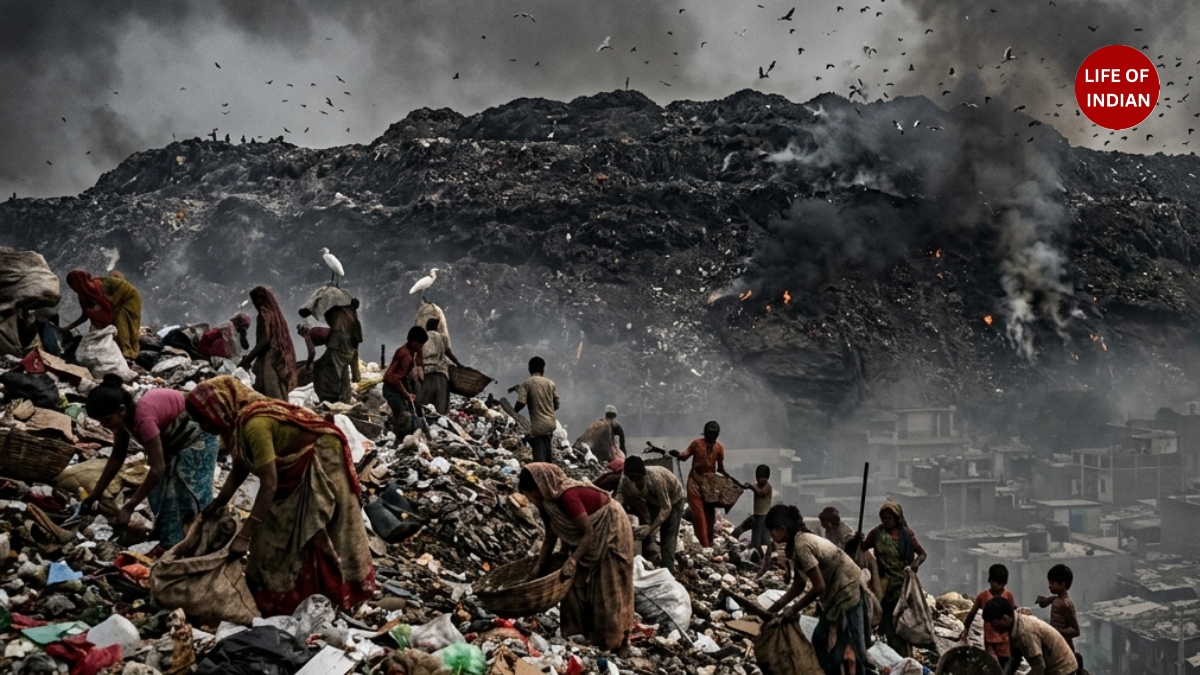
In the heart of East Delhi stands a mountain that should never have existed.
Not a mountain made by nature.
Not a hill formed over centuries.
But a giant, toxic pile of human waste that kept growing year after year until it became impossible to ignore.
Ghazipur is today known across India for its massive garbage mountain — a landfill so huge that it can be seen from far away like a dark shadow hanging over the city. Fires erupt there repeatedly. Toxic smoke spreads through the air. The smell becomes unbearable. Birds circle overhead. Methane gas builds up beneath layers of rotting waste. And thousands of people still continue to live around it every single day. But the most disturbing question is this:
How did a regular area of Delhi slowly become one of the biggest symbols of India’s waste crisis?
How did garbage become so powerful that it swallowed an entire neighborhood’s identity?
And perhaps the hardest question of all — what kind of life do people live beside a mountain of trash that never stops growing?
The story of Ghazipur is not just about waste. It is about urban failure, ignored warnings, environmental collapse, political blame games, and the invisible suffering of ordinary people.
What Is the Ghazipur Garbage Mountain?
Delhi’s Most Infamous Landfill
Ghazipur landfill was established in 1984 as a dumping site for Delhi’s municipal waste. At that time, it was meant to function as a temporary landfill.
But Delhi kept expanding.
Its population exploded.
Consumption increased.
Plastic usage multiplied.
And waste management failed to evolve with the city.
The landfill eventually became one of the largest garbage dumping sites in India. According to reports, the landfill spreads across nearly 70 acres and had already exceeded its capacity by 2002—yet waste continued to be dumped there every day. Today, the garbage mountain rises over 60 meters high in some areas, making it taller than many buildings and comparable to a small hill. Reports in recent years revealed that thousands of metric tonnes of fresh waste still reach the site daily despite cleanup efforts.
Was Ghazipur Always Like This?
The Area That Slowly Lost Its Identity
No. Before becoming known as Delhi’s garbage mountain, Ghazipur was simply another developing part of East Delhi. Residential colonies, markets, transport routes, and local businesses slowly emerged around the area as Delhi urbanized rapidly.
But one critical mistake changed everything:
The city kept dumping waste there long after the landfill had reached its limit.
Over the years:
- Garbage piled higher and higher
- Toxic liquid seeped into soil and water
- Air pollution worsened
- Illegal dumping increased
- Fires became frequent
- The smell spread across surrounding neighborhoods
And slowly, the identity of the area changed. People stopped recognizing Ghazipur for its communities. Instead, it became known only for its garbage mountain.
Why Did the Garbage Mountain Become So Huge?
Delhi Produced More Waste Than It Could Handle
Delhi generates enormous amounts of garbage every day. But the real problem was not just waste generation — it was:
- Poor segregation of waste
- Weak recycling systems
- Overdependence on landfills
- Lack of long-term planning
- Delayed waste processing infrastructure
Experts repeatedly warned that Ghazipur had crossed its capacity decades ago. Yet dumping never fully stopped. According to recent reports, the landfill still receives around 1,700 metric tonnes of fresh waste daily even now.
This means:
Even while authorities try to remove old garbage, new garbage keeps arriving. It became a cycle that the city could not control.
Why Do Fires Keep Happening at Ghazipur?
The Dangerous Role of Methane Gas
One of the most terrifying aspects of the Ghazipur landfill is the repeated fires and explosions. These fires happen mainly because of methane gas. When food waste, organic matter, plastic, and chemicals remain buried under huge piles of garbage without oxygen, they slowly decompose and produce methane — a highly flammable gas. Studies have shown that Ghazipur emits dangerous levels of methane and other greenhouse gases.
During extreme Delhi summers:
- Heat increases gas buildup
- Pressure rises beneath the garbage
- Small sparks can trigger massive fires
This is why Ghazipur catches fire repeatedly.
Major fires in recent years covered surrounding areas in thick toxic smoke, causing breathing problems for residents. Authorities themselves admitted that methane and high temperatures were major reasons behind these fires. For nearby residents, these fires are not just news headlines.
They are days filled with smoke, coughing, headaches, fear, and suffocation.
How Do People Live Near Such a Place?
The Invisible Human Suffering Around the Garbage Mountain
This may be the most heartbreaking part of the Ghazipur story. Thousands of people still live around the landfill because they have no other option. Many families around Ghazipur survive through:
- Waste picking
- Daily wage labor
- Small shops
- Informal recycling work
- Transportation jobs
For waste pickers, the garbage mountain itself becomes a source of livelihood. They search through mountains of waste for:
- Plastic
- Metal
- Bottles
- Scrap materials
But this work comes with terrible risks:
- Toxic air
- Skin diseases
- Respiratory illnesses
- Water contamination
- Accidents during landfill collapses
- Exposure to chemicals and smoke
Residents living nearby often complain about unbearable smell, polluted air, breathing problems, and constant fear of fires. Community discussions online and environmental reports repeatedly describe the area as suffocating and dangerous. Yet people continue living there because survival leaves them with few choices.
Why Doesn’t the Government Completely Solve the Problem?
The Problem Became Bigger Than One Agency
Many people ask:
“If the landfill is so dangerous, why hasn’t it been removed completely?”
The answer is complicated. The Ghazipur crisis developed over decades because of:
- Rapid urban population growth
- Weak waste segregation
- Administrative delays
- Political conflicts
- Inadequate landfill alternatives
- Lack of public discipline in waste disposal
Different agencies have blamed each other over the years. Meanwhile, Delhi’s waste generation kept increasing faster than processing capacity. Even waste-to-energy plants have struggled. Reports indicate that the Ghazipur waste-to-energy facility often operated below capacity and sometimes shut down for long periods, leading to even more garbage accumulation.
Authorities are now attempting:
- Biomining of old waste
- Methane venting systems
- Waste processing
- Height reduction
- Fire prevention measures
Recent reports suggest that full clearance of the landfill is targeted by 2028. But critics argue that unless Delhi fundamentally changes how it handles waste, the crisis may simply shift elsewhere instead of truly ending.
The Environmental Danger Beyond Ghazipur
This Is Not Just a Local Problem
The Ghazipur landfill affects far more than nearby residents. Environmental investigations have raised concerns about:
- Groundwater contamination
- Pollution entering rivers
- Methane emissions worsening climate change
- Toxic air spreading across Delhi-NCR
Some reports even warned that pollutants from the landfill may be affecting the food chain and nearby dairy systems. Experts describe landfills like Ghazipur as environmental time bombs. Because once toxic chemicals seep deep into soil and water systems, the damage can continue for decades.
What Is the Real Solution?
The Crisis Cannot End With Bulldozers Alone
There is no single magic solution. Experts say the real answer requires multiple changes happening together:
1. Waste Segregation at Home
People must separate:
- Wet waste
- Dry waste
- Plastic
- Hazardous waste
Without segregation, recycling becomes extremely difficult.
2. Strong Recycling Systems
Plastic, metal, paper, and electronic waste must be processed efficiently instead of dumped together.
3. Scientific Landfills
Modern landfills need:
- Methane capture systems
- Proper liners
- Leachate treatment
- Fire prevention infrastructure
4. Reducing Plastic Consumption
Single-use plastic is one of the biggest contributors to urban waste mountains.
5. Better Waste-to-Energy Systems
Processing plants need reliable operations and pollution control.
6. Protecting Waste Workers
Waste pickers and sanitation workers need:
- Health protection
- Safer working conditions
- Social security
- Recognition
Because cities survive partly due to their invisible labor.
Ghazipur Is a Warning for Every Indian City
The Ghazipur garbage mountain is not just Delhi’s problem.
It is a warning.
A warning about what happens when:
- Cities grow faster than planning
- Consumption increases without responsibility
- Waste is treated as “someone else’s problem”
- Environmental issues are ignored for too long
Because garbage never truly disappears.
It only moves somewhere else — until it becomes impossible to hide.
Ghazipur today stands as one of the strongest symbols of India’s urban waste crisis. What was once a normal part of Delhi slowly transformed into a toxic mountain of garbage because of decades of neglect, poor planning, uncontrolled waste generation, and delayed action. And while the city debates policies and cleanup plans, ordinary people continue breathing polluted air beside a mountain that keeps reminding everyone of a painful truth:
Modern cities create enormous waste.
But they rarely want to see where it finally ends up.
Ghazipur forces India to look directly at that reality.
FAQ
1. What is the Ghazipur Garbage Mountain?
The Ghazipur Garbage Mountain is a massive landfill site in East Delhi that has grown into one of India’s largest waste dumping areas.
2. Why does the Ghazipur landfill catch fire frequently?
The landfill produces methane gas from decomposing waste. During high temperatures, the gas can ignite and cause major fires.
3. When was the Ghazipur landfill created?
The Ghazipur landfill was established in 1984 as a temporary waste disposal site for Delhi.
4. Why is the Ghazipur landfill dangerous?
The landfill causes severe air pollution, toxic smoke, groundwater contamination, methane emissions, and health risks for nearby residents.
5. How do people survive near the Ghazipur landfill?
Many local residents work as waste pickers, laborers, recyclers, and small vendors despite difficult living conditions and pollution.
6. What is the government doing to clean Ghazipur landfill?
Authorities are attempting biomining, waste processing, landfill height reduction, and methane management to eventually reclaim the site.