
Ramadan is the holiest month in Islam, observed by Muslims worldwide through fasting, prayer, charity, and spiritual reflection. One concept widely shared during Ramadan—especially in South Asia—is the division of the month into three Ashras (ten-day periods).
Many people believe that each Ashra has a specific theme and a special dua (supplication):
- First Ashra—Days of Mercy
- Second Ashra—Days of Forgiveness
- Third Ashra—Days of Protection from Hellfire
But how authentic is this division? Is it mentioned in the Qur’an or authentic Hadith? And what is the correct understanding according to Islamic scholarship?
In this detailed guide, we will explore the meaning, background, authenticity, and spiritual lessons of the Three Ashras of Ramadan.
Ramadan 2026: Significance, Fasting Rules & Spiritual Importance
What Does “Ashra” Mean?
The word “Ashra” comes from the Arabic word ‘Asharah’ (عشرة), which means ten.
Since Ramadan usually lasts 29 or 30 days, it can naturally be divided into three ten-day segments:
- Days 1–10
- Days 11–20
- Days 21–30
This division is numerical and practical—but the question is whether it carries specific religious rulings.
The Popular Understanding of the Three Ashras
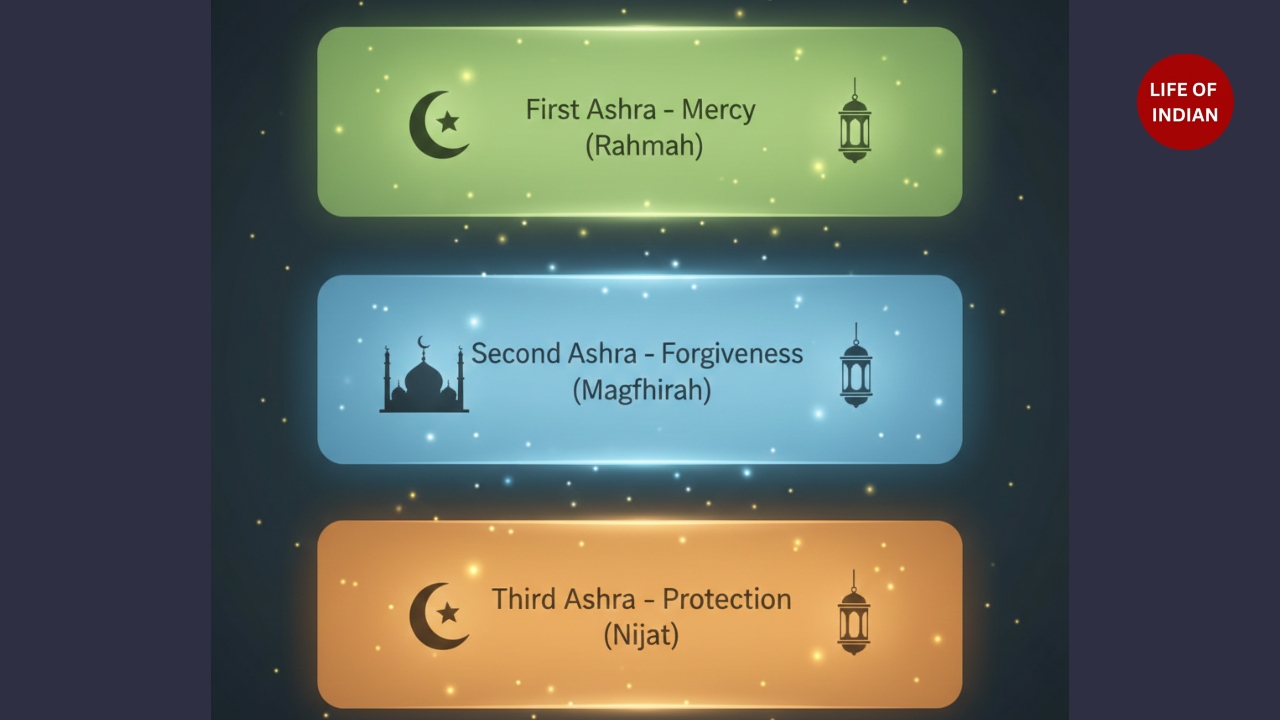
First Ashra – Days of Mercy (Rahmah)
It is commonly believed that the first ten days of Ramadan are especially dedicated to Allah’s mercy.
Popular Dua Recited:
“Rabbi ighfir warham wa anta khairur raahimeen”
“My Lord, forgive and have mercy, and You are the Best of the merciful.”
This dua is derived from Qur’anic wording (Surah Al-Mu’minun 23:118), but it is not specifically prescribed for the first ten days of Ramadan in any authentic hadith.
Spiritual Focus:
- Seeking Allah’s mercy
- Increasing good deeds
- Starting Ramadan with sincerity
Second Ashra – Days of Forgiveness (Maghfirah)
What Breaks a Fast in Ramadan? Complete Guide to Rules Every Muslim Should Know
The second ten days are popularly associated with seeking forgiveness from sins.
Commonly Recited Dua:
“Astaghfirullah Rabbi min kulli dhambin wa atubu ilayh.”
“I seek forgiveness from Allah, my Lord, from every sin and I repent to Him.”
Seeking forgiveness is strongly encouraged throughout Ramadan, but again, there is no authentic hadith specifying this dua exclusively for the second ten days.
Spiritual Focus:
- Repentance (Tawbah)
- Self-accountability
- Seeking purification from past sins
Third Ashra—Days of Protection from Hellfire (Nijat)
The last ten days are widely associated with protection from Hellfire.
Commonly Shared Dua:
“Allahumma ajirni min an-naar.”
“O Allah, protect me from the Fire.”
The last ten nights of Ramadan are extremely important because they contain Laylatul Qadr (The Night of Decree), which is better than a thousand months (Qur’an 97:3).
However, the idea that this specific dua must be recited only in the third Ashra is not supported by authentic evidence.
Is the Three Ashra Division Authentic?
This is the most important question.
A hadith often quoted states:
“The first part of Ramadan is mercy, the middle part is forgiveness, and the last part is freedom from the Fire.”
However, many hadith scholars have classified this narration as weak (da‘if). It is not considered strongly authentic by major scholars such as Imam Ahmad, Al-Albani, and others.
What Is Authentic?
Authentic hadiths confirm:
- The entire month of Ramadan is a month of mercy.
- The gates of Paradise are opened.
- The gates of Hell are closed.
- Devils are chained.
- Every night, Allah frees people from the Hellfire.
This means:
Mercy, forgiveness, and salvation are not limited to specific ten-day segments — they are available throughout the entire month.
Ramadan 2026 Begins in India: Check Full Sehri & Iftar Timings
The Special Importance of the Last Ten Nights
Although the “three Ashra” categorization may not be strongly authentic, the last ten nights of Ramadan are unquestionably special.
Authentic narrations confirm:
- The Prophet Muhammad (peace be upon him) would increase worship during the last ten nights.
- He would perform I‘tikaf (spiritual retreat in the mosque).
- He would wake his family for prayer.
- Laylatul Qadr is found in the last ten nights (especially odd nights).
The most authentic dua recommended for these nights is:
“Allahumma innaka ‘afuwwun tuhibbul ‘afwa fa‘fu ‘anni.”
“O Allah, You are Most Forgiving, and You love forgiveness, so forgive me.”
(Narrated in Tirmidhi – Authentic)
Why Is the Three Ashra Concept Popular?
The division became popular mainly in:
- South Asia (India, Pakistan, Bangladesh)
- Community sermons
- Social media graphics
- Religious motivational speeches
It helps people structure their spiritual goals:
- First 10 days: Build momentum
- Middle 10 days: Focus on repentance
- Last 10 days: Maximize worship
While this structure is motivational and beneficial, it should not be presented as a strict religious rule.
What Should Muslims Focus on Instead?
Instead of limiting mercy, forgiveness, and salvation to specific Ashras, Muslims should:
- Seek mercy throughout Ramadan
- Repent daily
- Make dua consistently
- Increase charity
- Guard their speech and behavior
- Pray Taraweeh regularly
- Search for Laylatul Qadr in the last ten nights
Ramadan is a complete spiritual journey—not segmented blessings.
Ramadan 2026: Significance, Fasting Rules & Spiritual Importance
Common Misconceptions About the Three Ashras
- Each Ashra has a fixed compulsory dua
- Mercy is only in the first ten days
- Forgiveness is only in the second ten days
- Salvation is only in the last ten days
These ideas are not supported by strong evidence.
The concept of the Three Ashras of Ramadan is a motivational framework rather than a strictly authenticated religious division.
There is no strong evidence that:
- Each ten-day segment has exclusive blessings
- Specific duas are mandatory for each Ashra
However:
- Seeking mercy, forgiveness, and protection from Hellfire are essential goals throughout Ramadan.
- The last ten nights are authentically more virtuous due to Laylatul Qadr.
Ramadan is a month of continuous mercy, repentance, and spiritual elevation. Rather than focusing only on labels, Muslims should strive to protect their fast, increase worship, and purify their hearts every single day.
FAQ
Q1: What are the Three Ashras of Ramadan?
The Three Ashras divide Ramadan into three parts of ten days each: mercy (Rahmah), forgiveness (Maghfirah), and protection from Hell (Nijat).
Q2: Is the concept of Three Ashras authentic in Islam?
The hadith mentioning the three phases exists but many scholars classify it as weak (da‘if). However, the meanings align with Islamic teachings about Ramadan.
Q3: What is the dua for the first Ashra?
Commonly recited dua:
“Rabbi ighfir warham wa anta khayrur raahimeen.”
Q4: What is the dua for the second Ashra?
“Astaghfirullaha Rabbi min kulli dhanbin wa atubu ilayh.”
Q5: What is the dua for the third Ashra?
“Allahumma ajirni minan naar.”