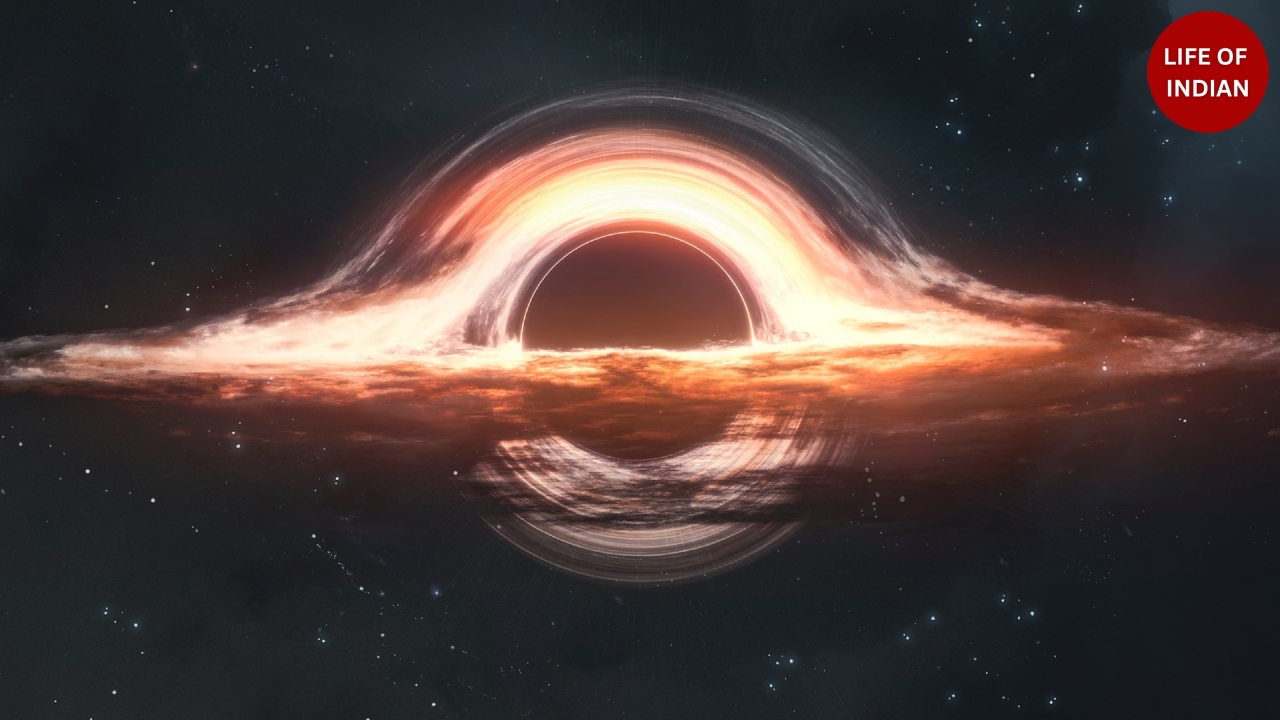
Supermassive Black Hole: In a groundbreaking astronomical discovery, scientists have detected the brightest flare ever observed emerging from a supermassive black hole. This cosmic flash was so powerful that it outshone 10 trillion suns, marking a new milestone in understanding the mysterious behavior of black holes.
According to researchers, this intense burst of light and energy may have been caused by disturbances in the gas disk surrounding the black hole or entangled magnetic fields near its event horizon. The discovery offers new insights into how black holes interact with their environment — shedding light, quite literally, on one of the darkest regions of the universe.
What Is a Flare and How Does It Form?
Black holes are among the most mysterious and powerful entities in the universe. Their gravitational pull is so strong that even light cannot escape. Supermassive black holes — often located at the centers of galaxies — are millions to billions of times more massive than the Sun.
Sometimes, the hot gas disk around a black hole experiences turbulence or magnetic chaos, leading to sudden releases of energy and radiation — known as flares. These bursts act like cosmic beacons, allowing scientists to observe the dynamics around black holes.
As astrophysicists explain, such flares are like a flashlight illuminating a dark room, revealing what lies near the edge of a black hole — a place normally hidden from view.
Captured on Camera
This incredible flare was first recorded in 2018 by the Palomar Observatory in California. It continued to glow intensely for nearly three months before gradually fading.
Researchers were initially stunned by the data. Matthew Graham, a lead researcher at the California Institute of Technology (Caltech), said, “At first, we couldn’t believe the energy readings — they were beyond anything we had ever observed.”
A Glimpse from the Early Universe
The flare originated from a supermassive black hole located 10 billion light-years away from Earth — making it the most distant flare ever recorded.
To put this in perspective, one light-year equals about 6 trillion miles (9.7 trillion kilometers). This means the light we are seeing today was emitted when the universe was still young, giving scientists a rare look into the early stages of cosmic evolution.
The Tragic Death of a Star
Astronomers believe the flare was triggered when a massive star wandered too close to the black hole. The black hole’s immense gravity tore the star apart — a process known as a Tidal Disruption Event (TDE).
As the shredded remains of the star spiraled inward, they heated up and emitted a brilliant burst of light, visible across billions of light-years.
This dramatic event not only revealed the destructive power of black holes but also their potential to help scientists study the origins of light, energy, and structure in the universe.